60-second summary
The Belgian company register is the Crossroads Bank for Enterprises, known as KBO in Dutch, BCE in French and CBE in English. It is run by the FPS Economy, it is free, and its Public Search works in English. Every Belgian company, association and self-employed person has a ten-digit enterprise number in it, which is also the VAT number once VAT is activated. The register tells you whether a company exists, where it sits, what it does and who runs it. It does not tell you how big it is or whether it pays its bills. For that you add three more free official sources: the Belgian Official Gazette for deeds and appointments, the National Bank's Central Balance Sheet Office for annual accounts, and RegSol for insolvency files. This guide walks through all four and ends with what the registers leave out.
Every fact below comes from the official pages of the FPS Economy, the National Bank of Belgium, Statbel, the FPS Finance and the European Commission, checked on 8 September 2026. Where a figure comes from anywhere else, we say so.
What is the Belgian company register?
The Crossroads Bank for Enterprises is a database owned by the FPS Economy that holds the basic data of every registered entity in Belgium and its establishment units. It replaced the old trade register under the law of 16 January 2003 and is now governed by Book III of the Code of Economic Law (FPS Economy).
You will see three names for the same thing. Dutch: Kruispuntbank van Ondernemingen, KBO. French: Banque-Carrefour des Entreprises, BCE. English: Crossroads Bank for Enterprises, CBE. Belgians say "the KBO" or "the BCE"; the official English pages say CBE. All three refer to one register with one search tool.
Who is in it. Every legal person under Belgian law, every self-employed natural person who has to register as an enterprise, every foreign legal person with a registered seat, establishment unit or branch in Belgium, and organisations without legal personality that have to register (FPS Economy, registration). Companies register through the company court registry, a notary or the JustAct application; self-employed people through an accredited business counter.
What a record contains. The FPS Economy lists these data categories (FPS Economy, contents):
the enterprise number and the establishment unit numbers
names, the registered office and every establishment unit address in Belgium
entity type (natural or legal person), status, legal form and legal situation
contact details the company chose to provide: phone, email, website
financial information such as capital and fiscal year-end; start and stop dates
the founders and mandate holders
economic activities coded in NACE-BEL, authorisations and licences
bank accounts
Bank accounts and the national registration numbers of natural persons are held but never shown publicly; the FPS Economy's privacy statement limits the national number to administrations acting within their legal missions.
An establishment unit is "a place of activity that can be geographically identified by an address in Belgium, where at least one activity of the registered entity is exercised or from which the activity is exercised". A retailer with twelve shops has one enterprise number and twelve establishment units, each with its own number. When you count "companies" in Belgium, decide first whether you mean entities or units.
Is the enterprise number the same as the VAT number?
Almost. The enterprise number is a permanent, unique ten-digit number starting with 0 or 1. The Belgian VAT number is the same ten digits with a BE prefix. The FPS Economy states that the number is unique, permanent and not transferable to another entity; the Belgian government's business portal shows the VAT format as the enterprise number preceded by BE, for example BE0202.239.951 (FPS Economy, business.belgium.be).
The distinction that trips people up: every VAT number is an enterprise number, but not every enterprise number is an active VAT number. VAT has to be activated with the FPS Finance. Associations, holding entities and some others exist in the register without a VAT activation. So a number that looks valid can be inactive for VAT, and a company that is active in the register may still not be entitled to charge you VAT.
Two things about the number we could not confirm on an official page and therefore state as unofficial: the last two digits are widely described as a modulo-97 check on the first eight, and numbers starting with 1 are said to have been issued since the 0-series ran out. Treat both as background, not as a validation rule.
How do you search the register?
Use KBO Public Search at kbopub.economie.fgov.be. No account, no cost, and the interface is available in Dutch, French, English and German. If you do not read Dutch or French, switch it to English; that version carries a disclaimer that it is an unofficial translation for information purposes, but the data is the same (KBO Public Search).
The form offers five ways in:
By number. Enterprise number or establishment unit number, with or without dots. This is the fastest route when a supplier or customer has given you a VAT number: drop the BE.
By name. A phonetic search on the current name, so spelling variants and missing accents still find the company. Expect several hits for common words; filter by postcode.
By activity. NACE-BEL code, which finds every entity that registered a given activity. Useful for market sizing, slow for one company; if you do this often, our prospecting guide for Belgium covers the faster routes.
By authorisation. Entities holding a particular licence or authorisation.
By address. Street and municipality, which lists every entity and establishment unit registered at that address.
The data is refreshed daily. On the day we checked, the form stated the situation in the database as of the previous day. Public Search also has a mobile version, and the results cover every registered entity, whether it is still active or has stopped.
There is no published limit on how many searches you may run by hand. Automated scraping is not the intended route: for volume, the FPS Economy points you to open data or its paid web service, both covered below.
Reading a company record: Status versus Legal situation
Two fields matter more than the rest: Status and Legal situation. They are not the same thing. Status says whether the entity is active or stopped. Legal situation says what is happening to it legally: normal situation, bankruptcy, dissolution, striking off, and so on.
We opened a record to check the layout. A record page runs through a dozen or so sections:
general information: number, status, legal situation, start date, name, registered office, phone, fax, email, website, entity type, legal form, number of establishment units
functions
entrepreneurial skills
characteristics and authorisations
activities under the 2025, 2008 and 2003 versions of the NACE-BEL codes
financial information
links between entities
external links to the Official Gazette and the National Bank
Functions lists the current mandate holders: directors, managers, people charged with daily management, liquidators. It shows names and roles, not birth dates or home addresses, and it does not show former directors. For history you go to the Official Gazette.
Striking off does not mean the company is gone. The FPS Economy strikes entities off ex officio when, among other grounds, they have not filed annual accounts for at least three consecutive financial years or have not met their UBO obligations. Its own page is explicit: the striking off is administrative only, the company continues to exist legally and retains all its rights and obligations (FPS Economy, ex officio striking offs). Since the law of 5 November 2023 added UBO non-compliance as a ground, the FPS Finance reported that nearly 21,000 shell or dormant entities had been struck off (FPS Finance, 30 January 2024). A struck-off counterparty is a warning sign, not a closed file.
Activities use NACE-BEL 2025. The FPS Economy introduced the 2025 version on 30 September 2025, and on 27 January 2026 it stopped using the old seven-digit codes for ambulatory trade, e-commerce, fairgrounds and limited-service catering, converting them to five-digit codes (FPS Economy, changes to the CBE, in Dutch). If you built segments on old codes, rebuild them.
Which free sources complete the picture?
The register tells you a company exists. Three other official sources tell you what it filed, what it earns and whether it is in trouble. All three are free.
The Belgian Official Gazette: deeds, appointments, changes
The Legal Entities annex of the Belgian Official Gazette (Belgisch Staatsblad, Moniteur belge) publishes incorporation deeds, articles of association, appointments and resignations, address changes and dissolutions as PDF images. Coverage runs from 1 January 1983 for enterprises and from 1 July 2003 for associations, and it is updated every working day (Official Gazette, legal entities search). The catch: the Gazette's search interface exists only in Dutch and French. Search by enterprise number, which needs no language, and read the publication list from the most recent down. Director appointments and the deed of incorporation are the two documents most people need.
The National Bank's Central Balance Sheet Office: annual accounts
Every Belgian company with limited liability files its annual accounts with the National Bank of Belgium, and anyone can consult them free of charge as PDF, XBRL or CSV through the Consult application (NBB, consultation of data). In 2025 the Central Balance Sheet Office received 593,323 sets of annual accounts and served 4.3 million consultations (NBB, in figures).
Three things to know before you open one:
Deadlines. Accounts must be filed within thirty days of approval by the general meeting and at the latest seven months after the financial year closes (NBB, when to file). For a December year-end that means the end of July. The NBB notes that about 39% of 2024 filings were late, so a missing set of accounts in August does not yet prove anything.
Late-filing surcharges rose in 2026. From 1 January 2026 a small company filing in the ninth month pays a surcharge of €151, rising to €227 in months ten to twelve and €453 from the thirteenth month; for other companies the figures are €504, €755 and €1,510 (NBB, supplementary charge).
Most accounts do not show turnover. Companies choose a model by size. Micro companies (up to 10 FTE, €900,000 turnover, €450,000 balance sheet total) file the micro model; small companies (up to 50 FTE, €11.25 million turnover, €6 million balance sheet total) file the abbreviated model; a company that exceeds two of the three thresholds, or is listed, files the full model (NBB, size criteria). In 2025, 69.4% of filings used a micro model, 25.5% an abbreviated one and 1.7% came from associations and foundations; only 3.3% used the full model that includes a full profit and loss account (NBB, in figures).
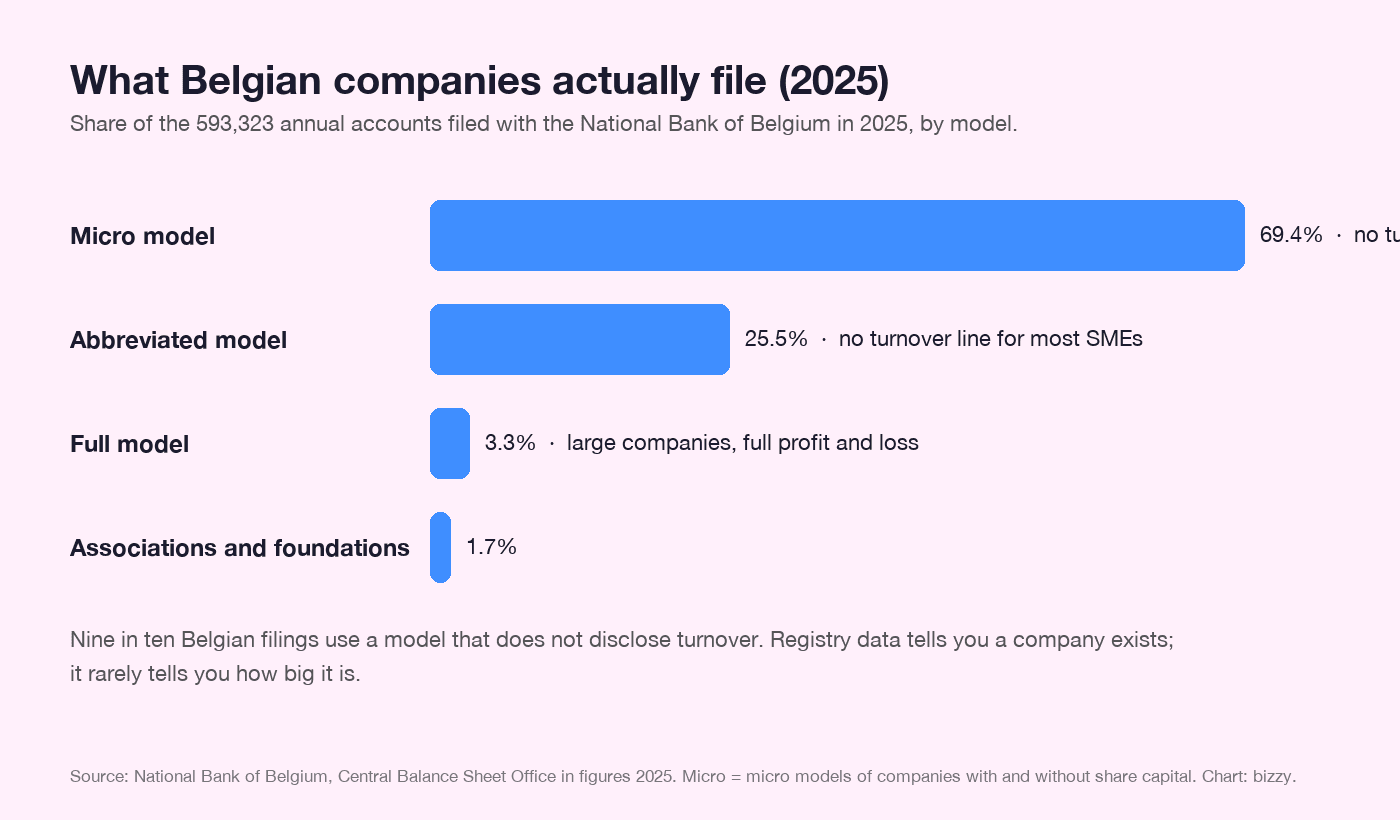
Nine in ten Belgian filings therefore tell you equity, debt and headcount, but not revenue. Anyone quoting you the turnover of a small Belgian company is almost always estimating; only the full model, and the minority of abbreviated filers who choose to disclose it, state revenue.
RegSol: bankruptcies and reorganisations
The Central Solvency Register, RegSol, holds the digital files of bankruptcies, judicial reorganisations and related procedures since 1 April 2017, and its interface can be switched to English (RegSol). The public part lets anyone look up whether a procedure is open and request access to the file, which shows the judgment, the appointed trustee and the key dates. Cross-check with the Legal situation field in Public Search and with the Official Gazette, where insolvency judgments are also published.
Two more, with limits
The UBO register at the FPS Finance records beneficial owners holding 25% or more. Since the Court of Justice of the EU ruling of November 2022 and the Belgian law of 8 February 2023, the general public no longer has open access: you need to demonstrate a legitimate interest linked to anti-money-laundering work and request access case by case (FPS Finance, UBO FAQ). For most sales and procurement checks, the Functions section and the Official Gazette will have to do.
VIES, the European Commission's VAT checker, confirms whether a Belgian VAT number is valid for intra-EU transactions. It is a search engine over national databases, not a database itself, and for some member states it will not return the name and address behind the number (European Commission, VIES). Use VIES to validate the VAT status and Public Search to confirm the identity.

How do you verify a Belgian company in ten minutes?
Number, record, accounts, insolvency, VAT. Five checks, five websites, no cost.
Get the enterprise number. From the invoice, the contract, the email footer or the website's legal notice; Belgian companies must show it. If you only have a name, search Public Search by name and match the postcode.
Open the record in Public Search. Confirm the legal name, legal form and registered office. Read Status and Legal situation together. Note the start date and the number of establishment units. Write down the mandate holders under Functions.
Pull the latest annual accounts from the NBB Consult application. Check the filing date against the seven-month rule, then read equity, total debt and average headcount. Three consecutive missing years is a striking-off ground, so a gap is meaningful.
Check RegSol and the Legal situation field for insolvency. An open bankruptcy or judicial reorganisation appears in both. Then look at the Official Gazette publications for the last two years: a change of registered office, a resignation of all directors or a dissolution resolution each tells a story.
Validate the VAT number in VIES if you will invoice or be invoiced across borders. A valid enterprise number with an inactive VAT status is common for holding entities and associations and is not a red flag by itself.
If any step contradicts what the counterparty told you, ask them before you conclude. The registers are authoritative, not instant: Public Search is one day behind the database, the database is as current as the last filing, the Gazette a few days behind, the accounts up to seven months.
Bulk access: open data, web service and the full file
Since November 2025 the full open-data file is refreshed daily and it is free for anyone who registers. The FPS Economy offers three reuse products (FPS Economy, public data available for reuse, updated 4 November 2025):
CBE Open Data. A CSV with the active data of active entities and establishment units. The complete file and update files are made available daily and stay accessible for 31 days. Free after registration and acceptance of the licence, by download or SFTP (FPS Economy, CBE Open Data). Guides that still describe a monthly file are out of date: full files have been daily since 3 November 2025.
Public Search web service. A SOAP service returning the same data as Public Search, prepaid at €50 for 2,000 requests.
The complete file for reuse. Active and discontinued data for all entities, with a full file each month and change files each day. Free for non-commercial reuse; for commercial reuse the annual fee is €30,000 as of November 2025, under a licence agreement with the CBE Management Service.
The GDPR condition that matters. Director names are public by law, but the FPS Economy's privacy statement and the open-data licence both state that personal data may not be reused for direct marketing purposes, and that reusers must comply with the GDPR. As we read the licence: you may use the register to verify a counterparty or build company-level segments, you may not turn the list of mandate holders into a mailing list. Bizzy, for the record, uses registry data for company profiles only and sources people separately; how is set out on our GDPR page.
Belgium in numbers
About 1.2 million VAT-registered enterprises, roughly 590,000 sets of accounts a year, and in 2025 the most bankruptcies since 2013, with a record 7,754 among limited liability companies.
Indicator | Figure | Source |
|---|---|---|
VAT-registered enterprises, June 2026 | 1,215,958, up 1.4% in a year | Statbel, 26 August 2026 |
Enterprises created in 2024 | 113,289; 94,532 cessations | Statbel, 16 October 2025 |
Bankruptcies in 2025 | 11,665, up 5.4%, the highest since 2013 | Statbel, 16 January 2026 |
Of which limited liability companies | 7,754, a record | Statbel, same release |
Jobs lost to bankruptcy in 2025 | 29,842 | Statbel, same release |
Annual accounts filed in 2025 | 593,323; 4.3 million consultations | |
Filings submitted late in 2024 | About 39% |
Two numbers we looked for and could not verify on an official page: the total count of entities of all types in the register, and the split between legal persons and sole traders. Statbel's VAT population includes natural persons; the NBB filer mix covers legal persons only. Full-year 2025 creation figures are due from Statbel in the autumn of 2026; GraydonCreditsafe has published its own 2025 count, which we quote in the prospecting guide, but the two series use different definitions.
Where does the register stop and a tool start?
The registers answer "does this company exist, who signs for it, what did it file". They do not answer "who should I talk to", "can they pay" or "are they buying now".
What no free official source gives you: contact persons beyond mandate holders, business emails and phone numbers, the history of former directors in one view, credit scores and payment behaviour, financial ratios across years, hiring or funding signals, or group structures across borders. And the Gazette has no English interface at all.
That is the space the Belgian data vendors occupy, each from a different angle. Companyweb and GraydonCreditsafe start from the accounts and the Gazette and add credit scores, payment experience and monitoring; Companyweb's VAT-number lookup page is in English. Trends Top adds surveyed contact persons and rankings for Belgian companies. Bizzy, which publishes this guide, builds company profiles from the official registers of 33 European countries and adds decision-makers, Creditsafe financials and buying signals, synced to the main CRMs. We compared the Belgian tools side by side in Belgian prospecting tools compared, Companyweb head to head in Bizzy vs Companyweb, and the wider European field in B2B data providers in Europe, compared.
The honest rule: verify with the registers, prospect with a tool. If you only need to check a counterparty a few times a month, this guide and five bookmarks are all you need. If your sales team looks up dozens of companies a day and needs the people behind them, you are paying for that in hours already. Our prospecting guide for Belgium covers what to do next.
Read next: the best B2B prospecting tools for European sales teams and how to generate B2B leads in Europe.
Read next: is B2B cold outreach legal in Europe? The rules for Belgium, the Netherlands and Germany, channel by channel.
Read next: B2B cold calling in Europe, from the list to the meeting.
Frequently asked questions
Can I search the Belgian register by a person's name?
No. KBO Public Search searches by enterprise number, entity name, activity, authorisation or address; there is no search by director or founder. To find the companies behind a person you need each enterprise number first, then read the Functions section of every record. Commercial databases add that person-to-company view.
Can I find the directors of a Belgian company for free?
Yes. The Functions section of the Public Search record lists current mandate holders by name and role. Appointments and resignations, including past directors, are published in the Legal Entities annex of the Belgian Official Gazette, searchable by enterprise number. Home addresses and birth dates are not shown, and the data may not be used for direct marketing.
Can I see who owns a Belgian company?
Shareholders of private companies are not in the public register. The UBO register records beneficial owners of 25% or more, but since 2023 access requires a demonstrated legitimate interest linked to anti-money-laundering work. Ownership by another company sometimes appears under "Links between entities" in Public Search, and share transfers in the Official Gazette when they change the articles.
Sources
All accessed on 8 September 2026. FPS Economy: Crossroads Bank for Enterprises, contents, registration, ex officio striking offs, public data available for reuse, CBE Open Data, changes to the CBE, KBO Public Search. business.belgium.be. Belgian Official Gazette. National Bank of Belgium: consultation, in figures, when to file, size criteria, supplementary charge. FPS Finance: UBO FAQ, UBO news. RegSol. European Commission, VIES. Statbel: bankruptcies 2025, enterprises created 2024, VAT units monthly.
This guide is general information, not legal or tax advice.