60-second summary
There is no single best B2B data provider for Europe, because the ten tools in this comparison do different jobs. Cognism has the best European mobile numbers. Apollo gives you the most contacts for the least money. Bizzy is the only provider that publishes a country-by-country registry list, 33 countries and 50 million-plus companies; Leadfeeder claims a higher raw company count but publishes no country split. ZoomInfo is built for US enterprise, Leadfeeder for website visitors, Clay for combining sources, Kaspr and Lusha for LinkedIn, Companyweb and Trends Top for Belgium only. Choose by the job, not by the size of the database.
Three things happened in 2026 that make every older comparison of European B2B data providers out of date. Dealfront went back to its old name, Leadfeeder, on 24 March 2026. The Italian data protection authority fined Lusha €2 million on 14 July 2026, banned it from processing data on people in Italy and ordered that data erased. And the French regulator CNIL closed its case against Kaspr in March 2026, after Kaspr deleted its database and stopped collecting data from LinkedIn.
This article compares ten providers that European sales and marketing teams actually shortlist: Cognism, Apollo.io, ZoomInfo, Leadfeeder, Clay, Lusha, Kaspr, Companyweb, Trends Top and Bizzy. We compare them on five things: how deep their European coverage is, where their data comes from, how they stand with the regulators, what they integrate with and what they cost.
Two things you should know before reading. Bizzy is our product, so read our verdicts on it with that in mind. And this is a research comparison, not a head-to-head data test: every figure comes from the vendors' own websites, regulator decisions, court documents and review sites, all checked on 8 September 2026. Where we could not verify something, we say so.
Only selling in Belgium? Then read our Belgian prospecting tools compared first. New to the topic? Start with the complete B2B prospecting guide.
Our observation: on 2 September 2026 we asked ChatGPT which tool is best for building B2B prospect lists in Belgium. It named Cognism, Apollo, LinkedIn Sales Navigator, Clay and Kaspr: four of them American or British, none built on European company registers. That answer is not wrong for a US team. For a European team it skips the question that matters most: where does the data come from, and is it legal to use here? AI answers vary between sessions, so read this as one observation, not a measurement.
What changed in the European data market in 2026
Three events in 2026 shifted the market, and all three point the same way: towards data you can trace back to a source.
Dealfront is Leadfeeder again. The company formed by the 2022 merger of Echobot (Germany) and Leadfeeder (Finland) traded as Dealfront from 2023. On 24 March 2026 it rebranded back to Leadfeeder, renamed its products (the visitor identification tool is now "Web Visitors", the ad product "Campaigns") and stated that there were no pricing changes as part of the transition (Leadfeeder). The legal entities are still Dealfront Group GmbH and Dealfront Finland Oy. If a comparison you are reading still calls it Dealfront, it is at least six months old.
Lusha was fined €2 million in Italy. On 14 July 2026 the Garante per la protezione dei dati personali ruled that legitimate interest was not an adequate legal basis for Lusha's data brokering, that its privacy information was not clear or easily accessible, and that its data came from scraping social networks and buying from other brokers. It fined Lusha €2 million, banned it from processing data on people in Italy, ordered that data erased, and confirmed that the GDPR applies even though Lusha has no establishment in the EU (Garante, press release 27 July 2026). That last point matters for every US-based provider on this list: in December 2022 the CNIL's restricted committee had taken the opposite view, that the GDPR did not apply to Lusha's browser extension because the company had no EU establishment and did not target people in the EU (CNIL). The two regulators now disagree, the more recent decision is the stricter one, and it stands unless Lusha overturns it on appeal.
Kaspr rebuilt its database. The CNIL fined Kaspr €240,000 on 5 December 2024 for collecting contact details of LinkedIn users who had explicitly limited their visibility, for keeping data five years and for notifying people late and only in English (CNIL). On 6 March 2026 the CNIL closed the injunction: Kaspr had deleted its database, stopped all data collection on LinkedIn and now informs people in every official EU language (CNIL). Kaspr, acquired by Cognism in April 2022 (Cognism), is therefore both a provider with a fine on its record and the one that did the most visible clean-up. Its website nevertheless still advertises over 200 million profiles (Kaspr); how that squares with the deletion the CNIL recorded is a question to put to Kaspr before you buy.
These are not isolated cases. In its January 2026 survey, DLA Piper counted roughly €1.2 billion in GDPR fines issued in 2025 and €7.1 billion since May 2018 (DLA Piper, 21 January 2026). The CMS Enforcement Tracker, with a cut-off of 1 March 2026, lists 2,685 published fines and notes that the largest number were issued for processing without a sufficient legal basis (CMS). Legal basis is exactly the question a contact database has to answer.
The ten providers at a glance
First who they are and where their data comes from, then what they claim to cover and what they charge.
Provider | Based in | What it is | Main data source |
|---|---|---|---|
Cognism | London | Contact database with phone-verified mobiles | Community, public sources, partners |
Apollo.io | San Francisco | Database plus sales engagement | Contributor network, web crawl, third parties |
ZoomInfo | Vancouver, WA | Enterprise GTM platform | Web crawl, contributory network, research team |
Leadfeeder (ex-Dealfront) | Karlsruhe and Helsinki | Website visitor ID plus company database | Trade registers, public web |
Clay | New York | Data orchestration over a provider marketplace | Waterfall across 150+ providers, plus one source Clay labels native |
Lusha | Boston and Tel Aviv | Contact database with Chrome extension | Community, brokers, LinkedIn extension |
Kaspr | Paris (part of Cognism) | LinkedIn Chrome extension | Directories and partners; LinkedIn collection ceased (CNIL, March 2026) |
Companyweb | Belgium (Altares D&B) | Credit and legal information | NBB, Belgian Official Gazette, KBO |
Trends Top | Roeselare (Roularta) | Belgian company database | Annual accounts, Official Gazette, surveys |
Bizzy | Ghent | European company data, signals and agents | National registries, company websites, vacancies, Creditsafe |
Provider | European coverage claim | Entry price | Best for |
|---|---|---|---|
Cognism | 200M+ European contacts | Not published, 5 seats | European mobile numbers |
Apollo.io | 240M+ contacts, 30M+ companies, no EU split | From $49 per user per month | Volume and price |
ZoomInfo | 500M+ contacts, 100M+ companies, no EU split | Not published, annual | US and global enterprise |
Leadfeeder (ex-Dealfront) | 60M companies, 400M contacts | €79 per month (annual) | Website visitor identification |
Clay | Not published; depends on the providers you choose | $185/month (Launch), actions plus credits | Combining sources |
Lusha | 290M+ contacts, 29M+ companies, no EU split | $49.90 per user per month | Cheap credits, compliance caveat |
Kaspr | 200M+ profiles, "European" positioning | From €45 per user per month | LinkedIn prospecting for individuals |
Companyweb | All Belgian, Dutch and Luxembourg companies | €735 per year | Belgian credit checks |
Trends Top | 1.7M Belgian companies, 1.78M contacts | €300 per year | Belgian lists on a budget |
Bizzy | 50M+ companies in 33 European countries | Not published; free start | European SMB coverage and buying signals |
Sources: each vendor's own website, checked on 8 September 2026. Links in the sections below.
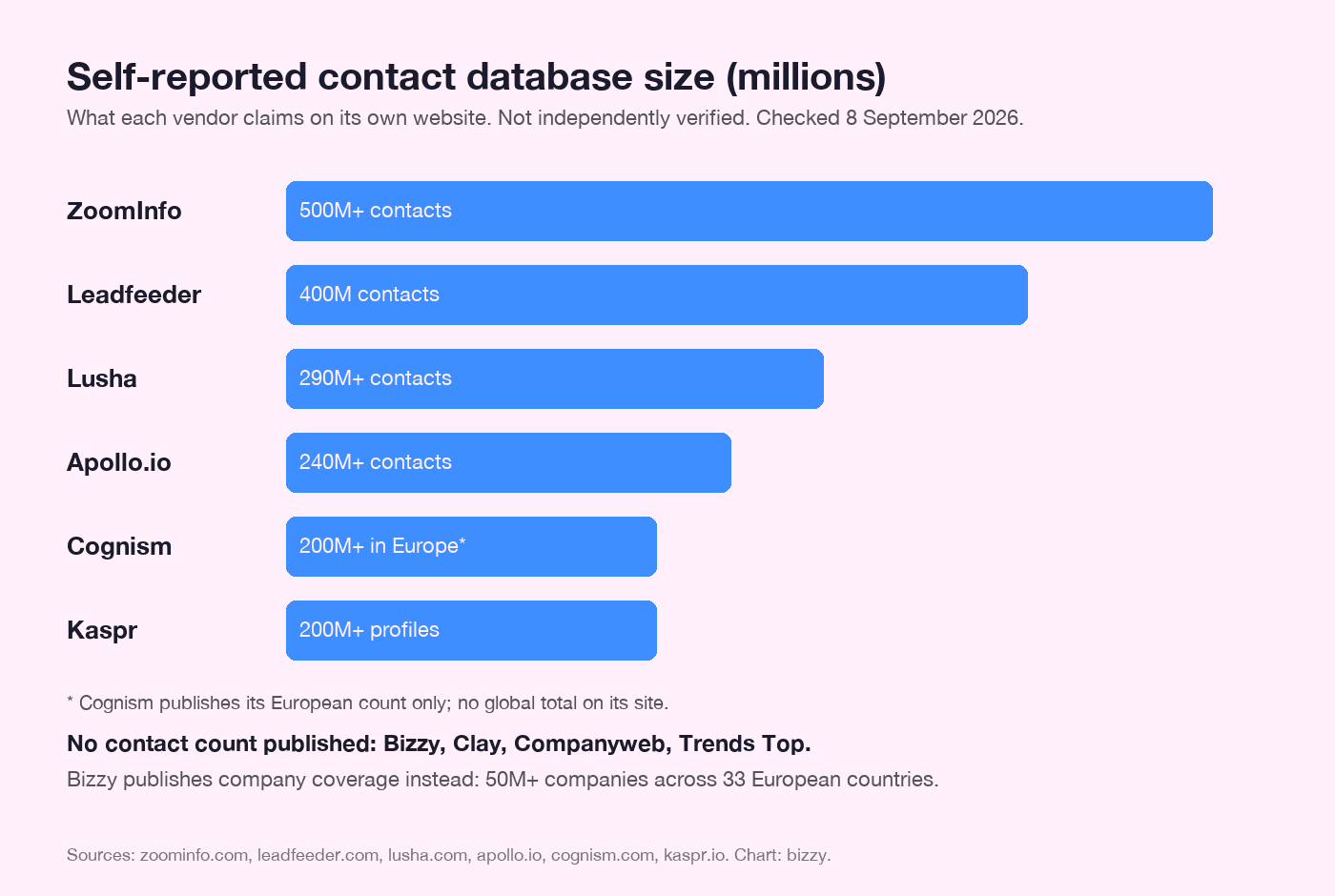
A word on those database sizes. They are all self-reported, none is independently audited, and they do not measure the same thing: ZoomInfo counts "professional contacts", Kaspr counts "profiles", Cognism only publishes its European number. None of the six publishes a figure for Belgium or the Netherlands. Treat the chart as a picture of marketing claims, not of data quality.
Which provider has the best European mobile numbers?
Cognism, the only one of the ten that publishes a phone-verified mobile figure.
Cognism's product is built around Diamond Data: mobile numbers that a human has phone-verified. It states that Diamond Data covers over 10 million phone-verified contacts globally, that it holds over 200 million European contacts, and that its strongest coverage is in the UK, DACH, Benelux, the Nordics, France and Spain (Cognism, updated 20 May 2026; Cognism Diamond Data). It says it screens against do-not-call lists in fifteen countries; twelve are named on its compliance page, Belgium among them (Cognism compliance). Capterra reviewers rate it 4.7 out of 5 across 263 reviews and praise the accuracy of European mobiles (Capterra).
The nuance: Diamond Data is a subset. You pay for the whole database and the verified pool is weighted towards Cognism's strongest regions. Trustpilot tells the other side of the story: 2.9 out of 5 across 389 reviews, with a third of them one star, mostly from people who received unwanted calls or struggled to get their data removed (Trustpilot). Kaspr, Cognism's SMB brand, gives you a cheaper route into part of the same data via a Chrome extension.
Apollo, ZoomInfo and Lusha publish no European mobile counts at all. Bizzy does not publish a contact count either, which is a fair criticism of us: if your outbound is mainly cold calling, you should compare Bizzy's mobile coverage for your segment in a trial before you sign.
Verdict: Cognism for cold calling in Europe. Compare our Bizzy vs Cognism page if you need registry data next to the phone numbers.
Which gives you the most contacts for the least money?
Apollo, once you count the credits.
Apollo publishes its prices, which most of this list does not. In its own May 2026 comparison it lists a free plan with 900 credits a year, Basic at $49 per user per month, Professional at $79 and Organization at $119 with a minimum of three users, all billed annually; monthly billing is available on Basic and Professional at a higher rate (Apollo, 13 May 2026). Basic includes 30,000 credits a year and one credit reveals one email; Lusha's Starter plan, at a similar $49.90, includes 400 credits a month, so 4,800 a year (Apollo, Lusha). Apollo claims 240 million contacts, 30 million companies and 150 million contacts refreshed monthly (Apollo). Sequences, a dialer and CRM integrations are included, so for a small team Apollo replaces two or three tools at once.
The nuance is European depth. Apollo publishes no European numbers. Its data comes from a contributor network, web crawling and third-party providers, not from company registers (Apollo). The method sets the limit for European SMBs: a contributor network can only hold the contacts its users have shared and a crawler only what is published online, so the smaller and less digital the company, the thinner the coverage. Apollo publishes no list of the do-not-call registers it screens against; Cognism's comparison page claims Apollo's screening covers only the UK and US in beta, which we could not verify on Apollo's own site (Cognism). Trustpilot is rough (3.1 out of 5 across 1,292 reviews, with 37% one star, mostly about account lockouts and credit costs), while Capterra sits at 4.5 across 398 reviews (Trustpilot, Capterra).
Verdict: Apollo when you sell globally, need volume and want engagement built in. Read Bizzy vs Apollo if Europe is your main market.
Which is built for US and global enterprise?
ZoomInfo, if you have the budget and most of your market is in the United States.
ZoomInfo is the only provider on the list that is itself a listed company (Nasdaq: GTM; Trends Top's parent Roularta is listed in Brussels) and the largest by claimed data: 500 million professional contacts, 100 million companies and 120 million direct-dial numbers (ZoomInfo, updated 7 July 2026). Its intent data, technographics, WebSights visitor identification and Salesforce integration are the reasons enterprise teams buy it.
Two caveats for European buyers. First, ZoomInfo publishes no European contact count. Cognism, a competitor, reports that European access has been sold as a paid add-on called Data Passport and puts ZoomInfo's non-US contacts at 145 million; treat both as a rival's reading (Cognism). Capterra reviewers rate ZoomInfo 4.1 out of 5 across 322 reviews and name weak EMEA coverage as a recurring complaint (Capterra). Second, the contract. ZoomInfo states that paid plans are not published at a fixed price, include a minimum number of seats and are billed annually upfront. Apollo, quoting Vendr, puts the median ZoomInfo contract at $33,500 a year; that is a competitor's estimate, not a list price (Apollo). On Trustpilot it scores 1.7 out of 5 across 330 reviews, most about auto-renewal and cancellation (Trustpilot). ZoomInfo also settled a US right-of-publicity class action for roughly $29.6 million in 2024 over the use of people's names in its free-trial preview pages (settlement site).
Verdict: ZoomInfo for US-centred enterprise sales teams. For a European mid-market team it is usually the most expensive way to buy the least local data.
Which has the most complete coverage of European SMBs?
Bizzy if you want to know exactly which countries' registers are covered, Leadfeeder for the larger raw company count. Both start from the registers rather than from people.
Every contact database in the three sections above is built from the contact upwards: a profile, an email, a phone number, then a company attached to it. Bizzy builds from the company downwards. It combines the official company registers of 33 European countries into 50 million-plus companies, then adds company websites, LinkedIn profiles, vacancies (via PredictLeads and, for Belgium, VDAB), and credit scores and limits from Creditsafe (Bizzy data). The practical difference follows from the method: a register lists every company that has filed accounts, whether or not anyone there has a LinkedIn profile, while a contributor-network or crawl-based database can only list the people it was given or found. A ten-person installer with no online footprint therefore shows up in a registry-based tool and gives a contact-first tool little to work with.
On top of the registry data Bizzy adds buying signals (hiring, growth, funding, website visits via Snitcher), lookalike search, dozens of financial and legal filters, an AI agent that builds and refreshes prospect lists, and two-way integrations with HubSpot, Salesforce, Pipedrive, Microsoft Dynamics 365, Teamleader Focus and Odoo (Bizzy integrations). Data is primarily stored on servers in the EU, and do-not-call cross-checking is available where the law requires it, such as in Belgium and the Netherlands (Bizzy GDPR).
Now the honest part. Bizzy publishes no contact or mobile count, lists no ISO or SOC 2 certification on its website, covers Europe only, and has a small review footprint (a handful of reviews on G2 and Trustpilot, and a Capterra listing that is out of date). And you will not find a price on the pricing page: there are three tiers, Core, Boost and Scale, and a free start, but the number comes from a conversation (Bizzy pricing). If you need US data or want to compare quotes in an afternoon, that is a real disadvantage.
Leadfeeder is the closest alternative on this axis. It also sources company data from national trade registers and chambers of commerce, says every record can be traced back to a source, and claims 60 million companies and 400 million contacts (Leadfeeder, Leadfeeder). Its strongest markets are DACH, where Echobot came from, and the Nordics, Leadfeeder's home.
Verdict: Bizzy for European SMB coverage with signals on top; Leadfeeder if your market is Germany or the Nordics and website visitors are your first use case.
Which identifies your website visitors?
Leadfeeder, with Apollo, Lusha, ZoomInfo and Bizzy as the alternatives.
Website visitor identification was Leadfeeder's original product and remains the core of the platform. The Lite plan is free for up to 100 identified companies a month with unlimited users, Discover costs €79 per month billed annually (€113 monthly), Activate €369 per month annually and adds verified emails and phones, intent signals and B2B display campaigns, and Scale €599 per month on annual billing only (Leadfeeder pricing). All data is processed within the EU on servers in Ireland (Leadfeeder GDPR).
The nuance: identification is at company level, and Capterra reviewers (4.2 out of 5 across 135 reviews) complain about misidentified companies and the 30-day notice period on auto-renewal (Capterra). It is no longer a Leadfeeder monopoly. Apollo identifies visiting companies and, since 2026, contacts, on all plans for up to three domains (Apollo). Lusha offers a company-level Website Visits API (Lusha). ZoomInfo sells WebSights inside its enterprise bundle, and Bizzy shows visitors inside the same workspace as its registry data. Visitor identification is not part of the product at Cognism, Kaspr or Clay.
Verdict: Leadfeeder if visitor identification is the job. Our older Bizzy vs Dealfront page compares the two under the previous name.

Which is best for prospecting on LinkedIn?
Kaspr for individuals, Lusha for small teams, with a compliance caveat on both.
Kaspr is a Chrome extension that reveals emails and phone numbers while you browse LinkedIn, Sales Navigator or Recruiter. It has a free plan (15 email credits and 5 phone credits a month), a Starter plan at €45 to €59 per user per month with unlimited B2B emails and 100 phone credits, and a Business plan at €79 to €99; the lower figure is annual billing (Kaspr pricing). It integrates with HubSpot, Salesforce, Pipedrive, Zoho, Lemlist and Aircall. After the CNIL case it no longer collects data from LinkedIn itself; it matches the profile you are viewing against data from directories and partners (Kaspr GDPR).
Lusha works the same way with a larger database: 290 million contacts and 29 million companies, a free plan with 40 credits, Starter at $49.90 per user per month, Professional at $69.90, Premium at $399.90; an email costs one credit, a phone number five (Lusha pricing). It adds signals, ICP scoring and lookalikes, and integrates with Salesforce, HubSpot, Zoho and Clay.
The caveat is the one from the top of this article. Lusha's Italian fine and processing ban date from July 2026, and its Trustpilot score is the lowest of the ten: 1.2 out of 5 across 774 reviews, 57% one star, largely about ignored deletion requests and auto-renewals (Trustpilot). Capterra is kinder at 4.0 out of 5, though wasted credits on failed lookups is a recurring theme (Capterra). Kaspr scores 1.5 on Trustpilot across 88 reviews, mostly about billing (Trustpilot). If your legal team asks where a phone number came from, Lusha, and to a lesser extent Kaspr, are the hardest to answer for.
Verdict: Kaspr if you live in Sales Navigator and want a cheap extension from a company that has just cleaned house. Lusha if you accept the compliance risk. See also Bizzy vs Sales Navigator and Bizzy vs Lusha.
Which is best if you want to combine several sources?
Clay, and it is the only one of the ten that sells you other providers' data rather than mainly its own.
Clay is a marketplace with a workflow engine on top. It lets you buy data from what its pricing page calls 150-plus data partners, run a "waterfall" that tries one source after another until it finds a match, and use AI agents to research companies on the web (Clay pricing, Clay). It is not purely an aggregator: its catalogue also lists one source, "Companies, People, and Jobs", that Clay labels "Source (Native)" with no third-party vendor attached (Clay). It raised $100 million at a $3.1 billion valuation in August 2025 and ran a $55 million employee tender at a $5 billion valuation in January 2026, when it reported $100 million of annual recurring revenue and 14,000 customers (Clay).
Pricing has two meters rather than seats, and the headline price is their sum. On monthly billing, Launch is $185 a month, which is $60 of platform actions plus $125 of data credits; Growth is $495, which is $205 of actions plus $290 of credits. Each meter has its own volume ladder and neither can be set to zero, so $185 and $495 are the minimums rather than starting points; annual billing takes 10% off (Clay pricing, checked 8 September 2026). Credits roll over up to one month; actions do not roll over at all; top-ups cost a 30% premium. Budget from your volume, not from the entry price.
The nuance is that Clay's European coverage is exactly as good as the providers you plug into it, and the legal basis for the data you pull through it stays your responsibility. Its Trust Center lists SOC 2 Type 2, ISO 27001:2022 and ISO 42001:2023 certificates and offers a Data Processing Agreement on request, which is a stronger paper trail than most of this list (Clay Trust Center). The catch for European buyers is where the work happens: Clay's own documentation states that customer data is "primarily processed in the United States (AWS US-East)", and we found no EU hosting option (Clay docs). Trustpilot reviewers give it 2.3 out of 5, but only across 16 reviews, and point at credit costs and complexity (Trustpilot). It is a tool for an operations person who enjoys building, not for a rep who wants a list on Monday morning.
Verdict: Clay if you have a RevOps owner and want to stack Bizzy, Cognism or Apollo data with your own enrichment logic. Not a first tool. We go deeper in Bizzy vs Clay.
Which is best if you only sell in Belgium?
Companyweb for credit and compliance, Trends Top for cheap marketing lists.
Companyweb processes data from the National Bank of Belgium, the Belgian Official Gazette and the KBO daily and covers all Belgian, Dutch and Luxembourg companies (Companyweb). Its subscriptions are Basic at €735, Standard at €985 and Premium at €1,235 per year excluding VAT, each with 250 searches a week and add-ons for international search (€500), data marketing (€250) and compliance (€500), with a seven-day trial (Companyweb). Altares Dun & Bradstreet announced its acquisition of Companyweb in January 2025; Companyweb continues as an independent brand within the group (Altares).
Trends Top, the B2B information division of Roularta, shows 1,708,063 Belgian companies and 1,778,273 contacts on its pricing page and charges €300 per year for Consult, €620 for Marketing (1,000 prospect addresses included) or Finance, and €1,050 for Business with a free second user (Trends Top). Part of its contact data is collected by surveying companies directly, a method that refreshes names as often as the survey runs rather than as often as a profile is crawled.
Neither has buying signals, neither publishes a data-sourcing or legal-basis statement for its contact data that we could find, and neither goes beyond the Benelux. For a head-to-head, see Bizzy vs Companyweb. We compared both with Qantara and Bizzy in detail in Belgian prospecting tools compared.
Verdict: Companyweb to decide whether to do business with a Belgian company, Trends Top to build a Belgian list on a small budget.
How do they compare on GDPR?
Leadfeeder and Bizzy have the cleanest story to tell, Cognism the most documented compliance programme, Lusha and Kaspr the only fines.
The table below records only what each vendor states itself or what a regulator or court has decided. Absence of a regulator action is not proof of compliance; presence of one is a fact.
Provider (HQ) | Legal basis | Do-not-call lists |
|---|---|---|
Cognism (UK) | Legitimate interest, notifies contacts | 15 countries by its own count, 12 named (incl. Belgium) |
Apollo.io (US) | Legitimate interest, EU rep. | Not published |
ZoomInfo (US) | Legitimate interest, EU rep., notifies contacts | Not published |
Leadfeeder (DE/FI) | Legitimate interest, source per record | "Many countries" |
Clay (US) | Not stated; you keep the legal basis | Not applicable |
Lusha (US/IL) | Legitimate interest, EU rep. | Not stated |
Kaspr (FR) | Legitimate interest | Not stated |
Companyweb (BE) | Not stated (registry data) | Not applicable |
Trends Top (BE) | Not stated (registry data) | Not applicable |
Bizzy (BE) | Not named; no scraping of non-public sources | Belgium and Netherlands |
Provider (HQ) | Hosting | Regulator or court action |
|---|---|---|
Cognism (UK) | "Generally" within the EEA | None found |
Apollo.io (US) | US, EU-US DPF | noyb complaint 2021, no fine found |
ZoomInfo (US) | US | US settlement, $29.6M (2024) |
Leadfeeder (DE/FI) | 100% EU (Ireland) | None found |
Clay (US) | US (AWS US-East), no EU option published | None found |
Lusha (US/IL) | Not stated | Garante: €2M fine, Italy ban and erasure (Jul 2026) |
Kaspr (FR) | Not stated | CNIL: €240k fine (Dec 2024), closed Mar 2026 |
Companyweb (BE) | Not stated | None found |
Trends Top (BE) | Not stated | None found |
Bizzy (BE) | "Primarily" EU | None found |
Sources: Cognism, Apollo, ZoomInfo, Leadfeeder, Clay, Lusha, Kaspr, Bizzy, Garante, CNIL, noyb, checked 8 September 2026.
Three practical rules follow from the table.
Ask any provider for the source of a specific record. Leadfeeder states that each record can be traced back to a source, Bizzy that its company data comes from national registries; a contributor-network database can by design only point at "a community member".
Check do-not-call screening for the countries you call: Belgium has a "Bel me niet meer" list, and Cognism and Bizzy are the only two that name Belgium.
Ask where the data is hosted; only Leadfeeder commits to 100% EU processing in writing.
This is not legal advice, and the fines above show that regulators are still working out where the line sits.
What do they integrate with?
Every provider that itemises its integrations names Salesforce and HubSpot, except Trends Top; Companyweb does not itemise its 60-plus. The differences are in Pipedrive, Teamleader and Odoo support and in whether a Chrome extension exists.
Provider (HQ) | CRM integrations | Chrome extension and API |
|---|---|---|
Cognism (UK) | Salesforce, HubSpot and others | Extension: yes. API: yes (DaaS) |
Apollo.io (US) | Salesforce, HubSpot and many more | Extension: yes. API: yes |
ZoomInfo (US) | Salesforce, HubSpot, Dynamics and others | Extension: yes. API: yes |
Leadfeeder (DE/FI) | Salesforce, HubSpot, Dynamics | Extension: no. API: yes |
Clay (US) | Auto-sync from Growth plan | Extension: no. API: from the Growth plan |
Lusha (US/IL) | Salesforce, HubSpot, Zoho, monday | Extension: yes. API: yes |
Kaspr (FR) | HubSpot, Salesforce, Pipedrive, Zoho, Lemlist, Aircall | Extension: yes, the core product. API: yes |
Companyweb (BE) | "60+", not itemised | Extension: not stated. API: yes |
Trends Top (BE) | Teamleader, Odoo, Dynamics, Efficy | Extension: yes. API: yes |
Bizzy (BE) | HubSpot, Salesforce, Pipedrive, Dynamics 365, Teamleader, Odoo | Extension: yes. API: yes |
Sources: Cognism, Apollo, ZoomInfo, Leadfeeder, Clay, Lusha, Kaspr, Companyweb, Trends Top, Bizzy, checked 8 September 2026.
What do they cost?
For a five-person European team, the published prices run from a few hundred euros a year for a Belgian database to a few thousand for Apollo or Lusha, and reportedly into five figures for the enterprise platforms; three providers, including Bizzy, publish no prices at all.
Provider (HQ) | Free plan | Entry price and billing |
|---|---|---|
Cognism (UK) | No | Not published; 5 seats included. Annual, talk to sales |
Apollo.io (US) | Yes, 900 credits a year | $49 per user/month (annual). Monthly costs more; Organization min. 3 users |
ZoomInfo (US) | Lite, 10 credits/month | Not published. Annual upfront, minimum seats, auto-renewal |
Leadfeeder (DE/FI) | Lite, 100 companies/month | €79 per month (Discover, annual). Scale annual only; 14-day trial |
Clay (US) | Yes, 100 credits a month | Launch $185/month, Growth $495 (actions + credits), 10% off annually. Top-ups +30% |
Lusha (US/IL) | Yes, 40 credits | $49.90 per user/month. Teams above 5 users via sales |
Kaspr (FR) | Yes, 15 email + 5 phone credits/month | €45 per user/month (annual). Enterprise min. 5 users, annual |
Companyweb (BE) | 7-day trial | €735 per year (Basic). Annual, excl. VAT |
Trends Top (BE) | 24-hour test login | €300 per year (Consult). Annual |
Bizzy (BE) | Free start, no credit card | Not published; Core, Boost, Scale. Talk to sales |
Sources: vendor pricing pages linked in the sections above, checked 8 September 2026. Prices are list prices and exclude VAT.
The hidden costs are consistent across the list. Credits expire at the end of the period on most plans (Apollo states that credits do not roll over) or carry a premium on top-up (Clay). Annual contracts auto-renew and the notice periods are short (ZoomInfo, Leadfeeder, Lusha reviews all mention this). European data has been sold as an add-on at ZoomInfo, according to Cognism. And three providers, Cognism, ZoomInfo and Bizzy, will not tell you the price without a call, which makes a quick comparison impossible. We are one of them, and the honest reason is that Bizzy is priced on team size and modules, not on a per-contact credit; that is fairer for a team that actually uses the data and less convenient for a team that is shopping.
Who should choose what
If you cold call across Europe, choose Cognism. If you sell worldwide on a budget, choose Apollo. If you sell to European SMBs and want to know who to call this week, choose Bizzy. If you only sell in Belgium, choose Companyweb or Trends Top.
An SDR team of five that lives on the phone, selling into the UK, DACH and Benelux: Cognism. Pay for the verified mobiles, add Kaspr for reps who prospect in Sales Navigator.
A start-up selling globally with two reps and no budget line for data: Apollo. The free plan and the cheapest published seat price among the full databases here make it hard to beat, sequences are included, and you can add a European source later when a US-centred database runs thin in Europe.
A marketing or sales team at a European company with 20 to 500 employees, selling to other European SMBs: Bizzy. Registry-sourced coverage of companies that have no LinkedIn footprint, signals that tell you when to call, and a CRM sync into HubSpot, Salesforce, Pipedrive, Dynamics, Teamleader or Odoo. Run a trial on your own segment first to check the contact depth.
A company whose website already gets B2B traffic and wants to know who is visiting: Leadfeeder, or Bizzy if you want visitors next to registry data in one place.
A RevOps owner who wants to control the enrichment logic: Clay, fed with one or two of the databases above.
An accountant, credit controller or Belgian SME on a small budget: Companyweb or Trends Top.
A US enterprise with a European expansion team: ZoomInfo for the American data you already have, plus a European source for the expansion team, since ZoomInfo publishes no European contact count and Capterra reviewers name EMEA coverage as a weakness.
If none of this fits because you have no sales process yet, start with our prospecting guide and pick the tool after you know what you will do with the list.
Read next: the best B2B prospecting tools for European sales teams and how to generate B2B leads in Europe.
Read next: Bizzy vs Qantara: which answers your question?
Read next: Bizzy vs Sectora: same register, different job
Read next: Why international prospecting tools miss Belgian SMEs
Read next: LinkedIn Sales Navigator in Belgium: the honest limits
Read next: Apollo vs ZoomInfo: pricing, coverage and the European gap
Read next: Clay vs Apollo: a database or the plumbing?
Read next: Bizzy vs Company.info: breadth or focus?
Read next: Best B2B databases for the Benelux: which register is it built on?
Frequently asked questions
What is the best B2B data provider in Europe?
It depends on the job. Cognism has the best European mobile numbers, Apollo the best price per contact, Bizzy the only published country-by-country registry coverage (33 countries), Leadfeeder the larger raw company count and the strongest website visitor identification. No single provider wins on every axis.
Is Dealfront the same as Leadfeeder?
Yes. Dealfront was formed by the 2022 merger of Echobot and Leadfeeder and rebranded back to Leadfeeder on 24 March 2026. Products were renamed and the company stated there were no pricing changes as part of the rebrand (Leadfeeder).
Are US data providers such as Apollo and ZoomInfo GDPR compliant?
Both state legitimate interest as their legal basis and name an EU representative; ZoomInfo's policy says it notifies data subjects, Apollo's does not say. Neither has been fined by a European regulator as far as we could find. The Italian Garante's July 2026 decision against Lusha applied the GDPR to a data broker with no EU establishment; unless it is overturned on appeal, "we are a US company" is not a defence. The compliance risk for the buyer lies mainly in cold calling people who are on a national do-not-call list; check the screening coverage for your countries.
Why does Bizzy not publish a contact count?
Because Bizzy is built from companies downwards, not from contacts upwards, and counts what it can verify: 50 million-plus companies from the registers of 33 European countries. Contacts are added from public sources per company. We recognise that this makes a quick comparison with contact-first databases harder, which is why we recommend a trial on your own segment.
Can I use two of these providers together?
Yes. Sensible pairings are Bizzy or Leadfeeder for company coverage and signals plus Cognism for verified mobiles, or Apollo for global volume plus a European registry source. Clay exists specifically to run such combinations. Check that your CRM integration deduplicates, or you will pay twice for the same contact.
Which of these providers has been fined under the GDPR?
Two of the ten. Kaspr was fined €240,000 by the CNIL in December 2024 and the case was closed on 6 March 2026 after Kaspr, in the CNIL's words, chose to delete its database and cease all data collection on LinkedIn. Lusha was fined €2 million by the Italian Garante in July 2026, banned from processing data on people in Italy and ordered to erase it. ZoomInfo settled a US class action for roughly $29.6 million in 2024, which is not a GDPR case.
Verdict
Job | Our pick |
|---|---|
European mobile numbers | Cognism |
Volume and price | Apollo.io |
US and global enterprise | ZoomInfo |
Published country-by-country registry coverage | Bizzy |
Largest raw company count | Leadfeeder |
Buying signals on registry data | Bizzy |
Website visitor identification | Leadfeeder |
LinkedIn prospecting | Kaspr |
Combining sources | Clay |
Belgian credit and compliance | Companyweb |
Belgian lists on a budget | Trends Top |
Cleanest GDPR story | Leadfeeder and Bizzy |
The market moved in 2026, and it moved towards traceability. Two of the providers built on scraped or crowdsourced contacts have been fined, one deleted the database it was fined for, and Leadfeeder has raised its coverage claim: our own comparison page from earlier this year still records it at 34 million companies, against the 60 million it claims today. If you sell in Europe, start your evaluation with the question the regulators are asking: where did this record come from? Then pick the tool whose answer you can repeat to your legal team.
Want to see what registry-based European data looks like for your own market? Search 50 million European companies for free, no credit card needed, or book a demo and bring your ideal customer profile.