AI lead generation for Benelux SMEs: what an AI sales agent does and does not do
Tips
The short answer
An AI sales agent does one job well: it keeps looking for companies that match a description of your ideal customer, checks each one against real evidence, and puts the ones that fit in front of you with a reason. It does not talk to anyone, it does not decide who you should sell to, and it does not make a company that filed no accounts and has no website any easier to research. If you sell to SMEs in Belgium or the Netherlands, the question to ask is not "does it use AI" but "what does it read, and how often".
Three things people mean by "AI lead generation"
The phrase covers three different products, and vendors are not always keen to say which one they sell.
Enrichment automation. You already have a list; a tool fills in the blanks, matches records, deduplicates. Useful, but the list was built by a human and nothing new is discovered.
AI outreach bots. Sometimes sold as an "AI SDR". The software writes and sends emails or LinkedIn messages at scale, often to contacts it bought elsewhere. This is where most of the compliance problems live, because it pushes personal data around at speed.
Research agents. The software goes looking for companies you have not found yet, reads what is publicly known about them, and tells you which ones deserve a call. This page is about the third kind, because it is the only one that changes what ends up in your pipeline rather than how fast you work through it.
What a research agent actually does
The Bizzy Lead Generation Agent is a fair example, because it is the one we build. Strip the marketing out and the loop is short.
You describe the customer in plain language. "Installers of solar panels in Flanders with 10 to 50 staff who are hiring" is a valid brief. So is a structured set of filters. The agent is meant to understand the nuance a filter cannot express, such as "serves industrial clients, not households".
It searches, overnight, every night. Rather than a one-off list, the agent runs on a schedule against company data covering 33 European countries, with the deepest coverage where the registers are richest: Belgium and the Netherlands. New registrations, new vacancies and new filings enter the pool as they appear.
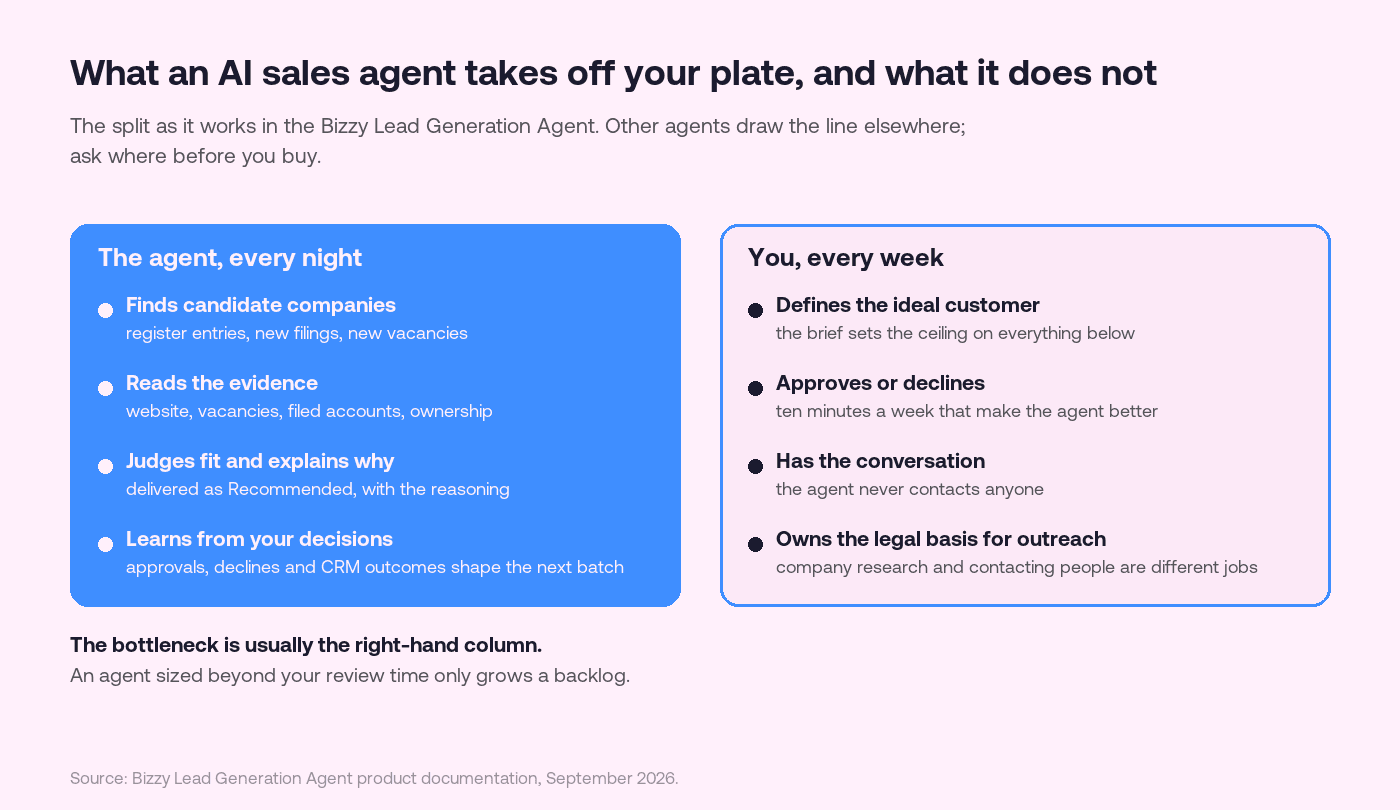
It reads the evidence. For each candidate it looks at the company website to see who it actually serves, the open vacancies to judge growth and intent, the filed accounts to judge size and health, and the ownership structure to understand who decides. That is the same checklist a good rep runs by hand, applied to the whole market instead of the twenty companies there was time for.
It delivers with a verdict, not a dump. Matches land in your list with a "Recommended" status and the reasoning attached. You approve or decline. Approved companies move into your normal pipeline; declined ones teach the agent what you meant.
It learns from what happens next. Approvals, declines and, where a CRM is connected, deal outcomes feed back into the next batch. Occasionally it will include a company from an adjacent segment on purpose, to test whether your definition is too narrow.
Read next to that, the Signals feature is the same idea pointed at companies you already know: tell me when something changes.
What it does not do
This is the part vendors skip, so here it is in one place.
It does not invent evidence. If a company has no website, no vacancies and files abbreviated accounts, the agent has very little to read. Many small Belgian firms fit that description, and it is why LinkedIn-based tools struggle here too; we measured that in LinkedIn Sales Navigator for Belgian prospecting. A research agent is better than a filter in that case, because it can still use the register entry, the establishment units and the filings, but "better" is not "complete".
It does not know turnover for most small Belgian companies. Abbreviated accounts do not disclose it. The agent judges size from what is filed, such as equity, headcount and balance-sheet totals, and it should say so rather than guess. If a vendor claims a full financial picture of every company, that claim is wrong for Belgium. How to read a Belgian company's annual accounts explains what is and is not in the filing.
It does not decide who your customer is. The quality of the brief sets the ceiling. "Companies in Belgium" returns companies in Belgium. Teams that get value from an agent spend an hour on the ideal customer profile first, and revise it after the first two batches.
It does not send anything. The Bizzy agent finds and qualifies companies; the conversation is yours. Tools that do send on your behalf take on the legal basis for that contact, and in Europe that is where the questions start. Keep the two jobs separate and you keep control of both.
It does not remove the review step. In practice the bottleneck is rarely the agent's output; it is the team's discipline in reviewing it. An agent that delivers thirty candidates a week to a team that reviews ten will simply grow a backlog. Size the agent to the review time you actually have.
It does not fix the offer. If prospects do not want what you sell, a better list produces better-qualified rejections.
Why the Benelux is a special case
Most AI prospecting tools were built on North American data, where the company website and LinkedIn page are the record. In Belgium and the Netherlands the record is the register. Belgium keeps the Kruispuntbank van Ondernemingen, with one enterprise number per company and a separate number for each establishment unit, annual accounts at the National Bank and legal events in the Belgisch Staatsblad. The Netherlands keeps the Handelsregister at KVK, counting establishments rather than legal entities. We covered the practical difference in best B2B databases for the Benelux.
For an agent this changes two things. First, the ground truth for "does this company exist, where, and how big" comes from the register, not from a scrape, which is why an agent built on register data finds the SMEs that LinkedIn-first tools miss. Second, the activity code a company registered at incorporation is often not what it does today, so an agent that reads the website and the vacancies outranks one that filters on NACE alone. That is also why the Bizzy agent treats company, legal entity and contact as three different objects rather than one row; the Belgian company register explained shows why that distinction matters.
How to evaluate one before you buy
Ask these, and expect specific answers.
What does "qualified" mean? Ask to see the reasoning attached to a lead, not a score.
Which sources, per country? Register data for Belgium and the Netherlands, or a scrape of the web? Both have a place; they are not the same thing.
How often does it run? Once, weekly, nightly. New vacancies age quickly.
What happens when you decline? If nothing, it is a search, not an agent.
Where is the data stored? Bizzy stores data primarily on servers in the EU; ask any vendor the same and ask for it in writing.
Does it send messages? If yes, ask who holds the legal basis for that contact.
What does it cost as it scales? Per agent, per lead, per seat, or included in a plan.
Is there a trial without a credit card? The only reliable test is your own ICP against your own market.
What it costs
For Bizzy, the agent is part of the platform rather than a separate purchase. The number of agents you can run depends on the plan, from one up to ten, and every plan starts with a free trial without a credit card. That means the honest way to price it is to run one agent for two weeks against a segment you know well and count the companies you would not have found by hand.
Who should use one, and who should not
Use one if you sell to a definable segment of SMEs in Belgium or the Netherlands, your reps spend their mornings building lists, and you can commit review time every week.
Wait if your ideal customer is not yet clear, or your total market is a few hundred named accounts you already know. An agent finds what you have not found; it adds little when there is nothing left to find.
Look elsewhere if what you actually need is more verified phone numbers. That is a contact-data problem, and the tools that solve it are compared in Belgian prospecting tools compared.
Read next: Who is visiting my website? How B2B visitor identification works, and its limits
Read next: Bizzy vs Leadinfo: visitor identification alone, or the whole picture
Frequently asked questions
What is an AI sales agent? Software that searches for companies matching a description of your ideal customer, checks each one against public evidence such as websites, vacancies and filed accounts, and delivers the ones that fit with a reason. It finds and qualifies; it does not contact anyone.
Does an AI sales agent replace SDRs? No. It replaces the list-building and first-pass research part of their week. The qualification call, the discovery conversation and the judgement about fit remain human work, and the agent gets better only if a human reviews its output.
Is AI lead generation GDPR-compliant? Researching companies from public and registry data is a different matter from contacting individuals. A research agent that works at company level and stores data in the EU is the easier case. Outreach automation that emails named people is where legal basis, retention and opt-out have to be worked out before you start.
How is this different from LinkedIn Sales Navigator or Apollo? Those are search tools over people-first data; you run the search and read the results. A research agent works from company-level register data, runs on its own schedule, and comes back with a shortlist and reasons. In Belgium the difference in coverage is large, because many SMEs have no LinkedIn presence to search.
How quickly does it produce results? The first batch typically arrives after the first overnight run. Judge it after two or three batches, once your approvals and declines have had a chance to shape it.