Who is visiting my website? How B2B visitor identification works, and its limits
Tips
The short answer
You can find out which companies visit your website, but not which people. Visitor identification works by matching the network a visit comes from to the organisation that owns it, then telling you what that organisation looked at, how often and for how long. It works well for visits from company offices and poorly for visits from home connections, mobile networks and VPNs. Leadinfo, one of the most used tools for this in the Benelux, reports identifying roughly 30% of visitors (Leadinfo pricing page, retrieved 18 September 2026). Treat that as the honest ceiling for any tool in this category, and then the interesting question is what you do with the companies it does identify.
Checking your website visitors: counts, or companies?
Analytics tells you that 1,200 people visited last week and that 40 of them read the pricing page. It does not tell you that eight of those forty came from the same mid-sized logistics company in Antwerp, on three different days, and that two of them stayed on the integrations page for six minutes. That second kind of knowledge is what visitor identification adds. It answers "which companies", never "which person". Every serious tool in this space, including the Bizzy website visitor tracker, shows visitors as pseudonymous counters under a company name, and any vendor that claims to name individuals from a plain page visit is either using something you did not consent to or overstating what they have.
So "checking your website visitors" is two different jobs. Counting them is free: Google Analytics or Matomo for sessions and pages, Search Console for the queries that brought them. Naming the companies behind them takes an identification tool with a script on your site. The rest of this page is about the second job, because that is the one that produces a list a sales team can act on.
How the identification works, and where it stops
A visit arrives from an IP address. Companies of a certain size route their office traffic through addresses registered to the organisation, and those registrations are public. A specialised identification layer maps the address to the company; Bizzy uses one and adds the company data, the intent scoring and the workflow on top rather than building the matching itself. The company is then matched to a full profile: register entry, financials, legal structure, size, technology in use, and the decision-makers on file.
The limits follow directly from the mechanism.
Home offices and mobile. A sales director reading your pricing page on a train, or from her kitchen table, comes from a consumer network. That visit is a session in your analytics and nothing in your visitor tracker. Since 2020 this is a larger share of B2B traffic than it used to be, which is why identification rates are what they are.
Shared and small networks. Very small companies often sit behind an internet provider's shared addresses and cannot be told apart from consumers. In Belgium, where most companies are small, this matters: the identified companies skew towards the ones with their own offices and their own network.
VPNs and privacy tools. A visit through a corporate VPN resolves to wherever the VPN exits. Sometimes that is still the company; often it is a data centre.
Bots and your own team. Crawlers, uptime monitors and your colleagues checking the site all generate visits. A decent tool filters the obvious ones; check yours does.
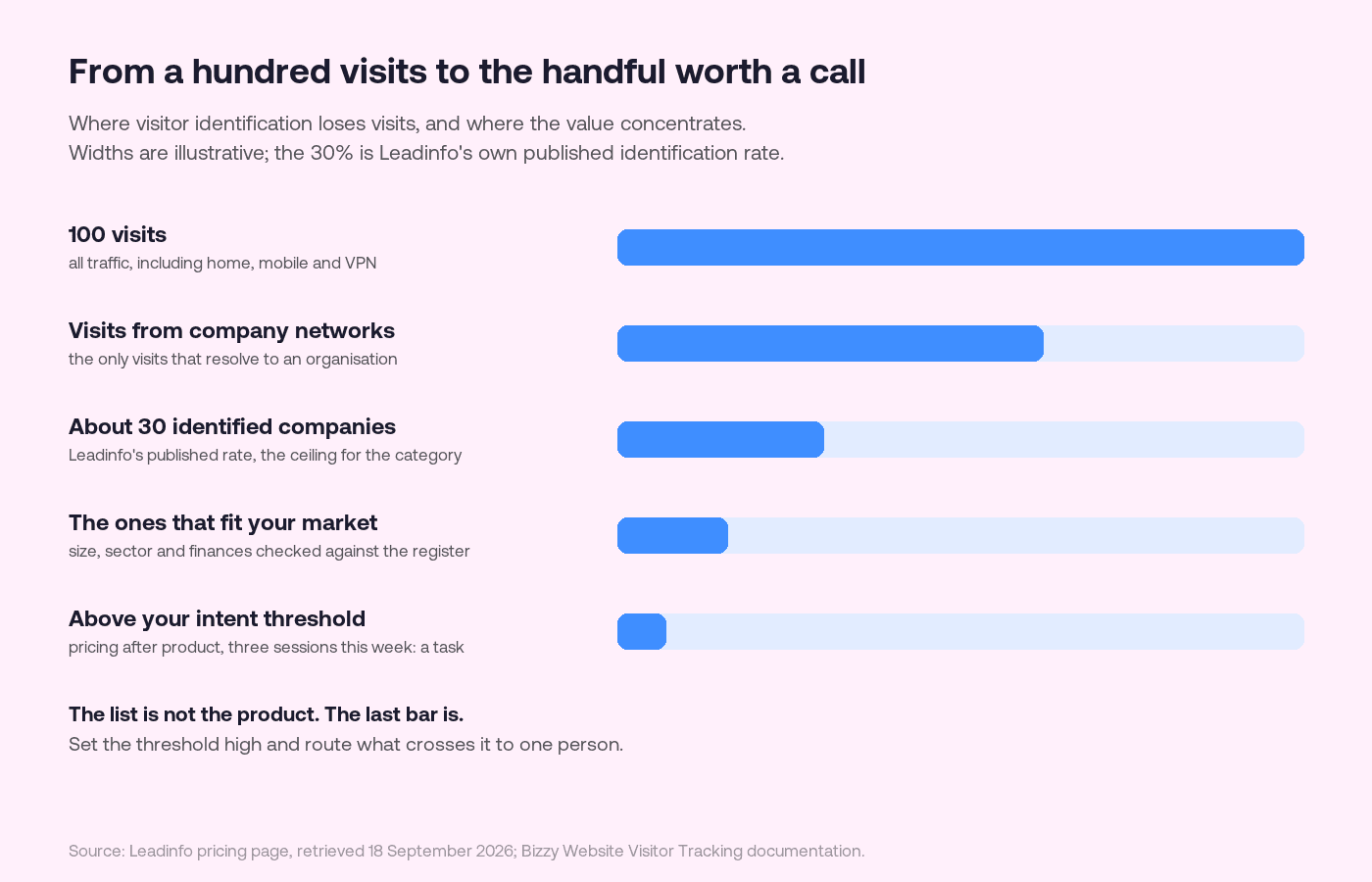
So a typical outcome looks like this: of every hundred visits, roughly a third resolve to a named company, a share of those are companies you would want to sell to, and a handful of those show behaviour worth acting on today. The value is entirely in that last handful.
What a useful visitor record actually contains
The difference between a list of company names and something a rep can act on is in the detail underneath each row.
Field | What it tells you |
Company | The organisation behind the traffic |
Visitors / visits | One company can generate many sessions; the ratio matters |
Intent | Graded (medium, high, very high) rather than a yes/no flag |
Pages viewed | The exact URLs, with a timestamp per page |
Session duration | Thirty seconds and eleven minutes are different signals |
Source | How they arrived: referral, search, direct |
Location | City and country |
Last seen | Recency is most of the value |
In Bizzy the visitor surface (identification is powered by Snitcher) is filterable on country, domain, source, date range, intent, number of visits and session duration. The domain filter matters if you run more than one site.
The single most useful of those is frequency. One visit is noise. A company that has been on your pricing page three times this week is a different proposition, and it is the pattern rather than the page that tells you so.
What to look at once you have a company name
A company name and a page count are not a reason to call. The signals that are:
Which pages, in which order. Pricing after a product page is a different visit from the careers page. Bizzy records the exact URLs viewed with timestamps per session, so you can see the path rather than a total.
How many sessions over how many days. One visit is curiosity. Three sessions in a week from the same company is a buying process, and the tracker shows that frequency directly.
Whether they already know you. An existing customer on a new product page is an expansion signal, not a lead, and it belongs with the account manager. Bizzy flags visiting companies that are already customers.
Whether they fit at all. A large company from outside your market reading your blog is traffic, not pipeline. Because each visitor is matched to a register-sourced profile, you can see size, sector and financial standing before anyone spends time on it. Signals does the same job for companies you already track: it tells you when something changes.
From a visit to an action
The failure mode of visitor tracking is a dashboard nobody opens. The fix is to decide once what "worth a call" means and let the tool do the watching.
In Bizzy that is a threshold on the intent score. Every visit gets a score with a stated reason. When a company crosses the level you set, Bizzy creates a task for the right rep, notifies them by email or in the app, and can push the company into a list, a CRM such as HubSpot, or an outreach play. The rep opens a task that says which company, which pages, how often, and who the likely contacts are, instead of a list of two hundred names.
Two rules keep this useful. Set the threshold high enough that the tasks stay rare and specific; a tool that fires on every visit trains the team to ignore it. And decide what an account manager gets versus what an SDR gets: returning customers and open opportunities go one way, new companies that fit the ideal customer profile go the other.
Privacy, in plain terms
Visitor identification works at company level, from public network registrations, and Bizzy stores data primarily on servers in the EU. That is a materially easier position than tools that try to identify individuals. Two things still need doing on your side: the tracking script belongs in your cookie and privacy notices like any other measurement tool, and once you decide to contact a person at an identified company, the usual rules for B2B outreach apply, including a clear legal basis and an easy way to opt out. Identifying that a company visited does not by itself give you the right to email everyone who works there.
When this is the right tool, and when it is not
It is worth it when you already have meaningful traffic from your target market, you sell something with a considered buying process, and someone will actually work the tasks. Then it turns existing demand you could not see into named companies at exactly the moment they are looking.
It is not enough when your problem is finding companies that have never heard of you. Visitor tracking only ever shows the companies that already came. For the rest of the market you need to go looking, which is what an AI lead generation agent is for. The two work together: the agent finds the accounts, the tracker tells you when one of them shows up.
Compared with a dedicated tool. Leadinfo does one thing, visitor identification, and prices by the number of companies identified per month. Bizzy includes visitor tracking in a platform that also holds the company data, the signals and the prospecting. Which is better depends on whether you want the identification alone or the whole picture; we set the two out fairly in Bizzy versus Leadinfo.
What to check before buying
Four questions that separate the tools quickly.
What resolves for your traffic? Ask for a trial against your own site rather than a coverage claim. Identification rates are audience-dependent and a headline percentage tells you little.
What arrives with the company? A name and a logo, or a record you can qualify from?
Where does the data go? A list nobody opens is worth nothing. Check the CRM push, not the dashboard.
Is it company-level only? If a vendor suggests it can name individuals, that is a reason to walk away rather than a feature.
Choosing a tool? Website visitor identification tools for the Benelux compared puts Leadinfo, Leadfeeder, Salesfeed, Albacross and Bizzy side by side on published prices; website visitor identification and GDPR covers what the script may and may not do in Belgium and the Netherlands; and Bizzy vs Leadfeeder sits next to the Leadinfo comparison above.
Frequently asked questions
Can I see which people visited my website? No, not from a page visit alone. Identification tools resolve the company behind the network address; individuals appear as pseudonymous visitors. Tools that claim otherwise rely on data you would need explicit consent to use.
What share of visitors can be identified? Leadinfo publishes a figure of roughly 30%. Rates vary by market and by how much of your traffic comes from company offices rather than home or mobile connections; expect less for very small companies and more for larger ones.
Does visitor tracking work in Belgium and the Netherlands? Yes, with the caveat that the Belgian market has a large share of very small companies without their own network, which are harder to identify. The value is in matching the companies that are identified to register-sourced data, so that you know who they are before you call.
Is it GDPR-compliant? Company-level identification from public network data, with EU storage, is the easier case. Add the script to your privacy notice, and treat any outreach to individuals as a separate decision with its own legal basis.
What should I do with the list? Nothing with the list as a whole. Set an intent threshold, route what crosses it to the right person as a task, and review the threshold after a month.