The short answer
There is no single best B2B prospecting tool for Europe, because the nine tools people shortlist are built on different things: company registers, contributor networks, a LinkedIn extension, a website tracker or a marketplace of other providers. Which one is right depends on whether your problem is finding companies, reaching people, or knowing when to call.
The fast verdicts: Bizzy for register-sourced company coverage across Europe with buying signals on top; Cognism for phone-verified mobile numbers; Apollo for volume at a low price; Sales Navigator for searching LinkedIn; Kaspr or Lusha for contact details while you browse LinkedIn, with a compliance caveat on both; Leadfeeder for website visitor identification, especially in Germany and the Nordics; Clay for combining several sources; ZoomInfo for US-centred enterprise sales.
Bizzy is our product, so read our verdicts on it with that in mind. Every figure below comes from the vendors' own websites, regulator decisions and review sites, checked between 8 and 10 September 2026, with sources linked throughout.
How we compared them
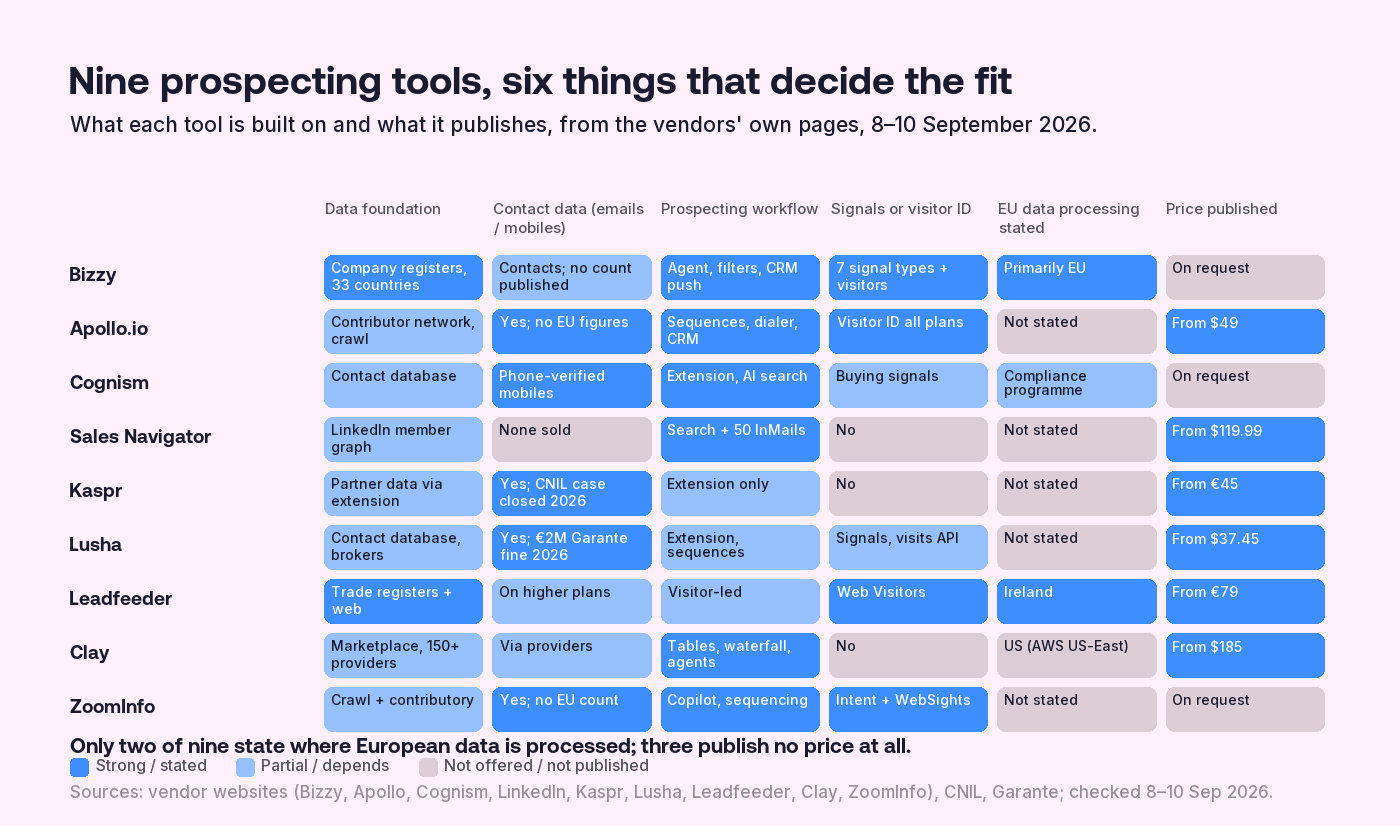
Prospecting is three jobs, and most tools only do one well: finding the right companies (coverage and filters), reaching the right people (emails, mobiles, LinkedIn), and knowing when to act (buying signals, website visits, intent). We looked at each tool on those three, and on three things European teams get burned by: where the data comes from, where it is processed, and whether the price is published.
This is a research comparison, not a head-to-head data test. If you are choosing between two of these for your own segment, run both on a sample of your target accounts before you sign; coverage differs enormously between a German industrial SME and a Dutch SaaS scale-up.
The nine tools at a glance
Tool | Built on | Best for | Entry price (published; annual billing unless stated) |
Bizzy | Official company registers of 33 European countries, plus websites, vacancies and Creditsafe | European SME and mid-market coverage with signals and an agent | Free start; three plans, price on request |
Apollo.io | Contributor network, web crawl, third parties | Volume and price, engagement built in | From US$49 per user per month |
Cognism | Contact database with phone-verified mobiles | Cold calling in Europe | Not published; 5 seats included |
LinkedIn Sales Navigator | LinkedIn's own member graph | Searching and messaging on LinkedIn | From US$119.99 per month per licence (monthly billing) |
Kaspr | Chrome extension over LinkedIn, matched to partner data | Individuals who live in Sales Navigator | Free plan; from €45 per user per month |
Lusha | Contact database with Chrome extension | Small teams wanting cheap credits | Free plan; from US$37.45 a month (US$49.90 on monthly billing) |
Leadfeeder (ex-Dealfront) | Website visitor identification plus a company database from trade registers | Knowing which companies visit your site | Free Lite plan; from €79 per month |
Clay | Marketplace and workflow engine over 150+ providers | Combining sources with your own logic | From US$185 per month (monthly billing) |
ZoomInfo | Proprietary contact database; sources not detailed on its public product pages | US and global enterprise | Not published; annual, seat minimum |
1. Bizzy: company registers, signals and an agent
Bizzy builds from the company downwards. It combines the official company registers of 33 European countries into a database of 50 million-plus companies, then adds company websites, LinkedIn profiles, job openings tracked from company websites through PredictLeads (complemented in Belgium by VDAB vacancies), and credit scores and limits from Creditsafe (Bizzy). For eleven of those countries, including Germany, Austria and the United Kingdom, the company data is supplied through Creditsafe (Bizzy). The website does not publish a company count per country, so ask for one for your markets before you sign.
On top of the data sit the parts that make it a prospecting tool rather than a lookup: buying signals across seven types, including hiring surges, funding rounds, leadership changes and website visits (Bizzy Signals); more than 54 targeting filters; and a lead generation agent you brief in plain language, which researches and qualifies companies continuously and delivers prioritised leads weekly (Bizzy). Company and contact records push straight into HubSpot, Salesforce, Pipedrive, Microsoft Dynamics 365, Teamleader Focus and Odoo, and into Lemlist and La Growth Machine, with a Chrome extension and an API (Bizzy integrations). Data is primarily stored on servers in the EU, and do-not-call cross-checking is available where the law requires it, such as Belgium and the Netherlands (Bizzy GDPR).
Where it falls short: Bizzy publishes no contact or mobile count, so if your outbound is mostly cold calling, compare its mobile coverage for your segment in a trial before you commit. It covers Europe only. It lists no ISO or SOC 2 certification on its website. It has too few public reviews on Capterra or Trustpilot to quote a meaningful score, so you will be relying on a trial rather than on other buyers. And there is no price on the pricing page: three plans, Core, Boost and Scale, a free start without a credit card, and the number comes from a conversation (Bizzy pricing).
Choose it when your market is European SMEs and mid-market, you want to know where a record came from, and timing matters more than raw contact volume.
2. Apollo.io: volume and price
Apollo is the cheapest way to get a lot of contacts. It claims 240 million contacts and 30 million companies, of which it says 150 million are refreshed monthly, sourced from a contributor network, web crawling and third-party providers rather than from company registers (Apollo). Sequences, a dialer and CRM integrations are included, so a small team can replace two or three tools at once. It identifies visiting companies on every plan (20 a month on the free plan, 100 on paid plans); contact-level identification is a paid add-on and US-only (Apollo).
It publishes its prices, which most of this list does not. A free plan carries 900 credits a year; Basic is US$49 per user per month, Professional US$79 and Organization US$119 with a minimum of three users, all billed annually, with monthly billing available on the two lower tiers at a higher rate; Basic includes 30,000 credits a year and one credit reveals one email (Apollo pricing; credits).
Where it falls short for European teams: Apollo publishes no European contact or mobile figures at all, and no list of the do-not-call registers it screens against. Capterra rates it 4.5 out of 5 across 398 reviews (Capterra); Trustpilot gives 3.1 across 1,292, with 37% one-star reviews mostly about account lockouts and credit costs (Trustpilot).
Choose it when you sell globally, need volume, and want engagement in the same tool. If Europe is your main market, read Bizzy vs Apollo.
3. Cognism: phone-verified European mobiles
Cognism's product is built around Diamond Data: mobile numbers a human has phone-verified. It states that Diamond Data covers more than 10 million phone-verified contacts globally, that it holds more than 200 million European contacts, and that its strongest coverage is in the UK, DACH, Benelux, the Nordics, France and Spain (Cognism, updated 20 May 2026). It says it screens against do-not-call lists in fifteen countries, twelve of which are named on its compliance page, Belgium among them (Cognism compliance). It is the only vendor here that publishes a phone-verified figure; ZoomInfo publishes a direct-dial count but does not describe it as verified.
As a prospecting tool it offers a browser extension that combines buying signals with contact data over LinkedIn and company websites, daily account recommendations and an AI search (Cognism). Plans are Standard and Pro, each with five seats included and credits per revealed contact; there is no public price (Cognism pricing).
Where it falls short: Cognism itself says its coverage is strongest in the UK, DACH, Benelux, the Nordics, France and Spain, so test it before relying on it outside those markets, and the price requires a sales conversation. Capterra reviewers rate it 4.7 across 263 reviews; Trustpilot gives 2.9 across 389, a third of them one star, mostly from people who received unwanted calls or struggled to have their data removed (Capterra, Trustpilot).
Choose it when cold calling is your main motion and you need mobiles that connect. See Bizzy vs Cognism if you want register data next to the phone numbers.
4. LinkedIn Sales Navigator: search and InMail, not a contact database
Sales Navigator is a tool many European reps already have, and it is worth being precise about what it is: a search and messaging layer over LinkedIn's own member graph. All three plans include more than 50 search filters and 50 InMails a month; Core is priced at US$119.99 per month per licence or US$1,079.88 a year, Advanced from US$159.99 per month, and Advanced Plus on request (LinkedIn).
What it does not sell is a contact database. LinkedIn's plan comparison lists no email or phone data on any tier; what you see is whatever a member has chosen to display on their own profile, and there is no bulk export of emails or phones. That gap is why Kaspr and Lusha exist as extensions on top of it. It also only knows what people put on LinkedIn: a company with a thin LinkedIn presence, and many European SMEs and owner-managed businesses have one, is nearly invisible to it.
Choose it when your buyers are active on LinkedIn and social selling is your motion. Pair it with a data source for everyone else. See Bizzy vs Sales Navigator.
5. Kaspr: the LinkedIn extension after the clean-up
Kaspr is a Chrome extension that reveals emails and phone numbers while you browse LinkedIn, Sales Navigator or Recruiter. It has a free plan with 15 email and 5 phone credits a month, a Starter plan at €45 to €59 per user per month with unlimited B2B emails and 100 phone credits, and a Business plan at €79 to €99, the lower figure being annual billing (Kaspr pricing). It has been part of Cognism since April 2022.
Its recent history matters for a European buyer. The French regulator CNIL fined Kaspr €240,000 on 5 December 2024 for collecting contact details of LinkedIn users who had limited their visibility, for keeping data five years, and for notifying people late and only in English. On 6 March 2026 the CNIL closed its injunction: Kaspr had deleted its database, stopped all data collection on LinkedIn and now informs people in every official EU language (CNIL). Today it matches the profile you are viewing against data from directories and partners rather than collecting from LinkedIn itself (Kaspr GDPR). Its website still advertises more than 200 million profiles, presumably partner data now; ask before you buy. Trustpilot gives it 1.5 across 88 reviews, mostly about billing (Trustpilot).
Choose it when you live in Sales Navigator, prospect one profile at a time, and want a cheap extension from a company that has just cleaned house.
6. Lusha: cheap credits, a live compliance question
Lusha is also a LinkedIn extension, with its own database behind it: 290 million contacts and 29 million companies, a free plan with 40 credits a month, Starter at US$37.45 a month on annual billing (US$49.90 monthly), Professional at US$52.45 (US$69.90) and Premium at US$299.95 (US$399.90); an email costs one credit and a phone number five (Lusha pricing). It adds signals, ICP scoring and lookalikes, a company-level website-visits API, and integrations with Salesforce, HubSpot, Zoho and Clay.
The caveat is not small. On 14 July 2026 the Italian data protection authority ruled that legitimate interest was not an adequate legal basis for Lusha's data brokering, fined it €2 million, banned it from processing data on people in Italy and ordered that data erased, confirming that the GDPR applies even though Lusha has no EU establishment (Garante). The French CNIL had concluded in December 2022 that the GDPR did not apply to Lusha's browser extension; the Italian decision goes the other way on the wider data-brokering activity and stands unless overturned on appeal. Lusha publishes no European mobile figures. Its Trustpilot score is the lowest here, 1.2 across 774 reviews, 57% one star, largely about ignored deletion requests and auto-renewals (Trustpilot).
Choose it when you want the cheapest credits for LinkedIn-based prospecting and your legal team has signed off on the risk. See Bizzy vs Lusha.
7. Leadfeeder: website visitors first, German and Nordic roots
Leadfeeder is the company formed by the 2022 merger of Echobot, from Karlsruhe, and Leadfeeder, from Helsinki. It traded as Dealfront from 2023 and went back to the Leadfeeder name on 24 March 2026, renaming its visitor tool "Web Visitors" and stating there were no pricing changes; the legal entities are still Dealfront Group GmbH and Dealfront Finland Oy (Leadfeeder). If a comparison you are reading still calls the product Dealfront, it predates the March 2026 rebrand.
Website visitor identification was its original product and remains the core. Around it sits a company database sourced from national trade registers and chambers of commerce, with a claimed 60 million companies and 400 million contacts, and a statement that every record can be traced back to a source (Leadfeeder). Its strongest markets are DACH, where Echobot came from, and the Nordics. Lite is free for up to 100 identified companies a month with unlimited users; Discover is €79 per month billed annually (€113 monthly), Activate €369 per month adds verified emails and phones, intent signals and display campaigns, and Scale is €599 per month on annual billing only (Leadfeeder pricing). All data is processed within the EU on servers in Ireland (Leadfeeder GDPR).
Where it falls short: identification is at company level, and Capterra reviewers, who rate it 4.2 across 135 reviews, complain about misidentified companies and the 30-day notice period on auto-renewal (Capterra). It publishes no country-by-country coverage.
Choose it when your market is Germany or the Nordics and knowing who visits your website is the first thing you want. See Bizzy vs Leadfeeder.
8. Clay: a marketplace with a workflow engine
Clay is different in kind: it sells you other providers' data. Its pricing page describes 150-plus data partners, a "waterfall" that tries one source after another until it finds a match, and AI agents that research companies on the web (Clay). It is not purely an aggregator, since its catalogue also lists one source, "Companies, People, and Jobs", that Clay labels "Source (Native)" with no third-party vendor attached (Clay), but most of what you enrich in Clay comes from elsewhere. It raised US$100 million at a US$3.1 billion valuation in August 2025 and reported US$100 million of annual recurring revenue and 14,000 customers in January 2026 (Clay).
On monthly billing, Launch is US$185 a month, made of US$60 of platform actions plus US$125 of data credits, and Growth is US$495; the pricing page presents both as minimums, annual billing takes 10% off, credits roll over one month, actions do not, and top-ups carry a 30% premium (Clay pricing, checked 8 September 2026). Its Trust Center lists SOC 2 Type 2, ISO 27001:2022 and ISO 42001:2023, the most security certifications of any vendor here (Clay Trust Center). Trustpilot shows 2.3 across 16 reviews, too few to weigh.
Where it falls short for European teams: Clay's European coverage is exactly as good as the providers you plug into it, the legal basis for the data you pull through it stays your responsibility, and its own documentation states that customer data is "primarily processed in the United States (AWS US-East)", with no EU hosting option we could find (Clay docs). It also has no visitor identification of its own.
Choose it when you have a RevOps owner and want to stack providers such as Cognism, Apollo or Lusha, or pull Bizzy in through its API, with your own enrichment logic. We go deeper in Bizzy vs Clay.
9. ZoomInfo: US enterprise
ZoomInfo is the largest by claimed data and the only one that is itself a listed company (Nasdaq: GTM): 500 million professional contacts, 100 million companies and 120 million direct-dial numbers (ZoomInfo, updated 7 July 2026). Its platform stretches well beyond data into an AI agent (Copilot), workflow automation triggered by buying signals, buyer intent, website visitor tracking, phone and email sequencing and conversation intelligence (ZoomInfo).
Where it falls short for European teams: it publishes no European contact count. Its competitor Cognism reports that European access has been sold as a paid add-on called Data Passport and puts ZoomInfo's non-US contacts at 145 million; treat that as a rival's reading (Cognism). Capterra reviewers rate it 4.1 across 322 reviews and name weak EMEA coverage as a recurring complaint (Capterra). Paid plans are not published at a fixed price, include a minimum number of seats and are billed annually upfront; Apollo, quoting Vendr, puts the median contract at US$33,500 a year, a competitor's estimate rather than a list price (Apollo). Trustpilot gives 1.7 across 330 reviews, mostly about auto-renewal and cancellation (Trustpilot). In the United States it settled a right-of-publicity class action for roughly US$29.6 million in 2024 over the use of people's names in its free-trial preview pages.
Choose it when you have the budget and most of your market is in the United States.
Verdict per use case
European SME and mid-market coverage, Benelux first: Bizzy. Register-sourced across 33 countries, with the signals and the CRM push in the same workflow.
Germany and DACH: Leadfeeder for website visitors and a trade-register company database with Echobot roots; Cognism for verified mobiles, where DACH is one of its strongest regions; Bizzy if you want one register-sourced database across Europe, knowing that its German data comes through Creditsafe. Test all three on a German sample before deciding.
Cold calling: Cognism. Nobody else publishes a phone-verified figure; ZoomInfo's 120 million direct dials are not described as verified.
Prospecting inside LinkedIn: Sales Navigator to search, Kaspr for the contact details; Lusha if you accept its compliance position.
Volume on a small budget: Apollo, once you have counted the credits.
Knowing which companies visit your website: Leadfeeder if that is the whole job; Bizzy if you want the visitors next to the register data; Apollo now includes it on every plan.
Combining several sources with your own logic: Clay, on top of whichever data providers you choose.
US-centred enterprise: ZoomInfo.
Compliance-first buying: Leadfeeder has the clearest hosting statement (all data in Ireland); Leadfeeder and Bizzy the clearest provenance (registers, with Bizzy's storage "primarily" in the EU); Cognism the most detailed public do-not-call screening list; Clay the most security certifications but US processing; Lusha and Kaspr are the two with regulator fines on record, and ZoomInfo settled a US privacy class action in 2024.
What to check before you sign, if you sell in Europe
Five questions that separate a prospecting tool built for Europe from one designed around US assumptions:
Where does each record come from? Registers and public filings, a contributor network, scraping, or another provider. Registers and public filings are the easiest to trace to a source you could show a regulator; for the others, ask the vendor to show you provenance for a sample record.
Can you see coverage per country? "Europe" is not a market. Ask for the number of companies in Belgium, the Netherlands and Germany, not the global total.
Where is the data processed? Of the nine, Leadfeeder states on its website that data is processed in Ireland and Bizzy that it is primarily stored in the EU, Clay states the United States; we found no clear statement from the other six, so ask.
Which do-not-call rules are handled, and where? Belgium runs a do-not-call register that callers must check; the Netherlands replaced its register in 2021 with an opt-in regime that also covers sole traders and partnerships. Ask how the tool handles each. The prospecting guide for Belgium and our guide to buying a Dutch business address list cover the two sets of rules.
What does the price actually include? Credits, actions, seats, minimums, annual-only tiers and top-up premiums vary enough that the entry price tells you little.
If Belgium is your home market, how to read a Belgian company's annual accounts shows what the registers give you for free. For a data-only comparison of these vendors, see B2B data providers in Europe compared; for the Belgian-only tools, Belgian prospecting tools compared.
Read next: the best B2B prospecting tools for European sales teams and how to generate B2B leads in Europe.
Read next: is B2B cold outreach legal in Europe? The rules for Belgium, the Netherlands and Germany, channel by channel.
Read next: Best lead generation tools in 2026: 10 tools compared.
Read next: Bizzy vs Qantara: which answers your question?
Read next: Bizzy vs Sectora: same register, different job
Read next: Why international prospecting tools miss Belgian SMEs
Read next: LinkedIn Sales Navigator in Belgium: the honest limits
Read next: Apollo vs ZoomInfo: pricing, coverage and the European gap
Read next: Clay vs Apollo: a database or the plumbing?
Read next: Bizzy vs Company.info: breadth or focus?
Read next: Best B2B databases for the Benelux: which register is it built on?
Frequently asked questions
What is a B2B prospecting tool?
Software that helps a sales team find companies that fit its target market, reach the right people there, and decide when to make contact. Some tools do only one of the three: Sales Navigator is search and messaging, Kaspr and Lusha are contact lookup. Bizzy, Apollo, Cognism, Leadfeeder and ZoomInfo combine data with workflow.
Which prospecting tool has the best European data?
It depends on the kind of data. For company coverage traceable to official registers, Bizzy (registers of 33 countries) and Leadfeeder (national trade registers and chambers of commerce) are the two register-sourced options; neither publishes a per-country company count on its website, so ask for one. For phone-verified mobile numbers, Cognism is the only one that publishes a figure. Apollo and ZoomInfo publish no European contact figures; Lusha publishes no European mobile figure.
Which is the cheapest?
On published entry prices: Kaspr from €45 and Apollo from US$49 per user per month, Lusha from US$37.45, all with free plans; euro and dollar prices are not directly comparable, and all three figures assume annual billing. Leadfeeder's Lite plan is free for up to 100 identified companies a month. Cognism, ZoomInfo and Bizzy do not publish prices. Compare what a credit or action buys before comparing the headline figure.
Are these tools GDPR compliant?
Compliance is your responsibility as the controller, whatever the vendor says. The public record: Lusha was fined €2 million in Italy in July 2026 and banned from processing data on people there; Kaspr was fined €240,000 in France in 2024 and had its injunction closed in March 2026 after deleting its database. Leadfeeder processes data in Ireland; Bizzy stores it primarily in the EU; Clay processes it primarily in the United States.
Is Sales Navigator enough on its own?
For finding and messaging people who are active on LinkedIn, yes. Its plan comparison lists no email or phone data, and it does not see companies with a thin LinkedIn presence, which includes many European SMEs. Most teams pair it with a data source.
Do I need a different tool for Germany?
Not necessarily, but check coverage there specifically. Leadfeeder and Cognism both name DACH among their strongest regions; Bizzy's German company data comes through Creditsafe, so ask for its German company count. Whichever you choose, run it on a German sample of your own target list before signing.