The short answer
Apollo.io is an all-in-one outbound platform built on a global contact database: 240 million-plus contacts, sequences, a dialer, meetings and deal management in one tool, at published prices from US$49 per seat per month on annual billing. Bizzy is a European company-data platform: Belgian register data, other European countries through Creditsafe data, buying signals and a lead generation agent, with contacts attached to the companies and the outreach left to your CRM and sequencer. If you run high-volume outbound and want one tool that finds, emails and, in the US or with the international add-on, calls, Apollo is the more complete product. If your market is European SMEs and mid-market companies and the hard part is knowing which companies exist, which fit and when to call, Bizzy is built for that.
Four things a European buyer should weigh before either. Apollo publishes no European coverage figure at all. Its data is hosted in the United States. The dialer included in its paid plans is listed as a "US Dialer", with international dialling in a US$119-a-month add-on, and contact-level website-visitor identification is an add-on marked "US Only" too. A phone number costs eight credits against one for an email. Bizzy is our product; every figure below comes from the two companies' own websites, plus Eurostat, Capterra and Trustpilot, checked between 8 and 11 September 2026, with sources linked. This is not legal advice.
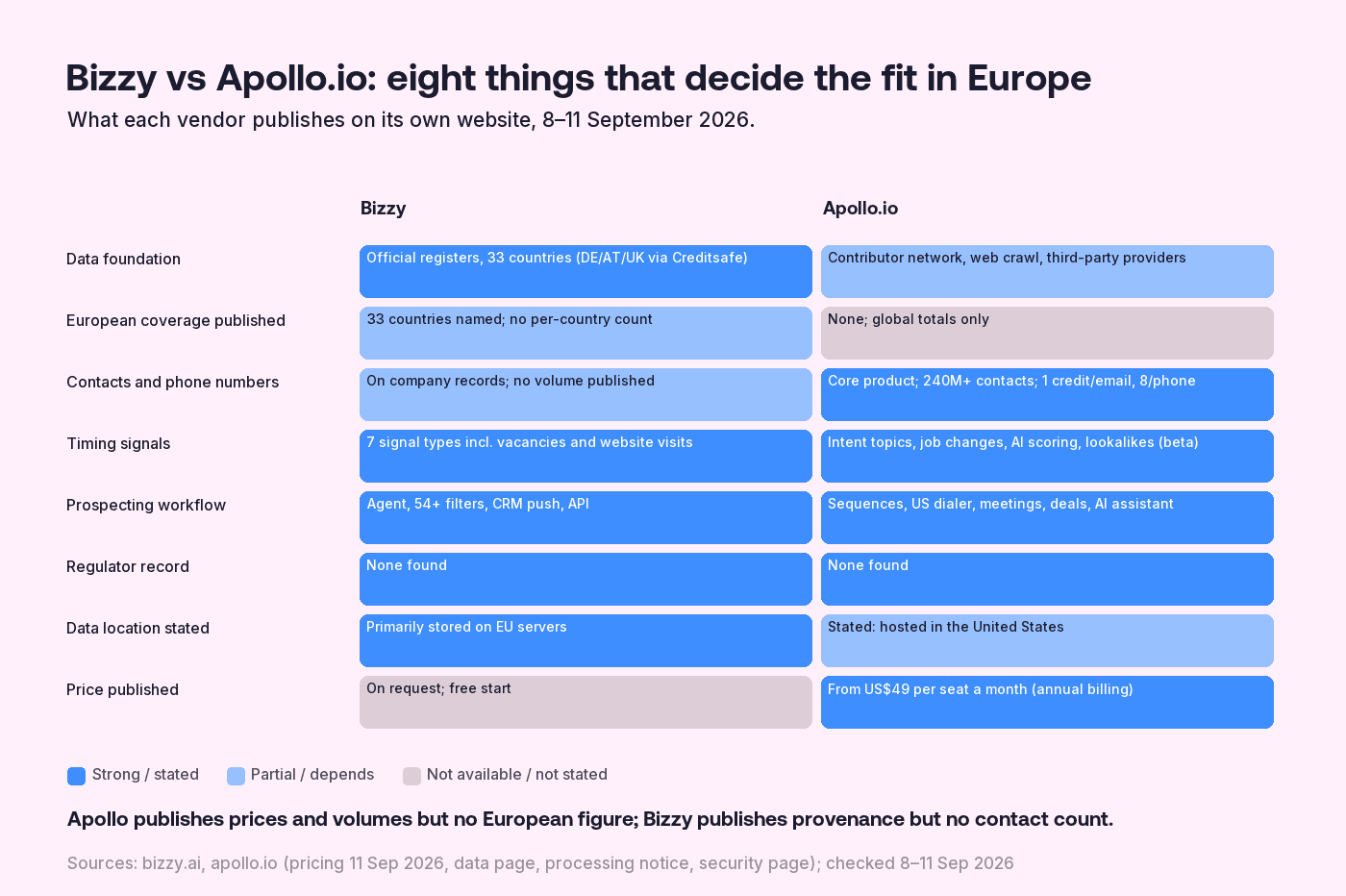
At a glance
Bizzy | Apollo.io | |
Built on | Official company registers for Belgium, Creditsafe data for other European countries, plus websites and vacancies | Contributor network, public web crawl, third-party data providers and engagement data |
Scale published | Deepest in Belgium | 240 million-plus contacts, about 30 million companies (Apollo pages, 8–10 September 2026); 150 million refreshed monthly |
European coverage published | Belgium from the registers, other countries through Creditsafe data; no per-country company count | None; global totals only |
Contacts and phone numbers | Decision-maker contacts and LinkedIn profiles on company records; no volume published | Core product; 1 credit per email, 8 per phone number; 98% email accuracy claimed |
Timing signals | 7 signal types incl. hiring surges, funding, leadership changes, website visits | Intent topics (1 to 12 by plan), job-change enrichment, AI lead scoring, lookalikes (beta), website visitors (companies) |
Workflow | Lead generation agent, 54+ filters, CRM push, Chrome extension, API | Sequences, US dialer, meetings, deal management, AI assistant, Chrome extension, API |
Data location stated | Primarily stored on servers in the EU | Hosted in the United States; SCCs and EU-US Data Privacy Framework for transfers |
Regulator record | None found | None found |
Price | Free start; Core, Boost, Scale on request | Free plan; Basic US$49, Professional US$79, Organization US$119 per seat per month on annual billing |
What each is built on
Apollo starts from the contact. Its data page describes four sources: a "data contributor network" drawing on "over 2 million data sources", an "engagement suite" that learns from email replies and bounces, "public data crawling" with "proprietary algorithms that regularly crawl the web", and "third-party data providers" processing "over 230 million records monthly". It claims 240 million-plus contacts, 150 million refreshed monthly, 5.3 million new contacts a month, a "98% email accuracy rate" from a "7-step email verification logic", and "less than 1% invalid direct phone numbers" (Apollo data). Its processing notice names the same three external sources and the legal basis: "our legitimate interests, as well as those of our customers" (Apollo processing notice). The accuracy figures are Apollo's own.
Bizzy starts from the company. It builds its Belgian company data from the official registers, then adds company websites, LinkedIn profiles, job openings tracked through PredictLeads (plus VDAB vacancies in Belgium), and credit scores and limits from Creditsafe (Bizzy). For every other country, the Netherlands, Germany, Austria and the United Kingdom among them, the company data is supplied through Creditsafe (Bizzy). Contacts sit on the company record; Bizzy publishes no count of them.
Why it matters in Europe: in 2023, 99% of the EU's 33.1 million enterprises were micro or small businesses (Eurostat), and a register lists them whether or not anyone has ever exchanged a business card with them. A contributor-and-crawl database is densest where most of its users are. Apollo publishes no regional breakdown, so we cannot say where that is; the US Dialer and the US-only contact-visitor identification are the only clues its website gives, and they point to the United States. That is not a flaw in Apollo's model; it is the shape of it.
European coverage: what each publishes
Apollo publishes global totals and nothing else: no figure for Europe, no country breakdown, and no European mobile count (Apollo data). Bizzy sources Belgium from the official registers and says the data for every other country comes through Creditsafe, but publishes no company count per country. So for your markets you have to ask both, and in the Apollo case you are asking for a number the website does not hint at.
The honest reading: Apollo probably has more people in its database than Bizzy in most markets; 240 million published against no figure at all makes that the safe assumption, but it is an assumption. Bizzy should have the fuller company list in Belgium, because the register is the list; Apollo publishes nothing that lets you check. Run both on a sample of your own target list before you sign; coverage can differ widely between a Belgian manufacturer with 40 staff and a London SaaS company.
Contacts, credits and phone numbers
Apollo's credit system decides what its coverage costs you. An email address costs one credit, a phone number eight, data enrichment one to eight (its FAQ says up to nine), an AI research run one, and the US dialer two credits per minute (Apollo pricing). Paid plans grant credits upfront for the year: 30,000 per seat on Basic, 48,000 on Professional, 72,000 on Organization. In practice a Basic seat's 30,000 credits buy 30,000 emails, or 3,750 phone numbers, or a mix; if your motion is cold calling, divide the headline credit count by eight before you compare.
Bizzy attaches decision-maker contacts to company records and pushes them into your CRM, but publishes no contact or phone-number count and no accuracy figure. For cold callers that is the number to test in a trial before committing. For a wider comparison of phone-data vendors, including Cognism's phone-verified figures, see the best B2B prospecting tools for European sales teams.
Timing: signals and qualification
Apollo has built a lot here. The pricing page lists buying-intent topics (one on Free, six from Basic, twelve on Organization), job-change enrichment, AI lead scoring, AI research, "People & Company Lookalikes" in beta, and website-visitor identification at company level, 20 companies a month on the free plan and 100 on paid plans (Apollo pricing). Two European caveats sit in the small print: contact-level visitor identification is part of the Inbound add-on (US$119 per team per month on annual billing) and is marked "US Only", and the larger company-visitor volumes (up to 50,000 a month) are in that add-on too.
Bizzy tracks seven signal types, including hiring surges, funding rounds, leadership changes and website visits, and lets you set alerts on them (Bizzy Signals); its lead generation agent takes an ideal customer profile in plain language, researches and qualifies companies continuously and delivers a prioritised list every week (Bizzy). The signals run over the register universe, and they include vacancies tracked through PredictLeads and, in Belgium, from VDAB.
Both tools sell timing. The difference is the universe under the signals: Apollo's fire on the companies in its contact database, Bizzy's on its company data, register-sourced in Belgium and from Creditsafe elsewhere, including the ones no contributor has ever uploaded. If your pipeline depends on spotting a 40-person Flemish manufacturer the week it posts three vacancies, test whether each database has the company at all.
Compliance and where the data lives
Legal basis and rights. Apollo says it processes prospect data on "our legitimate interests, as well as those of our customers", informs people through its Privacy Center and lets them request access, rectification or deletion there or at privacy@apollo.io (Apollo processing notice). It describes itself as "GDPR compliant as both a Data Processor and Data Controller" and is ISO 27001 and SOC 2 certified by A-LIGN (Apollo security). We found no regulator decision against Apollo, and none against Bizzy.
Location. Apollo is explicit: "The personal data that Apollo processes when providing its services is hosted in the United States", with Standard Contractual Clauses and EU-US Data Privacy Framework certification covering transfers (Apollo processing notice). Bizzy states that data is primarily stored on servers in the EU and offers do-not-call cross-checking where the law requires it, such as Belgium and the Netherlands (Bizzy GDPR). Apollo publishes no list of do-not-call registers it screens against.
Two concessions on Bizzy's side. It lists no ISO or SOC 2 certification on its website, where Apollo lists both, and it has too few public reviews to quote a meaningful score. Apollo's public record is mixed rather than bad: Capterra rates it 4.5 out of 5 across 398 reviews, Trustpilot 3.1 across 1,292 with 37% one-star reviews, mostly about account lockouts and credit costs, as at 10 September 2026 (Capterra, Trustpilot); its own pricing page cites 4.7 out of 5 across 9,690 reviews.
What it means for you. You are the controller for the outreach you do with either tool, and the rules differ by country; our guide to generating B2B leads in Europe sets out the rules for six countries with sources. US hosting is not illegal under the GDPR, but it is a question your DPO will ask, and Apollo's answer is on its processing notice.
Workflow: one tool versus a workspace plus your stack
Apollo is the more complete outbound tool, and it is fair to say so plainly. Paid plans include unlimited sequences (with A/Z testing from Professional), deliverability tooling and email warm-up, an AI assistant and AI research, meetings, deal management, call recording, automated workflows and integrations with Salesforce, HubSpot, Outreach, SalesLoft, Marketo, Sendgrid and LinkedIn, plus a Chrome extension and API (Apollo pricing). The catch for Europe is the phone: the dialer included in the plans is listed as a "US Dialer", and calling outside the United States needs the Advanced Dialer add-on at US$119 per team per month on annual billing, whose international minutes are billed in credits at a rate Apollo lists as "Varies by region".
Bizzy is a workspace with an agent. You brief the agent on your ideal customer, it delivers a researched, prioritised list weekly, and company and contact records push into HubSpot, Salesforce, Pipedrive, Microsoft Dynamics 365, Teamleader Focus and Odoo, and into Lemlist and La Growth Machine for sequences, with a Chrome extension and an API (Bizzy integrations). For email sequences and calling, outreach runs through the tools Bizzy connects to.
If your motion is "one rep, one tool, two hundred emails a day", Apollo is the shorter path. If your motion is "which of the 50,000 companies in my territory should we work this week, and push them to the tools we already have", Bizzy's agent is.
Pricing
Apollo publishes its prices, per seat, with annual billing shown by default and a monthly option at a higher rate (the page says annual billing saves 24%) (Apollo pricing, checked 11 September 2026):
Plan | Price (annual billing) | Credits per seat | Notes |
Free | US$0 | 900 a year, granted monthly | 2 sequences, 20 website-visitor companies a month, 5 AI-assistant chats |
Basic | US$49 per seat per month | 30,000 a year, upfront | Unlimited sequences, 6 intent topics, US dialer (credits apply) |
Professional | US$79 per seat per month | 48,000 a year, upfront | Adds A/Z testing, unlimited mailboxes, 4,000 call-recording minutes |
Organization | US$119 per seat per month, minimum 3 seats | 72,000 a year, upfront | 12 intent topics, SSO, 8,000 minutes, advanced security |
Add-ons | US$119 per team per month each, annual billing | – | Inbound (company visitors to 50,000 a month; contact visitors US only) and Advanced Dialer (international, parallel, power) |
Email 1 credit, phone number 8, enrichment 1 to 8, AI research 1 per run, US dialer 2 per minute. Apollo's FAQ gives trial credits as 100 in one answer and 50 plus 5 mobile credits in another; ask which applies. Prices exclude tax, and the plans are for internal use only; reselling the data needs a separate agreement.
Bizzy does not publish prices: three plans, Core, Boost and Scale, a free start without a credit card, and the number comes from a conversation (Bizzy pricing). That is a real disadvantage when you are comparing on a spreadsheet, and we say so; the trade is that you are pricing a company universe, signals and an agent rather than credits per reveal.
Verdict per use case
High-volume outbound with one tool: Apollo. Sequences, warm-up, meetings and deals in one place at a published price; nothing on Bizzy's side competes with that scope.
US-led or global outbound: Apollo. The dialer and the contact-level visitor identification are US-only, and nothing on Apollo's website suggests its database is denser anywhere else.
European SMEs and mid-market, Benelux first: Bizzy. Register-sourced company coverage in Belgium, Creditsafe data elsewhere, vacancies from VDAB, signals and the agent in one workflow, pushed to the CRM you already have.
Germany and DACH: test both. Apollo publishes no German figure; Bizzy's German and Austrian company data comes through Creditsafe and it publishes no German count either. Apollo's dialer for German numbers sits in the Advanced Dialer add-on; with Bizzy, calling runs through your own tools.
Cold calling as the main motion: count the credits. Apollo charges eight per phone number and its included dialer is a US dialer; Bizzy publishes no phone-number volume at all. Compare mobile coverage for your segment in a trial of each.
Compliance-first buying in the EU: Bizzy's register provenance in Belgium, EU storage and do-not-call checks are the cleaner story; Apollo's certifications are broader, but its data is hosted in the United States and it publishes no do-not-call list.
Both: one workable set-up. Bizzy to decide which European companies to work this week, Apollo to run the sequences and fill contact gaps. Keep one suppression list across both, and apply the per-country outreach rules to whatever you export.
Read next: Why international prospecting tools miss Belgian SMEs
Read next: LinkedIn Sales Navigator in Belgium: the honest limits
Read next: Apollo vs ZoomInfo: pricing, coverage and the European gap
Read next: Clay vs Apollo: a database or the plumbing?
Read next: Apollo alternatives for European sales teams
Every Apollo plan, what a credit buys and the renewal terms are in Apollo pricing.
Frequently asked questions
Is Apollo.io GDPR compliant?
Apollo says it is, as both processor and controller, relies on legitimate interest, offers a Privacy Center for access and deletion requests, and is ISO 27001 and SOC 2 certified. Its data is hosted in the United States under Standard Contractual Clauses and the EU-US Data Privacy Framework. We found no regulator decision against it. Compliance for your own outreach is your responsibility as controller.
Does Apollo have good European data?
Apollo does not say. Its website publishes global totals (240 million-plus contacts, 150 million refreshed monthly) and no figure for Europe or any European country. Ask for the count in your markets before you buy, and test a sample of your own target list.
How much does Apollo cost for a European team?
Basic is US$49, Professional US$79 and Organization US$119 per seat per month on annual billing (Organization needs three seats), each with credits granted upfront for the year. Emails cost one credit and phone numbers eight. Calling outside the United States needs the Advanced Dialer add-on at US$119 per team per month, and contact-level website-visitor identification is an add-on marked US only.
Does Bizzy have Apollo's contact data?
No. Bizzy attaches its own decision-maker contacts to its company records (register-based in Belgium) and publishes no contact count; Apollo publishes 240 million-plus contacts. If contact volume is the deciding factor, test Bizzy's coverage for your segment before you decide.
Can I use Bizzy and Apollo together?
Yes; it is a workable pairing: Bizzy to build and prioritise the company list from register and Creditsafe data and signals, Apollo to run the sequences and fill contact gaps on the accounts that matter. Keep one suppression list across both, and apply the per-country outreach rules to whatever you export.