The B2B sales funnel: the five stages, the process behind them and the numbers that show it works
Tips

The short answer
A B2B sales funnel is the path a company takes from not knowing you to paying you, cut into stages that each have an entry rule, an exit rule and a number you watch. In B2B it has five: awareness and prospecting, interest and discovery, evaluation and qualification, decision, and purchase and retention. The funnel describes the buyer's journey; the sales pipeline is your team's view of the same deals, with a value and an owner on each. A funnel is only worth drawing if you also decide what feeds the top of it, which is where most Benelux teams lose the game before the first call: a raw list of Belgian companies gives you a usable channel on roughly one in four, and LinkedIn reaches 6.5% of them. This page is the hub for the sales process on this blog: the five stages, the process that has to sit behind them, the numbers that tell you it works, and where each deeper piece lives.
What a B2B sales funnel is, and what it is not
The funnel is a model of how a stranger becomes a customer. In B2C it is wide and fast: many people, small decisions, little qualification. In B2B it is narrow and slow: fewer companies, several people per decision, and a real cost to talking to the wrong ones. That changes what the funnel is for. A B2C funnel is optimised for volume at the top. A B2B funnel is optimised for the quality of what enters it, because every bad-fit company that gets in costs a rep's time at every stage after.
Three things the funnel is not. It is not a pipeline: the pipeline is the sales team's working view of live deals, with a euro value, a stage and an owner on each, and it is covered on its own page. It is not a CRM setting: the stages in your CRM should mirror the funnel, but drawing the funnel comes first. And it is not a forecast: the forecast comes out of the numbers per stage once you have measured them for a few months.
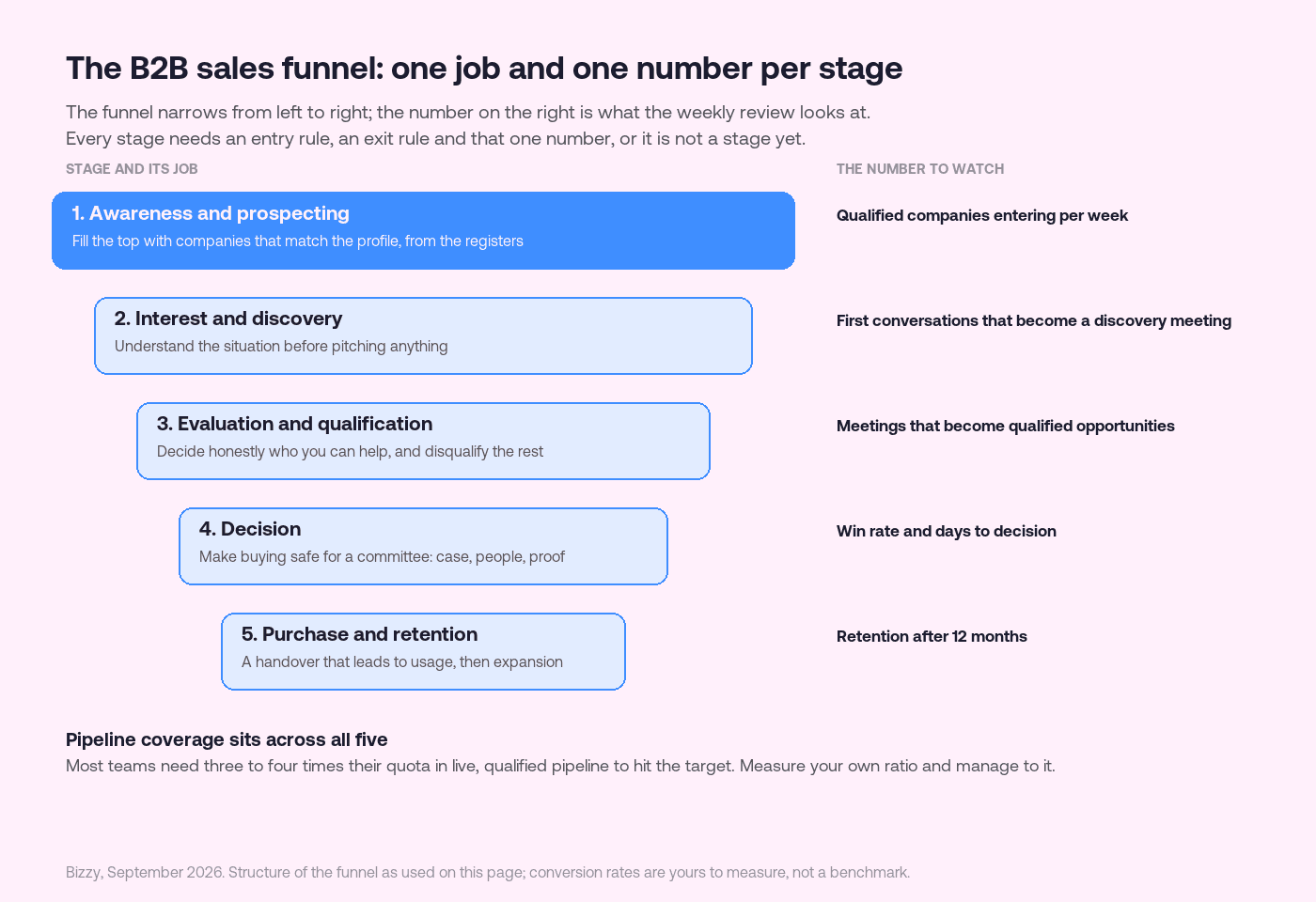
The five stages
Each stage has one job and one number. If you cannot say what the number is, the stage is not defined yet.
1. Awareness and prospecting. The job is to fill the top with companies that match your ideal customer profile, and only those. The number is how many qualified companies enter per week. In Belgium and the Netherlands this stage starts from the company registers rather than from LinkedIn, because most SMEs are barely present there; building an ICP on filters that actually exist covers what you can filter on, and prospecting in Belgium covers how to work the list. Buying signals, such as a company that is hiring or has just moved, decide who you call first.
2. Interest and discovery. The company knows who you are and is willing to talk. The job is to understand their situation before you pitch anything. The number is the share of first conversations that end in a booked discovery meeting. The B2B sales conversation has the questions for both the cold call and the discovery call.
3. Evaluation and qualification. The gate. The job is to decide, honestly, whether this is a company you can help and that can buy, and to disqualify the rest. The number is the share of discovery meetings that become qualified opportunities, and the share you disqualified on purpose. A clean funnel has a visible disqualification rate; a funnel with none is not being qualified.
4. Decision. The job is to make buying safe for a committee: a business case in euros, the people who can say no identified early, the risk removed with proof. The number is the win rate on qualified opportunities and the days it takes. How to increase B2B sales covers the closing playbook.
5. Purchase and retention. The funnel does not end at the signature. The job is a handover that leads to usage, then expansion. The number is retention after twelve months and expansion revenue. Bad fits admitted in stage one show up here as churn, which is why the funnel is measured end to end.
The process behind the funnel
A funnel drawn on a whiteboard changes nothing. What we see across the sales teams we work with is that the ones whose funnel actually behaves like one share five habits.
Targets that split new from existing business. A revenue goal is the start, not the plan. Split it into what existing customers will bring, what inbound will bring, and what outbound has to bring on top, and give each rep their share of that last number. One consultancy we work with did exactly this per office and could see for the first time which offices needed help from the centre.
Stages that mean the same thing to everyone. Not "in progress" and "follow-up", but "meeting booked", "proposal sent", "contract in review", with the team involved in naming them. One wholesaler cut its process to four stages every rep uses, measured conversion between them, and found its real bottleneck within a quarter.
A shared way of working. Reps need freedom in how they sell, but a team where everyone works on their own island loses what it learns. Shared sequences with A/B-tested message variants turn individual wins into a team standard.
A consistent flow of new companies. Reps are drawn to renewals and inbound because those are warmer. If existing business and inbound cannot carry the growth target, outbound has to run every week whether anyone feels like it or not, which is the job of an AI lead generation agent rather than of willpower.
One place where everything is tracked. A CRM, not a spreadsheet, an ERP or memory. Every new company and every deal goes in, with a stage, and Bizzy pushes companies straight into HubSpot, Teamleader Focus, Odoo and the other major CRMs so nothing lives only in a rep's head.
The numbers that tell you it works
Volume is the least useful number in the funnel. These five are the ones to put on the weekly review.
Number | What it tells you | Where it lives |
|---|---|---|
Qualified companies entering per week | Whether the top is fed consistently or in waves | Stage 1 |
Conversion between each pair of stages | Where deals stall; the stage with the lowest conversion is the one to fix first | Stages 1 to 4 |
Velocity: days from entry to decision | Whether the process is moving; a fast no beats a slow maybe | Stages 1 to 4 |
Win rate on qualified opportunities | Whether qualification is honest | Stage 4 |
Pipeline coverage | Whether there is enough live value to hit the target; most teams need three to four times quota in the pipeline | All |
Two warning signs sit outside the table. If everyone has the same monthly target despite different territories, deal sizes and conversion rates, the best reps coast and the rest lose momentum. And if new companies arrive in waves, one month of prospecting followed by a month of closing, next quarter's gap is already visible in this quarter's numbers. Sales pipeline: stages, hygiene and the numbers that predict revenue goes deeper on the metrics and on keeping the data honest.
Where the funnel starts in Belgium and the Netherlands
The top of the funnel is a list, and the list decides everything below it. Two Benelux facts shape it. First, the official registers are the only source that covers every company: the KBO in Belgium with the enterprise number and the filed annual accounts, the KVK in the Netherlands. A list built on them is complete, traceable and cleanable; a list scraped from LinkedIn is not. The Belgian company register explains what sits behind the enterprise number. Second, most Belgian SMEs have a thin web presence, so a funnel that expects to warm companies up with content before a rep calls will wait a long time. For them, the trigger is a signal from the register or a vacancy, and the first touch is a call or an email, which is why stage one and stage two are where the Benelux funnel is won.
The pages in this cluster
Sales pipeline: stages, hygiene and the numbers that predict revenue
The B2B sales conversation: cold call, discovery call and the questions that work
The B2B sales pitch: structure, three types and the data that makes it land
How to increase B2B sales: better leads, a real business case and a close that is not pushy
Feeding the top: generating leads from a company list to a conversation and lead qualification
Frequently asked questions
What is a sales funnel? A model of the path from a company not knowing you to becoming a customer, cut into stages with an entry rule, an exit rule and a number per stage. In B2B it has five stages: prospecting, discovery, qualification, decision, and purchase and retention.
What is the difference between a sales funnel and a sales pipeline? The funnel describes the buyer's journey and is measured in conversion rates between stages. The pipeline is the sales team's view of the live deals inside it, measured in euros, days and owners. You need both: the funnel to design the process, the pipeline to run it.
How many stages should a B2B funnel have? Five is the standard model on this page, but the number matters less than the rule: every stage needs an entry criterion, an exit criterion and one metric. Teams that cannot name those for a stage should merge it with the next one.
What is a good conversion rate between stages? There is no useful benchmark across industries and markets; the useful number is your own, measured for three months, and the stage where it is lowest is the one to fix first. Compare against your own last quarter, not against a vendor's chart.
Why does the funnel work differently in Belgium? Because most companies are small and barely present online, so the top of the funnel is built from the company register and from signals such as vacancies, and the first touch is usually a call rather than a piece of content.