The short answer
Clay is a workflow engine over a data marketplace. You pick providers, it runs them and pays per record found.
Bizzy is a European data source with a workspace on top. Registry-sourced company data for 33 countries, one subscription, no metering.
Clay wins on provider breadth, AI research tooling and published compliance certificates.
Bizzy wins on registry-traceable European company data, financial and legal filters, and EU data storage.
Clay processes customer data primarily in the United States by its own documentation; we found no EU option.
A data source and a workflow engine
Teams put Bizzy and Clay on the same shortlist because both promise better prospect data. They are not the same kind of product, and once you see the difference the choice usually makes itself.
Clay is orchestration. It gives you a spreadsheet-like table, a marketplace of data providers you pay for by the record, and an engine that runs them in sequence until one returns a match. Its pricing page describes credits as buying data "across our 150+ data partners". Its homepage sells the outcome as "infrastructure to get any data, run agentic workflows, and launch GTM plays". You bring the plan; Clay executes it at scale.
Bizzy is a data source with a workspace on top. It builds company profiles from the official business registers of 33 European countries, adds decision-maker contacts from public professional sources, credit and financial data from Creditsafe, and buying signals such as hiring and website visits. Then it hands a rep a list they can work today and syncs it to the CRM both ways.
So the real question is not which is better. It is whether you need a source of European company data or a machine for combining sources you already pay for. Plenty of teams end up with both.
Bizzy publishes this page, so read our column with that in mind. Every Clay figure below comes from Clay's own website, documentation, Trust Center or its own announcements. We read them on 8 September 2026 and we link each one, including the ones that favour Clay.
What Clay actually is
Clay is a New York company founded in 2017. In August 2025 it raised $100 million at a $3.1 billion valuation, led by CapitalG (BusinessWire). In January 2026 it ran a $55 million employee share tender at a $5 billion valuation and reported $100 million of annual recurring revenue and 14,000 customers (Clay). It is growing fast and its product is genuinely good at what it does.
Three things make Clay work.
The marketplace and the waterfall. Instead of buying one database, you buy attempts. Clay's waterfall tries provider after provider for an email or a mobile number and, in its own words, stops "as soon as one returns a valid result", so "you only pay credits for the provider that finds a match" (Clay docs). For contact data across many countries, this beats any single vendor we know of.
Claygents. AI agents that read the web and write a structured answer into your table, with a reasoning trace attached. The counter on Clay's Claygent page showed over five billion agent runs when we checked on 8 September 2026.
Openness about sources. Clay tells you which provider produced each field, and you can bring your own API keys so an existing subscription costs you no Clay credits, though the workflow still consumes Clay actions (Clay FAQ). That transparency is real and it is unusual in this market.
Clay is often described as holding no data of its own. That is not quite right: its catalogue includes a source called "Companies, People, and Jobs" which Clay labels "Source (Native)" with no third-party vendor attached (Clay). Most of what you enrich in Clay still comes from other providers, so it is better read as an orchestration layer with a small native dataset than as a pure aggregator.
What Bizzy actually is
Bizzy is a European sales workspace built on registry data. It reads the official company registers of 33 European countries, so a company that has filed accounts but has nobody on LinkedIn still exists in Bizzy. On top of that sits a searchable legal-entity layer with credit scores, solvency, EBITDA, directors and ownership, plus contact data, buying signals, website visitor identification and an autonomous Lead-Gen Agent that delivers a fresh qualified list on a schedule (Bizzy data).
It is a single subscription. There are no credits to meter, no providers to select and no waterfall to design. That is the point for a team without a RevOps engineer, and a limitation for a team that wants to control every step.
Which tool fits your team?
In one line each: Clay if someone on your team enjoys building systems and you sell beyond Europe; Bizzy if you sell to European companies and want a rep productive without a build phase. The table below has the detail, and the full verdict is at the end.
Bizzy vs Clay at a glance
Thirteen rows on the things that actually differ, from where the data comes from to where it is stored.
Read next: Clay vs Apollo: a database or the plumbing?
Feature
Bizzy


Clay
What it is
A European data source with a workspace on top
A data marketplace with a workflow engine on top
Where the data comes from
Official registers of 33 European countries, plus web, vacancies and Creditsafe
150+ data partners per its pricing page, plus one source labelled native to Clay
European company coverage
50M+ companies, published country by country
Not published; depends on the providers you select
Legal entity and financial filters
29.8M+ legal entities searchable: credit score, solvency, EBITDA, directors, ownership
No statutory registry or credit-bureau provider found in the catalogue
Contact data
Decision-makers per company, validated before credits are spent
Waterfall across many providers; you pay credits only for a match
Buying signals
Hiring, growth, funding, financial changes, website visits
Job changes, hiring, company news, social; web intent from the Growth plan
Website visitor identification
Identify and filter companies visiting your website
Not available
AI
Lead-Gen Agent runs on a schedule and learns from your feedback
Limited
CRM sync
Two-way with HubSpot, Salesforce, Pipedrive, Dynamics 365, Teamleader, Odoo
Auto-sync from the Growth plan ($495/month monthly billing)
Pricing model
Tier-based: Core, Boost, Scale. Everything included, no per-record metering
Two meters: platform actions plus data credits. Top-ups +30%
Where data is stored
Primarily EU servers; DNC screening where the law requires it
Primarily United States (AWS US-East); no EU option published
Certifications
None listed today
SOC 2 Type 2, ISO 27001:2022, ISO 42001:2023
Who operates it
A sales rep, out of the box
Best with an operations or RevOps owner
Data and coverage
Bizzy's European coverage
50M+ European companies, sourced from the official registers of 33 countries, published country by country so you can check your market before you buy
Of those, 29.8M+ legal entities are separately searchable with credit score, solvency, EBITDA, directors and ownership attached
Contacts, hiring and growth signals, website visitors and tech stack layered on the company record
Clay's coverage depends on the providers you pick
No European coverage figures published. Coverage is whatever the providers you select happen to hold, and Clay's own FAQ says it consolidates enrichment tools "some with better global or regional coverage than others" (Clay FAQ)
150+ data partners according to the pricing page, including strong European contact vendors such as Dropcontact, Prospeo, Datagma and Icypeas
One catalogue source, "Companies, People, and Jobs", is labelled native to Clay
We searched Clay's integrations directory on 8 September 2026 for Creditsafe, Graydon, Companyweb, Trends Top and national business registers, and found none of them. The closest is HitHorizons, tagged for EMEA, which returns legal company names and addresses but does not describe itself as a registry source
How many providers does Clay have?
A small thing that says something real about a marketplace this size. Clay quotes four different provider counts across its own properties: "200+ providers" on the homepage and integrations page, "150+ data partners" on the pricing page, "100+ premium data sources" on the Trust Center, and "75+ different enrichment tools" on an undated FAQ page.
The labels differ, and Clay defines none of them: "providers", "data partners", "premium data sources" and "enrichment tools" may well be four different populations. That is the point. A buyer cannot tell which number applies to them. None of this is dishonest, and a catalogue that changes weekly is genuinely hard to count, but the figure you are buying against is the one on the pricing page, where Clay defines what credits actually purchase, and it is a quarter lower than the 200-plus on the homepage.
Where your data lives
This is the sharpest difference on the page, and it is Clay's own documentation that states it. Clay's "AI in Clay" documentation says: "Customer data is primarily processed in the United States (AWS US-East)." We looked for an EU region or a data-residency option on clay.com, the documentation and the Trust Center on 8 September 2026, and found none. Note the word "primarily", and note that the statement sits on a page about AI processing, so ask Clay directly if EU-only processing is a hard requirement for you.
The same page confirms two good things: your data is never used to train AI models, and Clay names its AI subprocessors, currently OpenAI, Anthropic and Google.
Bizzy stores data primarily on servers inside the EU and offers do-not-call screening where national law requires it, including Belgium and the Netherlands (Bizzy GDPR).
Credit where it is due: Clay's compliance paperwork is better than ours. Its Trust Center lists SOC 2 Type 2, ISO 27001:2022 and ISO 42001:2023 certificates, the AI management standard included, and offers a Data Processing Agreement on request. Bizzy lists no certifications on its website today. If your procurement team scores certificates, Clay wins that row and we have work to do.
One structural difference remains, and it cuts both ways. Clay publishes no single legal basis for the records bought through its marketplace, and we found no statement of who holds it, which in practice leaves it with each provider and with you. Your compliance story is then only as good as the weakest source in the waterfall you built. Bizzy is not single-source either: it combines 33 national registers with Creditsafe and public professional sources. The difference is that Bizzy's sources are fixed and published, so you check each legal basis once rather than per record.
Product architecture
Bizzy: one product. Prospecting, registry and financial filters, signals, website visitors, pipeline views and two-way CRM sync with HubSpot, Salesforce, Pipedrive, Dynamics 365, Teamleader and Odoo sit in one place (Bizzy integrations). A rep opens the Tasks page and finds leads the agent delivered.
Clay: a platform you assemble. Tables, waterfalls, Claygents, signals, a sequencer, ad audiences and an HTTP API for anything without a native integration. It connects to HubSpot, Salesforce, Pipedrive, Close and Loxo among others (Clay FAQ). This is more powerful and it is more work. Someone has to design the waterfalls, choose the providers, watch the credit burn and maintain the tables when a provider changes.
Note which side of the paywall the plumbing sits on. Two-way CRM auto-sync and the HTTP API are both listed as Growth-plan features on Clay's pricing page, which is $495 a month on monthly billing. On Launch you can enrich and export, but the CRM sync many teams treat as basic is one tier up.
Pricing
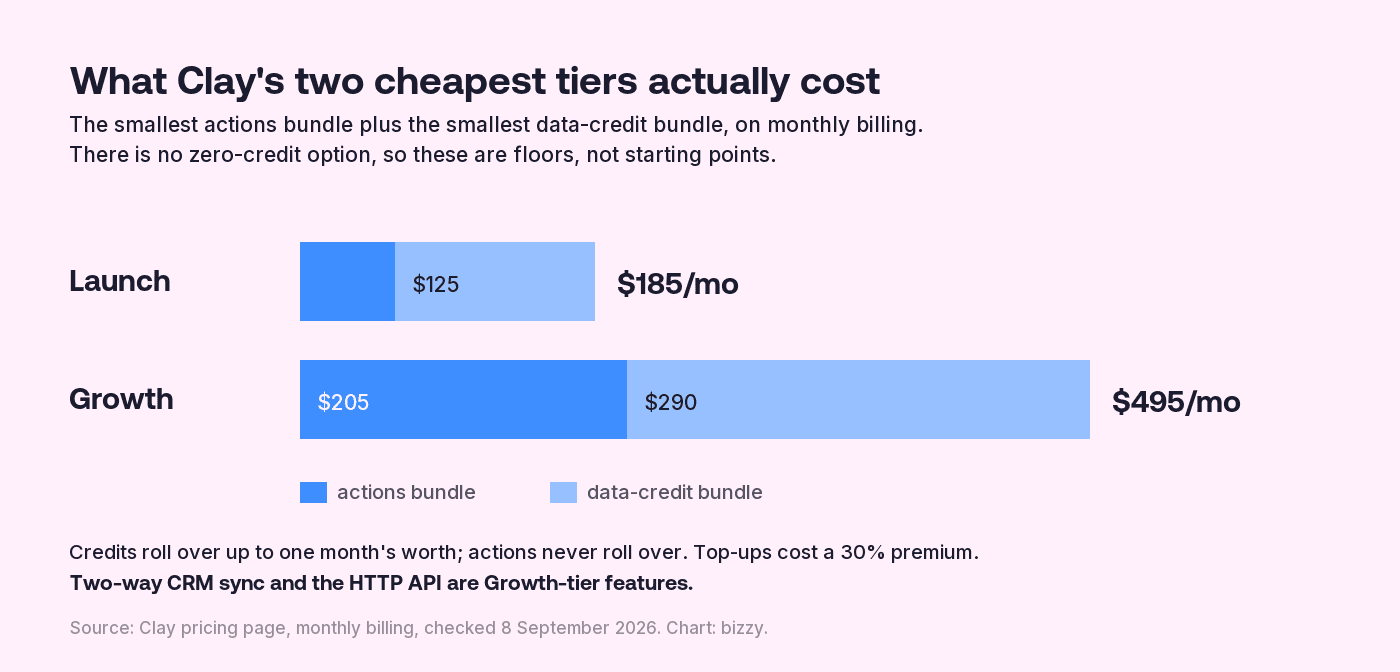
Clay runs two meters and the headline price is their sum. Actions measure platform usage, enrichment and execution. Data credits buy records from the marketplace. Reading the pricing page on 8 September 2026 with the billing toggle in both states:
Plan | Monthly billing | Annual billing | What the headline includes |
|---|---|---|---|
Free | $0 | $0 | 500 actions, 100 data credits |
Launch | $185 | $167 | 15K actions ($60) plus 2.5K credits ($125) |
Growth | $495 | $446 | 40K actions ($205) plus 6K credits ($290) |
Enterprise | Custom | Custom | Annual commitment; SSO, RBAC, custom DPA (a standard DPA is available on request on any plan) |
Each meter has its own ladder and you expand them independently, but neither can be set to zero: on 8 September 2026 the cheapest actions bundle on Launch was $60 a month and the cheapest credit bundle $125, which is where the $185 headline comes from. So $185 and $495 are the real minimums, not starting points to negotiate down from. Annual billing takes 10% off. Credits roll over up to one month's worth, actions never roll over, and top-ups cost a 30% premium. A workflow that runs and finds nothing still spends actions.
Clay bills in US dollars, before EU VAT.
Bizzy is tier-based. Core, Boost and Scale, priced on team size and the modules you enable, with no per-record metering inside a tier. You start free and you get the number from a conversation.
We cannot publish a like-for-like table here, because our own pricing is quote-based and Clay's is not. That asymmetry is a fair criticism of us. What we can say is the shape of it. Clay's entry point is $185 a month whether you use it or not, and the bill grows with volume in $125-and-up credit steps; a flat tier costs more at low volume and stops moving once a team is in the data every day. Work out your monthly record volume before you compare the two, because that number decides the answer.
AI: an instrument versus an agent
Clay's AI is a tool you point at a problem. Claygents read the web and return a structured answer with a reasoning trace, and Account Agents are in beta on paid plans (Clay). If you can describe a research task, you can automate it. For open-ended research we have not seen better in this category.
Bizzy's AI is an agent that owns a job. The Lead-Gen Agent runs on a schedule, applies your ideal customer profile, delivers new qualified companies weekly and learns from what your team marks as good or bad. You do not prompt it each time.
The difference is who holds the plan. Clay gives you a better instrument and expects you to play it. Bizzy hands over a finished result and gives you less room to change how it was produced.
How often AI assistants name and cite Clay: our 66-prompt sample
Here is why we wrote this page, with the method stated so you can discount it as you see fit.
We track 66 prompts in SE Ranking's AI Result Tracker across three configurations covering two engines: ChatGPT for Belgium in Dutch (36 prompts) and in English (15), and Google AI Overviews for Belgium in Dutch (15). Between 10 August and 8 September 2026, counting each brand named in an answer and each time a brand's own domain appeared among the cited sources, Clay was named 67 times and cited 67 times.
Clay and Apollo convert mentions into citations at close to one to one; Apollo sits at 133 mentions and 129 citations. The Belgian registry brands do not: Companyweb 188 and 25, Trends Top 176 and 14. Neither do we, at 135 and 70. HubSpot is the only brand in our set cited more often than it is named, at 37 and 44.
Three caveats. This is our own measurement of a small prompt set in one market, not a market-wide study. The exact 67/67 equality is a coincidence rather than a finding. And we counted mentions and citations separately, so we did not check whether they appear in the same answer.
What it points at is a pattern. Clay earns citations by publishing research of its own, such as Clay's phone-data benchmark, which we analysed in our EMEA phone data article. Publishing is a legitimate way to win the argument, and it is worth knowing that an AI assistant recommending Clay to a European team may well be reading Clay's own pages.
Other Clay alternatives for European teams
If you are shopping rather than deciding between these two, the honest shortlist depends on the job:
Cognism if the missing piece is phone-verified European mobile numbers. It is the only provider in our wider comparison that publishes a phone-verified figure, and it screens against do-not-call lists in more countries than anyone else here. Pricing is quote-only with five seats included.
Apollo.io if you sell globally and want the lowest price per contact. It publishes its prices, from $49 per user per month on annual billing, and bundles sequences and a dialler, but publishes no European coverage figures.
Leadfeeder, renamed back from Dealfront in March 2026, if your pipeline starts with website visitors. Its company data comes from trade registers too, it processes all data in the EU, and Discover starts at €79 a month.
Companyweb or Trends Top if you only sell in Belgium and mainly need credit and filing data. Companyweb starts at €735 a year, Trends Top at €300, and neither goes beyond the Benelux.
We compared all of these, and Clay, in B2B data providers in Europe, compared.
Final verdict
Bizzy and Clay solve different problems, so the recommendation depends on your team rather than on a feature count.
Choose Clay if you have an operations owner, sell beyond Europe, already pay for data providers, and want maximum control over how records are found and combined. Nothing in Europe matches its provider breadth or its agent tooling.
Choose Bizzy if your market is European, you want company data that traces back to a national register, you need financial and legal filters beside the firmographics, you want data stored in the EU, and you want a rep to be productive without a build phase.
Use both if you have the budget and the skills: Bizzy as the European company layer, Clay as the engine that enriches and routes it. That is a real pattern, not a diplomatic answer.
Book a demo to see what registry-based European data looks like for your market.
Frequently asked questions
Is there a GDPR-compliant European alternative to Clay? There are European alternatives, and whether any tool is compliant depends on how you use it. The concrete things to check are where data is stored, who holds the legal basis for each record, and whether a DPA is standard or an enterprise upsell. Clay's documentation states that customer data is primarily processed in the United States on AWS US-East; Bizzy stores data primarily in the EU. Clay's Trust Center lists SOC 2 Type 2, ISO 27001 and ISO 42001; Bizzy lists no certifications today.
Does Clay store data in the EU? Clay publishes no EU storage or residency option that we could find on 8 September 2026. Its documentation says customer data is "primarily processed in the United States (AWS US-East)", which speaks to processing rather than storage, and it appears on a page about AI processing. If EU-only processing or storage is a procurement requirement, ask Clay to confirm the scope in writing.
Does Clay have its own database, or does it resell other providers' data? Mostly the latter, but not entirely. Clay's pricing page describes credits as buying data from its marketplace across 150-plus partners, and its catalogue also lists one source, "Companies, People, and Jobs", labelled native to Clay. Treat Clay as a marketplace that also lists one source of its own; Clay does not publish its size.
How much does Clay cost per month? On monthly billing, Launch costs $185 and Growth $495, each being the cheapest actions bundle plus the cheapest data-credit bundle: $60 plus $125, and $205 plus $290. Neither meter can be set to zero, so those are minimums rather than starting points. Annual billing saves 10%, top-ups cost 30% more, and CRM auto-sync and the HTTP API start on Growth. Prices are in US dollars, before EU VAT.
Do you need a RevOps engineer to run Clay? Not strictly, and Clay has invested heavily in templates, a university and a community to lower that bar. In practice, teams that get the most from Clay have someone who owns it. If nobody on your team wants that job, a single-source tool will produce results sooner.
Can I use Bizzy data inside Clay? Clay's HTTP API, available from the Growth plan, connects tools without a native integration, so a technical team can push data into a Clay table. We searched Clay's integrations directory on 8 September 2026 and found no native Bizzy integration.
Sources
All accessed 8 September 2026. Clay: pricing, homepage, integrations directory, "Companies, People, and Jobs" provider page, waterfall enrichment, Claygent, work email waterfall docs, "AI in Clay" docs, Trust Center, tender offer, ARR and customer count, CRM integrations FAQ, global coverage FAQ, API keys FAQ. BusinessWire, Series C. Bizzy: data, integrations, GDPR, pricing. AI visibility figures are our own, from SE Ranking's AI Result Tracker, 10 August to 8 September 2026, method stated above.
Legal
This comparison is based on publicly available information as of 8 September 2026 and on Bizzy's own product knowledge. Product features, pricing and availability change; verify current capabilities directly with each vendor. Clay prices were read from clay.com/pricing on 8 September 2026 with the billing toggle in both states. Bizzy is not affiliated with, endorsed by or sponsored by Clay. CLAY is a trademark of its owner. References to it here are made for the purpose of lawful comparative advertising under Directive 2006/114/EC and equivalent national implementations. Nothing here is legal, tax or compliance advice.