60-second summary
Prospecting is the process by which a company actively identifies, approaches and qualifies potential customers. It is the engine of every B2B pipeline, and in Belgium it is harder in 2026 than five years ago: buyers have usually formed a preference before a salesperson calls, and the business landscape changes faster than a list can follow. Good prospecting therefore does not start with calling, but with a sharp customer profile, an up-to-date list and a reason to make contact now.
This guide explains what prospecting is, how it differs from acquisition and lead generation, which six steps a working prospecting process has, which methods still pay off in 2026, what is legally allowed in Belgium and how to measure results. All figures come from public sources, checked on 8 September 2026.
What is prospecting? Meaning and definition
Prospecting is the process by which a company actively identifies, approaches and qualifies potential customers. That is the meaning of prospecting in B2B, and the key word is active: in prospecting you do not wait for someone to fill in a form, you look for companies that fit you and take the initiative. Teamleader describes it as "the process of identifying, searching for and approaching potential customers" (Teamleader, consulted 2026). In Dutch the verb is prospecteren: actively going out to find new customers. A shorter explanation of the term and methods is in B2B prospecting explained.
A prospect is a company (or a person) that fits your customer profile and could become a customer, but is not one yet. The difference from a lead lies in direction: a lead has shown interest itself, for example by downloading a whitepaper, but does not necessarily fit your target group. A prospect is one you select based on your customer profile; through qualification, checking need, budget and decision authority, a prospect becomes an opportunity. A customer has bought at least once.
Prospecting consists of four parts you can improve separately:
Identify: determine which companies fit your ideal customer profile and put them in a list.
Research: check per company what is going on: growth, hiring, new directors, financial health.
Approach: make first contact by phone, email, LinkedIn, network or a combination.
Qualify: check in a conversation whether there is a problem, a budget and a decision-maker before you invest time in a proposal.
What prospecting is not: buying a list and calling it from top to bottom. That is the version most salespeople hate, and it is also the version that works worst.
Prospecting, acquisition or lead generation?
The three terms are used interchangeably but do not mean the same thing.
Prospecting (Dutch: prospectie) is the Flemish term for actively finding and qualifying new customers, cold or warm.
Acquisition (Dutch: acquisitie) is the Netherlands-Dutch word for largely the same activity. In Belgium "acquisitie" is more often used for the takeover of a company, which causes confusion when you search for it. Dutch sources split it into cold acquisition, contacting companies that have not shown interest yet, and warm acquisition, contact after a signal such as a completed form (Acquisitie.org).
Lead generation is the marketing side: attracting interest through content, search engines, advertising or email so that prospects come forward themselves. Lead generation fills the funnel, prospecting qualifies and starts the conversation.
Want to go deeper into lead generation? Read what lead generation is and how to build a system that works.
Cold, warm, inbound, outbound
Cold prospecting targets companies that do not know you yet and have not shown interest. Warm prospecting starts from an existing relationship or a signal: a customer who refers you, a visitor to your website, a company that has just hired a sales manager. Outbound means you start the contact, inbound means the prospect comes to you. Reachers calls the combination of both "allbound" (Reachers). In practice most Belgian sales teams work with a mix, and the gain lies in warming up the cold side: not calling less, but choosing better who you call.
Why prospecting in 2026 differs from five years ago
Two things have changed: the buyer decides earlier, and the business landscape moves faster. Anyone prospecting as in 2020 sees it in the numbers.
Buyers first. In a Gartner survey of 632 B2B buyers (June 2025), 61% said they prefer to buy without a salesperson and 73% said they actively avoid suppliers who send irrelevant messages (Gartner). 6sense's Buyer Experience Report among more than 4,000 buyers (November 2025) goes a step further: 94% of buying groups had already ranked a preferred vendor before first contact with a salesperson, and that favourite wins 77% of the time (6sense). The window to have influence is before your first message, not after.
Then the market. Belgium counted 1,215,958 active VAT-registered enterprises in June 2026, 1.4% more than a year earlier (Statbel, August 2026). In a single month 7,588 were founded and 7,520 closed. Over the whole of 2025, 128,147 businesses started and 116,930 closed; 11,685 of those disappeared through bankruptcy, the highest number since 2013 (GraydonCreditsafe; Statbel). A prospect list that is a year old therefore contains thousands of companies that no longer exist and misses tens of thousands that have just started.

And the salesperson has little time. According to Salesforce's State of Sales (5,500 respondents, 2024), reps spend 70% of their time on tasks that are not selling, and 67% do not expect to hit quota (Salesforce). Every minute that goes to research does not go to a conversation.
Our observation: Belgium's SMEs are the market. According to the FOD Economie SME dashboard there were 1,186,099 active SMEs at the end of 2024; SMEs make up 99.3% of employers registered with the social security office and provide 57.7% of jobs (FOD Economie, December 2025). Whoever prospects in Belgium prospects at SMEs, with short decision lines and an owner who picks up the phone. That is an advantage if your homework is right, and a disadvantage if you call generically.
The prospecting process in six steps

A working prospecting process runs from customer profile to meeting in six steps, and in our experience most teams skip the first two. That is also where most of the gain is.
Step 1: define your ideal customer profile
Start with your best customers: which sector, size, region, technology and which moment in their growth did they have in common when they became customers? That profile, your ICP, is the filter for everything that follows. Without an ICP every list is too broad and every message too vague. How to build that profile from data is in how to build an ideal customer profile that converts and in 7 tips for finding your ideal B2B audience.
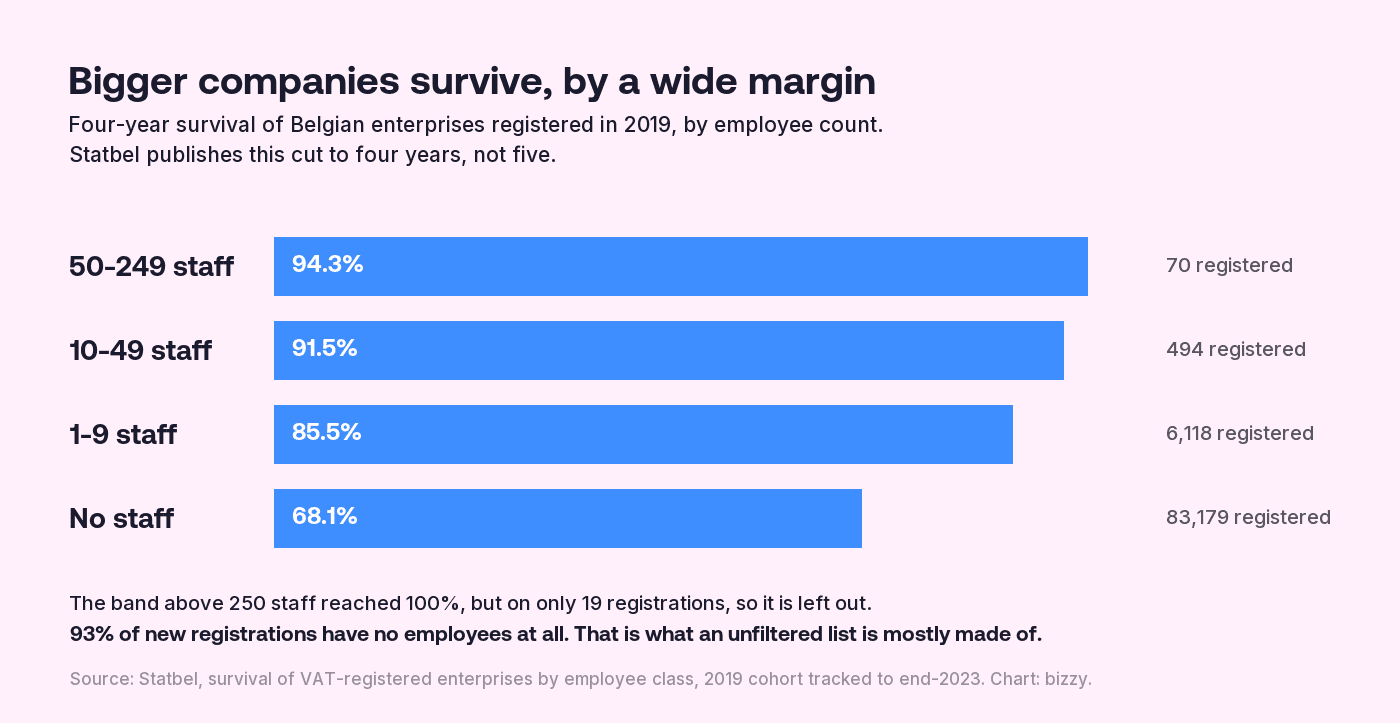
Headcount belongs in that profile for a reason beyond deal size. Of the Belgian enterprises registered in 2019, 68.1% of those with no employees were still active four years later, against 85.5% with one to nine staff and 91.5% with ten to forty-nine (Statbel). Since 93% of new registrations have no employees at all, an unfiltered Belgian list is mostly made of the least durable segment.
Step 2: build an up-to-date list
Translate the profile into filters: NACE code, province, headcount band, revenue band, founding date. Belgian registers are your friend here: every active enterprise is in the Crossroads Bank for Enterprises (KBO), every company with a filing obligation has annual accounts at the National Bank, and every incorporation, board change or move appears in the Belgian Official Gazette. Later in this guide you will find which sources are free. What matters: build the list from a source that is updated daily, not from last year's Excel file.
Step 3: research and enrich
Per company you want to know three things before you make contact: who decides, what is happening now and whether the company is financially healthy. Hiring, a new director, a capital increase or a move are reasons to call now. Declining solvency is a reason not to. This is the step that costs the most time when done manually, and the step that tools take over best.
Step 4: qualify before you invest
Not every company on the list deserves a conversation. Qualify on four questions: is there a problem we solve, is there budget, who decides, and when? Do that first on data, then in the first conversation. A prospect who drops out after two questions costs you ten minutes. A prospect who drops out after three meetings costs you a week.
Step 5: approach through more than one channel
Choose per prospect the channel that fits the role and the sector, and combine. The owner of a construction company picks up the phone; a marketing director at a software company reads LinkedIn. The methods and their numbers are in the next chapter. One rule applies everywhere: the first sentence is about them, not about you. Not "We are Bizzy and we help companies grow", but "I saw you are hiring two account managers for Antwerp this month; how do they build their first lists?"
Step 6: follow up and measure
Most meetings do not come from the first contact. RAIN Group found in a survey of 489 sellers that it takes an average of eight touches to get a meeting, that top performers do it in five, and that those top performers book 52 meetings per 100 contacts against 19 for the rest (RAIN Group). Whoever stops after two attempts leaves most of their meetings on the table. Record per step what you measure, from numbers dialled to meetings booked, so you know where the process leaks. That returns in the chapter on measurement.
Want to see this process condensed into five practical tips? Read 5 practical tips for prospecting that actually move the needle.
Prospecting methods in 2026: what works, with numbers
No single method wins everywhere; phone and email still deliver meetings if you combine them and time them well. Below are the five methods we see most often at Belgian B2B teams, with what the data say about them.
Method | Works best for | What the numbers say | Main pitfall |
|---|---|---|---|
Phone prospecting | SMEs, owner-managers, sectors where the phone is still answered | Two in three daily callers convert 2 to 10% of conversations into a meeting; 93% of the conversations you get, you get within three attempts | Giving up after one attempt |
Email prospecting | Roles that do not call, follow-up, larger volumes | 4.5% reply on average; a sequence of three emails gets 6.8% versus 3.3% for a single email | Mass mail without personalisation |
LinkedIn and social selling | Knowledge professions, marketing, IT, HR | No reliable public benchmark; works as preparation and follow-up | Selling in the first connection |
Network and referrals | Every sector, especially SMEs | Warmest entry; UNIZO puts it above the "cold calling round" | Not asking for referrals systematically |
Trade fairs and events | Sectors with physical products, construction, industry | Many contacts in one day, low qualification on the spot | No follow-up within 48 hours |
Phone prospecting

Cold calling is not dead, but it is a game of volume, timing and persistence. In HubSpot's State of Cold Calling 2025 (379 sales professionals), 52% call it "somewhat effective", 16% "very" and 4% "extremely effective", 72% combined; 68% work at an organisation that calls. Of those who call daily, 35% convert 2 to 5% of conversations into a meeting and 32% convert 6 to 10%; the surveyed callers pick Tuesday and the 10 to 12 o'clock slot as the best moment (HubSpot, 2025). Cognism's 2025 calling report based on dialer data shows why persistence pays: 93% of the conversations that eventually happen occur within the first three attempts, and 98.6% within five (Cognism, 2025). The same source puts Tuesday and the 10 to 11 and 14 to 15 o'clock slots as the best moments.
What you say matters too. Gong analysed 90,380 cold calls and found that a call in which the caller immediately states the reason for calling succeeds more than twice as often (Gong; research from 2018, but with an exceptionally large sample). How to run that conversation, with ten questions that work, is in the sales conversations cheat sheet.
Email prospecting
Hunter analysed 31 million emails its own users sent in 2025, a self-selected sample: 4.5% replies on average, 30% opened, 3.6% bounced. A sequence of three emails achieved 6.8% replies versus 3.3% for a single email; emails with two personalised elements achieved 5.6% versus 3.6% without; campaigns to 21 to 50 recipients achieved 6.2% versus 2.4% for campaigns to more than 500 (Hunter, 2026). The lesson is the same as on the phone: small, targeted and persistent beats large and generic.
LinkedIn, network and events
For LinkedIn there is no independent benchmark that stands up, so we promise no numbers. What works is using LinkedIn for what it is good at: finding out who decides, finding a reason for contact and preparing a conversation. Network and referrals remain the warmest entry; UNIZO, in its advice to SMEs, explicitly puts the warm network above the cold calling round (UNIZO, March 2026). Trade fairs deliver many contacts in one day, but only if you follow up within 48 hours.
Timing: prospecting on buying signals
The difference between a cold and a warm list is a reason to call now. We call that reason a buying signal: a public event indicating that a company is on the move.
The most important signals for Belgian prospecting are:
Incorporation: a new company still has everything to choose, from accountant to software. There were 128,147 of them in 2025.
Vacancies: a company looking for three salespeople is growing and needs tools. Whoever is looking for a first HR employee will soon choose an HR partner.
Board change: a new CEO or CFO reviews suppliers in the first hundred days. Every appointment is in the Belgian Official Gazette.
Capital increase or funding: budget being released.
Move or new site: new fit-out, new contracts.
Website visit: a company looking at your pricing page is further along than a company you have never seen.
Why this matters so much lies in the buyer behaviour above: if 94% of buying groups already have a preference before first contact, you need to be there when the need arises, not three months later. Signals are the only way to see that moment without working inside the company. The effect of this kind of intent data is hard to measure independently; a frequently cited figure comes from a study Forrester conducted for Bombora, reporting 18% higher conversion and 30% higher sales velocity for a composite model organisation (Bombora, 2022). Read that as direction, not as a promise.
How Bizzy bundles those signals from registers, vacancies and website visits is on the signals page. How AI takes over the research is in prospecting with AI.
What is allowed in Belgium? Prospecting and the law
You may use company data from public registers; for personal data and for email and phone, extra rules apply, and they became stricter in 2026. This chapter is a summary of official sources and not legal advice.
Personal data and the Data Protection Authority
The Belgian Data Protection Authority (GBA) states that processing data for direct marketing can be based on legitimate interest. Three conditions apply: the interest is genuinely legitimate, the processing is necessary, and the balancing test comes out in favour of the controller, taking into account what the data subject reasonably expects. The right to object must be offered from the first contact. It must be simple and effective and lead to cessation (Data Protection Authority). Its Recommendation 01/2025 on direct marketing was put out for public consultation in spring 2025 and published in its final version on 28 April 2026. It replaces the 2020 recommendation and explicitly brings communication to persons in their professional capacity under direct marketing (Data Protection Authority). B2B is therefore not a free pass: the contact person at a company remains a natural person with rights.
Email: legal person or individual?
For advertising by email, Belgium applies an opt-in: without prior consent it is prohibited (article XII.13 of the Code of Economic Law). The Royal Decree of 4 April 2003 provides two exceptions: existing customers for similar products, and addresses of legal persons. The FOD Economie explains that you may send unsolicited email to addresses that clearly only concern the legal person, such as info@ or sales@, but not to an employee's personal work address without consent, and that the burden of proof lies with the sender (FOD Economie). In practice, cold email to firstname.lastname@company.be in Belgium therefore requires prior consent; relying on legitimate interest under the GDPR changes nothing about that.
Calling: the do-not-call list also applies to companies
Unlike many salespeople think, companies can also put their number on the Belgian do-not-call list. Telemarketers must consult the list and remove registered numbers. Those who do not risk fines up to 80,000 euros (Do Not Call Me; FOD Economie). A bill prohibiting calling consumers without prior consent has been in the Chamber since October 2025 and had not been adopted at the time of writing (Belgian Chamber). If you also prospect in the Netherlands: an opt-in has applied there since 1 July 2021 for consumers and for businesses without legal personality, such as sole traders and partnerships, and in May 2025 the government announced a further tightening due to take effect on 1 July 2026 (Rijksoverheid). Check whether that rule is in force before you call.
Practically: document your legal basis in your processing register, offer a simple opt-out at every contact, check the do-not-call list before you call, and for email to individuals take the consent route.
Measuring prospecting: the numbers that count
Measure activity, reach, conversations and meetings separately; only then do you see where the process leaks. In our experience most teams only measure the end, the number of meetings, and then do not know whether the problem is in the list, the message or the follow-up.
Step | What you measure | Reference point |
|---|---|---|
List | Share of the list that fits your ideal customer profile and is still active | 100% active: check the list monthly against Statbel's bankruptcies and closures |
Reach | Share of calls that become a conversation; share of emails opened | Cognism: 93% of conversations within three attempts; Hunter: 30% opened |
Conversation | Share of conversations that become a meeting; share of emails that get a reply | HubSpot: 2 to 10% for two in three daily callers; Hunter: 4.5% reply, 6.8% with a sequence of three |
Meeting | Meetings per 100 contacts | RAIN Group: 52 for top performers, 19 for the rest |
Persistence | Touches per meeting | RAIN Group: 8 on average, top performers 5 |
Time | Share of the week that goes to conversations | Salesforce: 30% selling, 70% other tasks |
Sources: Cognism, Hunter, HubSpot, RAIN Group, Salesforce, checked on 8 September 2026. The reference points are international; use them to read your own trend, not as a norm for the Belgian market.
The most important ratio is not in the table: meetings per hour of prospecting time. If that rises while you call less, you are doing something right. Usually that comes from a better list, not a better script.
The five mistakes Belgian teams make most
The biggest mistake is not calling badly, but working without structure. UNIZO sums it up: prospecting is the engine of growth, but it takes time, discipline and structure; the classic SME mistakes are no structure, a vague value proposition and ad-hoc selling (UNIZO, March 2026). These are the five mistakes we see most in practice:
Prospecting from an outdated list. With 116,930 closures in 2025, of which 11,685 bankruptcies, against more than 1.2 million active enterprises, almost one in ten Belgian companies disappears from your list every year.
Approaching everyone in the sector. Without an ICP, half of your list would never have become a customer, and it costs as much time as the good half.
Stopping after two attempts. Eight touches is the average; two is giving up.
Working cold only. Whoever does not use signals calls companies that have no reason to listen.
Prospecting as a sprint. One week of hard calling and then three months of nothing gives a pipeline with gaps. An hour a day beats a day a month.
Free Belgian data sources and the tools that go with them
Everything you may publicly know about a Belgian company is in five free sources. Tools add speed, contact details and signals.
Source | What you get | Good for |
|---|---|---|
Every active enterprise: company number, legal form, status, establishments, NACE activities | Does the company still exist and what does it do? | |
All annual accounts filed since 1999 | Size, headcount, equity, financial health | |
Incorporations, appointments, capital increases, moves, dissolutions | Buying signals: who is changing director or address? | |
Live Flemish vacancies per company (for Wallonia and Brussels: Forem and Actiris) | Growth signal: who is hiring, and for which role? | |
Weekly bankruptcies, monthly incorporations and closures by NACE and municipality | List hygiene and market size per region |
These sources are free and complete, but they are built to look up one company, not to compare five hundred, find contact persons or spot a change without looking every day. That is where tools begin. Which Belgian and European tools do what and what they cost, from Companyweb to Bizzy, is in our comparison of Belgian prospecting tools. How to translate that into European leads without the compliance drama is in how to find quality B2B leads in Europe.
Getting started: a prospecting plan for your first week
Start today with one sentence: "Our best customers are companies that ..." Finish that sentence with sector, size and the moment they became customers. That is your ICP in rough form.
Day 1: write out your ICP and check it against your five best customers of last year.
Day 2: build a list of fifty companies that meet it, from a source updated this month. Remove what is bankrupt or closed.
Day 3: find one reason per company to make contact now: a vacancy, a new director, a move. No reason? Onto the list for later.
Day 4: approach the first twenty through the channel that fits the role, with a first sentence that is about them. Check the do-not-call list first.
Day 5: follow up with those who did not respond, note per company the step where it stopped, and count your meetings per hour.
After a week you do not have a pipeline, but you do have a measurement. After a month you know which sector, which signal and which channel work for you. That is more than most teams know after a year.
Frequently asked questions about prospecting
What exactly is prospecting?
Prospecting is the process by which a company actively identifies, approaches and qualifies potential customers. The difference from waiting for inbound requests is the initiative: you decide who you approach, based on a customer profile and, in the best cases, a concrete signal that the company is on the move.
What is the difference between prospecting and acquisition?
In Flanders, prospecting (prospectie) means finding and qualifying new customers. Acquisition (acquisitie) is the Netherlands-Dutch word for the same activity, split into cold and warm acquisition. In Belgium acquisition is more often used for the takeover of a company. If you are looking for information about finding new customers, use prospecting.
What is the difference between a lead and a prospect?
A lead has shown interest itself, for example by filling in a form, but does not necessarily fit your target group. A prospect is a company you select because it fits your customer profile; after qualification on need, budget and decision authority it becomes an opportunity. A lead can become a prospect; a prospect can come from outbound without ever having been a lead.
How much time should you spend on prospecting per week?
There is no Belgian norm. What the numbers do show is that salespeople spend on average 70% of their time not selling (Salesforce, 2024), and that regularity matters more than volume: a fixed block per day beats a sprint per month. Start with an hour a day and measure meetings per hour.
Is cold calling still effective in 2026?
Yes, as part of a mix and with persistence. In HubSpot's 2025 survey, 72% of the 379 sales professionals call cold calling at least somewhat effective (52% somewhat, 16% very, 4% extremely), and two in three daily callers convert 2 to 10% of conversations into a meeting (HubSpot). The return rises sharply if you call on a signal and do not give up after three attempts.
Can you cold call companies in Belgium?
Yes, with two conditions. You must consult the do-not-call list, because companies can register too, and you must respect objections to further contact. Fines can reach 80,000 euros. For consumers a stricter opt-in scheme is before the Chamber; for companies opt-out still applies at the time of writing. Document your legal basis and offer an opt-out at every contact. This is not legal advice; see the chapter on the law.
Can you send unsolicited emails to companies?
To general addresses of a legal person, such as info@ or sales@, yes. To an employee's personal work address, not without prior consent, unless it is an existing customer. That is how the FOD Economie explains article XII.13 of the Code of Economic Law and the Royal Decree of 4 April 2003. The burden of proof lies with the sender. This is not legal advice; see the chapter on the law.
How many follow-up emails should you send?
Hunter's analysis of 31 million emails shows that a sequence of three emails yields roughly twice as many replies as a single email. RAIN Group counts an average of eight touches, across all channels combined, for a meeting. Three to five follow-ups across phone and email combined is a defensible standard; stop as soon as someone objects.
What is the best time to call?
Cognism's calling report (dialer data) and HubSpot's survey (what callers themselves choose) both point to Tuesday. Cognism sees 10 to 11 and 14 to 15 o'clock as the best slots; HubSpot's surveyed callers choose 10 to 12 (Cognism; HubSpot). Test it for your sector: you reach a construction company early in the morning, an office after lunch.
How do you find companies in Belgium to prospect?
Free of charge via KBO Public Search, the National Bank's Central Balance Sheet Office, the Belgian Official Gazette, VDAB's vacancy database and Statbel's open data. Those sources show every company, its figures and its changes, but one at a time. Prospecting tools bundle the same registers, add contact persons and signals, and let you filter hundreds of companies at once.
In closing
Prospecting in Belgium in 2026 is not a matter of calling harder. It is a matter of choosing the right companies, at the right moment, with a reason that is about them, within the rules set by the Data Protection Authority and the Code of Economic Law. The market gives you material for that every day: hundreds of incorporations, appointments and vacancies. Whoever reads those signals prospects warm in a cold market.
Want to see which companies in your ideal customer profile are giving a signal today? Book a demo or first compare the Belgian prospecting tools yourself.
Read next: the best B2B prospecting tools for European sales teams and how to generate B2B leads in Europe.
Read next: is B2B cold outreach legal in Europe? The rules for Belgium, the Netherlands and Germany, channel by channel.
Read next: how to search the Belgian Official Gazette and B2B cold calling in Europe.
Read next: how to check an EU VAT number and is this company financially healthy?
Read next: How to check whether a Belgian company is bankrupt, and Belgian bankruptcies in numbers.
Read next: How to find newly founded Belgian companies.