The short answer
Lusha and Bizzy solve different problems. Lusha is a global contact database with a browser extension: 290 million-plus contacts, published prices from US$37.45 a month, and a workflow built around revealing an email address or phone number while you browse. Bizzy is a European company-data platform: Belgian register data, other European countries through Creditsafe data, buying signals and a lead generation agent, with contacts attached to the companies rather than the other way round.
If your reps live in LinkedIn and need contact details fast, at a known price, Lusha is the more direct tool. If your market is European SMEs and mid-market companies and you need to know which companies exist, which fit, and when to call, Bizzy is built for that job.
Two things a European buyer should weigh before either: Lusha publishes its European coverage (42.8 million contacts, with figures for seven countries), and it carries a €2 million fine and a ban on processing data about people in Italy, imposed by the Italian regulator in July 2026. Bizzy is our product; every figure below comes from the two companies' own websites and from regulators, checked between 8 and 11 September 2026, with sources linked. This is not legal advice.
At a glance
Bizzy | Lusha | |
Built on | Official company registers for Belgium, Creditsafe data for other European countries, plus websites and vacancies | Contact database from "first-party contributions, community-sourced updates, and trusted vendors" |
Scale published | Deepest in Belgium | 290 million-plus contacts across 239 countries and territories; 29 million-plus companies |
European coverage published | Belgium from the registers, other countries through Creditsafe data; no per-country company count | 42.8 million European contacts; UK 9.8M, France 5.6M, Germany 4.3M, Netherlands 2.7M, Switzerland 1.2M |
Contacts and phone numbers | Decision-maker contacts and LinkedIn profiles on company records; no volume published | Core product; 1 credit per email, 5 per phone number; 86% phone accuracy claimed |
Timing signals | 7 signal types incl. hiring surges, funding, leadership changes, website visits | "24 real-time signals" incl. funding, hiring surges, leadership changes; ICP scoring; lookalikes |
Workflow | Lead generation agent, 54+ filters, CRM push, Chrome extension, API | Chrome extension, search, API, CRM and Clay integrations |
Regulator record | None found | Garante (Italy) €2M fine and processing ban, 14 July 2026; CNIL (France) found the GDPR not applicable to the extension, December 2022 |
Data location stated | Primarily stored on servers in the EU | Not stated on its GDPR page |
Price | Free start; Core, Boost, Scale on request | Free 40 credits a month; Starter US$37.45, Professional US$52.45, Premium US$299.95 a month on annual billing |
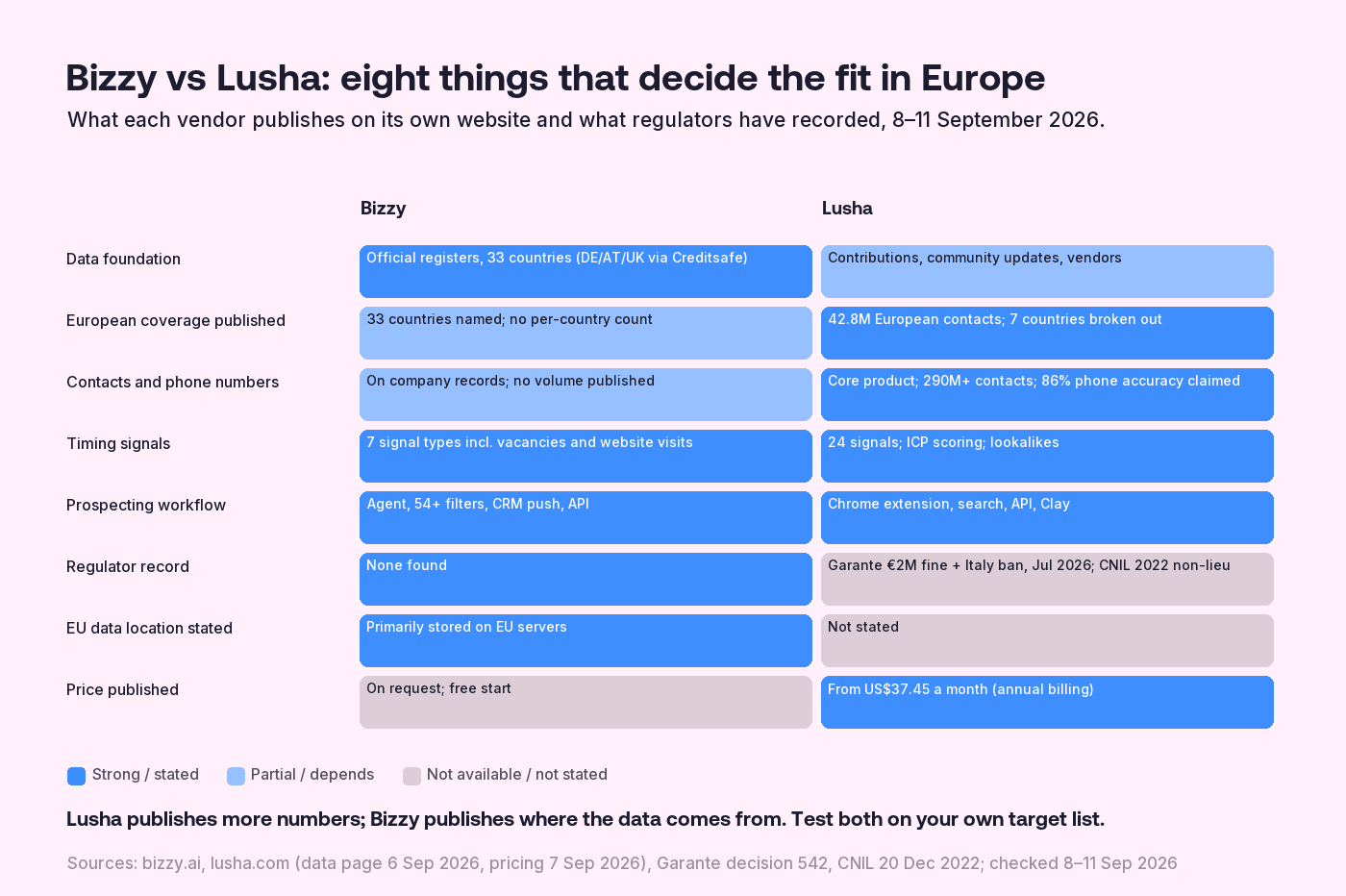
What each is built on
The difference that explains everything else is where the first record comes from.
Lusha starts from the person. Its data page says the database "combines first-party contributions, community-sourced updates, and trusted vendors", that "every record is validated to ensure accuracy and freshness", and that it "never scrape[s] professional networks or social platforms". It claims 290 million-plus contacts across 239 countries and territories, with up to 77 data fields, 29 million-plus companies, 98% email accuracy and 86% phone accuracy, and daily refreshes (Lusha data, updated 6 September 2026; Lusha). Those accuracy figures are Lusha's own; the page does not say how "verified" is measured.
Bizzy starts from the company. It builds its Belgian company data from the official registers, then adds company websites, LinkedIn profiles, job openings tracked through PredictLeads (plus VDAB vacancies in Belgium), and credit scores and limits from Creditsafe (Bizzy). For every other country, the Netherlands, Germany, Austria and the United Kingdom among them, the company data is supplied through Creditsafe (Bizzy). Contacts sit on the company record; Bizzy publishes no count of them.
Why it matters in Europe: 99% of the EU's 33.1 million enterprises are micro or small businesses (Eurostat), many of them with little or no LinkedIn presence, and a register lists them whether or not anyone has ever contributed a business card. A contact-first database is only as complete as the people who have passed through it. That is not a flaw in Lusha; it is what a contributor-and-vendor model produces, and Lusha publishes the result, as the next section shows.
European coverage: what each publishes
Lusha publishes a regional and country breakdown, and it is worth reading closely. Of its 290 million-plus contacts, 105.4 million are in North America (87.8 million in the United States) and 42.8 million in Europe. The European countries it breaks out are the United Kingdom (9.8 million), France (5.6 million), Germany (4.3 million), Spain (2.7 million), the Netherlands (2.7 million), Italy (2.4 million) and Switzerland (1.2 million); Belgium and Austria are not listed separately (Lusha data). So Europe is about 15% of the database, Germany about 1.5%, and for Belgium you would have to ask.
Bizzy sources Belgium from the official registers and says that every other country, Germany, Austria, the UK and the Netherlands among them, comes through Creditsafe data; it publishes no company count per country, so for your markets you also have to ask. Neither vendor publishes a European phone-number count.
The honest reading: on people in the large European markets, Lusha has published numbers and Bizzy has not. On companies, Bizzy is built from the Belgian registers that define which companies exist there, and from Creditsafe data elsewhere; Lusha publishes 29 million companies but does not say where they come from. Run both on a sample of your own target list before you sign; coverage can differ widely between a German industrial SME and a Dutch SaaS scale-up.
Contacts and phone numbers
This is Lusha's home ground. The browser extension reveals email addresses and phone numbers while you browse; the CNIL described it in 2022 as working on LinkedIn and Salesforce, and Lusha's current pages do not name the sites (CNIL). The search platform lets you filter contacts, and every reveal costs credits: one for an email address, five for a phone number (Lusha pricing). The 86% phone-accuracy claim means, taken at face value, that roughly one number in seven does not connect to the person named; budget the credits accordingly.
Bizzy attaches decision-maker contacts to company records and pushes them into your CRM, but it publishes no contact or phone-number count. If your outbound is mostly cold calling, that is the number to test in a trial before you commit; until your own sample says otherwise, Lusha's published figure is the only one on the table. For a wider comparison of phone-data vendors, including Cognism's phone-verified figures, see the best B2B prospecting tools for European sales teams.
Timing: signals and qualification
Both tools now sell timing, and the marketing language is similar. Lusha's homepage describes "24 real-time signals" such as "funding events, hiring surges, leadership changes", plus ICP scoring, lookalike companies and territories, an API, and a connection to "Claude, ChatGPT, or any MCP-compatible AI assistant" (Lusha). Bizzy tracks seven signal types, including hiring surges, funding rounds, leadership changes and website visits, and lets you set alerts on them (Bizzy Signals); its lead generation agent takes an ideal customer profile in plain language, researches and qualifies companies continuously and delivers a prioritised list every week (Bizzy).
The difference is the universe the signals run over. Lusha's run over its 29 million-plus companies; Bizzy's run over its company data, register-sourced in Belgium and from Creditsafe elsewhere, and they include vacancies tracked through PredictLeads and, in Belgium, from VDAB. If your pipeline depends on spotting a 40-person Flemish manufacturer the week it posts three vacancies, test whether each database has the company at all.
The compliance record
This is the section European buyers ask about, so here is the public record, without adjectives.
Italy, 2026. On 14 July 2026 the Italian data protection authority (Garante) fined Lusha Systems Inc. €2 million, banned it from processing personal data of people in Italy and ordered the data erased. The authority found that legitimate interest was not an adequate legal basis for Lusha's data brokering, and that the GDPR applied under its monitoring criterion even though Lusha has no EU establishment, because Lusha "does not merely collect professional information but also updates and monitors it over time" (our translation); it cited failures of transparency, lawfulness, fairness and data minimisation (Garante, decision no. 542). Lusha's GDPR page does not mention the decision.
France, 2022. On 20 December 2022 the CNIL's sanctions committee closed a case against Lusha without penalty, finding that the GDPR did not apply to the browser extension: Lusha had no establishment in the EU, and the extension was not tied to an offer of goods or services to the people whose data it revealed (CNIL). The two regulators reached different conclusions on territorial scope by applying different tests to different objects: the CNIL tested establishment and the offer of goods or services for the extension and found neither met; the Garante applied the monitoring criterion to the database and found it met. The Italian decision is the more recent and stands unless overturned on appeal.
What Lusha says. Its GDPR page states that it collects business contact data from public sources, notifies contacts "as required by Article 14", offers a self-serve tool for access, erasure and rectification, and holds ISO 27001, ISO 27018, ISO 27701 and SOC 2 Type 2 certifications plus the TRUSTe and ePrivacy seals (Lusha GDPR). It does not state where data is processed or which legal basis it relies on.
What its customers say. Lusha's Trustpilot score is 1.2 out of 5 across 774 reviews as at 10 September 2026, 57% of them one star, largely about deletion requests and auto-renewals (Trustpilot).
Where Bizzy stands. Its Belgian company data is traceable to the official registers and other countries come through Creditsafe data; data is primarily stored on servers in the EU, and do-not-call cross-checking is available where the law requires it, such as Belgium and the Netherlands (Bizzy GDPR). Two concessions: Bizzy lists no ISO or SOC 2 certification on its website, where Lusha lists four, and it has too few public reviews to quote a meaningful score.
What it means for you. Whichever tool you buy, you are the controller for the outreach you do with the data, and the rules differ by country; our guide to generating B2B leads in Europe sets out the rules for six countries with sources. Lusha's Italian ban is the vendor's problem; using an Italian contact you exported from it before July 2026 is yours.
Workflow and integrations
Lusha is a layer over the places reps already work: the Chrome extension, a search platform with ICP scoring, lookalikes and territories, and an integration marketplace that lists Salesforce, HubSpot, Pipedrive, Zoho CRM, Bullhorn and Capsule for CRM, Salesloft, Outreach and Gong for engagement and revenue intelligence, and Clay and Zapier for data workflows, alongside the API (Lusha integrations).
Bizzy is a workspace with an agent. You brief the agent on your ideal customer, it delivers a researched, prioritised list weekly, and company and contact records push into HubSpot, Salesforce, Pipedrive, Microsoft Dynamics 365, Teamleader Focus and Odoo, and into Lemlist and La Growth Machine for sequences, with a Chrome extension and an API (Bizzy integrations). For email sequences Bizzy relies on the tools it connects to.
If your motion is "find the person on LinkedIn, get the number, call", Lusha's extension is the shorter path. If your motion is "which of the 50,000 companies in my territory should we work this week", Bizzy's agent is.
Pricing
Lusha's pricing page, updated 7 September 2026, lists prices in US dollars (Lusha pricing):
Plan | Monthly billing | Annual billing (per month) | Credits |
Free | US$0 | – | 40 a month |
Starter | US$49.90 | US$37.45 | 400 a month, or 4,800 a year on annual |
Professional | US$69.90 | US$52.45 | 600 a month, or 7,200 a year on annual |
Premium | US$399.90 | US$299.95 | 3,400 a month, or 40,800 a year on annual |
An email costs one credit and a phone number five. On monthly plans unused credits roll over up to twice the plan limit; on annual plans all credits are issued upfront and unused ones reset at year end. Teams larger than five users are asked to contact sales, and custom plans exist. In practice a Starter subscription on annual billing has 4,800 credits a year: 4,800 email addresses, or 960 phone numbers, or a mix.
Bizzy does not publish prices: there are three plans, Core, Boost and Scale, a free start without a credit card, and the number comes from a conversation (Bizzy pricing). That is a real disadvantage when you are comparing on a spreadsheet, and we say so; the trade is that you are pricing a company universe, signals and an agent rather than credits per reveal.
Verdict per use case
Reps who live in LinkedIn and need contact details now: Lusha. The extension is the shortest path from profile to phone number, the price is published, and the free plan lets you test it this afternoon.
US-led or global outbound on a small budget: Lusha, once you have counted the credits; 87.8 million US contacts and published prices are exactly what a US-led team wants.
European SMEs and mid-market, Benelux first: Bizzy. Register-sourced company coverage in Belgium, the Netherlands through Creditsafe data, vacancies from VDAB, signals and the agent in one workflow.
Germany and DACH: test both. Lusha publishes 4.3 million German and 1.2 million Swiss contacts; Bizzy's German and Austrian company data comes through Creditsafe and it publishes no German count. Run a German sample of your target list through each.
Cold calling as the main motion: compare phone coverage for your segment in a trial of each. Lusha publishes contact counts and an accuracy figure but no phone-number count; Bizzy publishes neither. Neither publishes a phone-verified contact count the way Cognism does for its Diamond Data (Cognism).
Compliance-first buying in the EU: Bizzy's register provenance in Belgium and EU storage are the cleaner story; Lusha's certifications are broader on paper, but the Italian ban is on the record and its data location is not.
Both: plenty of teams use a register-based tool to decide which companies to work and a contact tool to fill gaps. If that is you, keep the do-not-call and objection checks in one place.
Read next: Lusha alternatives for European sales teams
Frequently asked questions
Is Lusha GDPR compliant?
Lusha says it complies, notifies people under Article 14 and offers self-serve erasure, and it holds ISO 27701 and other certifications. The Italian regulator disagreed on 14 July 2026, fining it €2 million and banning it from processing data about people in Italy; the French regulator had found in December 2022 that the GDPR did not apply to its extension at all. Compliance for your outreach is your responsibility as controller whichever tool you use.
Is Lusha banned in Italy?
The Garante banned Lusha Systems Inc. from processing personal data of people in Italy and ordered erasure, in decision no. 542 of 14 July 2026, alongside a €2 million fine. That binds Lusha, not its customers, but any Italian contacts you hold from it deserve a review of your own legal basis.
How much does Lusha cost in Europe?
Lusha's pricing page lists prices in US dollars: Starter US$37.45, Professional US$52.45 and Premium US$299.95 a month on annual billing, or US$49.90, US$69.90 and US$399.90 on monthly billing, with a free plan of 40 credits a month. One credit reveals an email address, five a phone number.
Does Bizzy have Lusha's contact data?
No. Bizzy attaches its own decision-maker contacts to its company records (register-based in Belgium) and publishes no contact count; Lusha publishes 290 million-plus contacts, 42.8 million of them in Europe. If contact volume is the deciding factor, test Bizzy's coverage for your segment before you decide.
Can I use Bizzy and Lusha together?
Yes, and some teams do: Bizzy to build and prioritise the company list from register and Creditsafe data and signals, Lusha to fill contact gaps on the accounts that matter. Keep one suppression list across both, and apply the per-country outreach rules to whatever you export.