The short answer
Generating B2B leads in Europe is a six-step system: define your ideal customer per country, build your company universe from official registers, add contacts and buying signals, pick the outreach channel each country's law allows, run outreach as a repeatable sequence, and measure to the qualified opportunity. The steps are the same everywhere. What changes in Europe is the raw material and the rules: every country keeps a public company register you can build from, and every country sets its own limits on cold email and cold calls.
That second point is where most playbooks written for the US break. A cold email without prior consent is possible to a named employee in France and to a generic company address in Belgium; in the Netherlands, Germany, Austria and Switzerland a first cold email to a business generally needs consent. This guide walks through the six steps with the sources, the registers and the rules for Belgium, the Netherlands, Germany, France, Austria and Switzerland, checked on 10 September 2026. Bizzy is our product and appears where it is relevant; the steps work with any tooling. This is not legal advice.
Why Europe needs its own playbook
Three facts shape B2B lead generation in Europe.
The market is overwhelmingly small companies. Of the roughly 33.1 million enterprises in the EU's business economy in 2023, 99% were micro or small enterprises with fewer than 50 people, and together they employed almost half of the business economy's workforce (Eurostat, 13 October 2025). Germany's statistical register counted 3.5 million legal units in 2024, 84% of them with fewer than ten employees (Destatis). The Dutch Business Register held 2,599,668 establishments on 1 January 2026, 1,788,559 of them sole traders (KVK). Belgium had 1,215,958 active VAT-registered enterprises in June 2026 (Statbel). A large share of any European target list is therefore owner-managed businesses with thin LinkedIn profiles and no marketing department, which is exactly where contact databases built from social profiles run out.
Every country publishes a company register. Legal name, registration number, legal form, address, activity code, directors and, in most countries, filed annual accounts are public record. That is a lead source American teams do not have at this quality, and it is the reason a register-first approach works in Europe.
One GDPR, many outreach laws. The GDPR governs how you process a person's data, and its Recital 47 says that "the processing of personal data for direct marketing purposes may be regarded as carried out for a legitimate interest", subject to a careful assessment of what the person can reasonably expect (GDPR Recital 47). But whether you may send that person a cold email or call them is set country by country, under national rules that implement the ePrivacy directive. Those rules are the subject of step 4.
Step 1: Define your ideal customer per country
Start with the profile, not the list. An ideal customer profile (ICP) for Europe is a set of company-level criteria you can actually filter on, and the useful ones are the ones the registers hold: legal form, activity code (NACE), size class, founding year, region, and, where accounts are filed, turnover, equity and headcount.
Two rules make the profile work across borders:
Write one ICP per country, not one for "Europe". Legal forms differ (a Belgian BV, a Dutch BV and a German GmbH are cousins, not twins), size thresholds differ, and what is public differs. A Belgian company's annual accounts are free to read; a Dutch sole trader files nothing. If your ICP relies on a financial filter, check that the filter exists in each register you plan to use. Our guide to reading a Belgian company's annual accounts shows what the Belgian filings give you.
Decide up front which legal forms you are allowed to contact, and how. In the Netherlands, calling a sole trader now requires prior consent while calling a BV does not; in Belgium, emailing info@ at a legal person is permitted while emailing a named employee cold is not. The legal form column in your ICP is therefore also your channel column. Step 4 sets out the rules.
If you are unsure where a lead ends and a prospect begins, what is a lead? and lead qualification settle the vocabulary before you build the list.
Step 2: Build your company universe from official registers
Bought lists are quick and go stale fast; the Dutch Business Register alone recorded 194,057 closures in 2025, 7.5% of its establishments in a single year (KVK). The alternative is to build your universe from the registers themselves and refresh it against them.
Country | Register | What you get free | Notes |
Belgium | KBO/BCE Public Search; NBB Consult for annual accounts | Company data, activity codes, establishment units; annual accounts as PDF or XBRL | The most open register in this list. See the Belgian company register guide |
Netherlands | KVK Handelsregister | Search and basic details | Extracts and bulk data are paid; sole traders dominate the file |
Germany | Handelsregister.de; Bundesanzeiger for accounts | Register entries free since August 2022; published accounts | Sole traders (Einzelunternehmen) are largely absent from the Handelsregister |
France | INPI (data.inpi.fr) | Company data and filed accounts, free | Open data since 2023 |
Austria | Firmenbuch | Search | Extracts are paid via authorised clearing houses |
Switzerland | Zefix (central business name index) | Search across the cantonal registers, free | Cantonal registers hold the detail |
Working register by register is fine for one country and painful for six. This is the gap Bizzy was built for: it combines the official registers of 33 European countries into one database of more than 50 million companies, with company websites, LinkedIn profiles, vacancies and Creditsafe credit data layered on top (Bizzy). Be precise about what that means for Germany and Austria: in eleven of the 33 countries, Germany, Austria and the United Kingdom among them, the company data is supplied through Creditsafe (Bizzy), and Bizzy does not publish a company count per country, so ask for one for your markets.
If you do buy a list, buy it knowing what it is. Our guide to buying a Dutch business address list covers what a file contains, how fast it decays and what the law lets you do with it; Belgian prospecting tools compared covers the Belgian vendors.
Step 3: Add contacts and timing signals
A register tells you which companies exist. Two more layers turn that into leads: who to talk to and why now.
Contacts. For most European SMEs the decision-maker is the managing director or owner, and registers name them. For larger companies you will need role-based contacts from a data provider, and here the European caveats apply in full: ask where every contact record comes from, whether the provider screens do-not-call registers in your countries, and where the data is processed. Two of the best-known LinkedIn-extension vendors carry regulator records in 2026, and our roundup of B2B prospecting tools for European teams goes through nine providers on exactly those questions.
Signals. Timing beats volume. A company that has just posted three vacancies, raised money, changed its managing director or started visiting your website is a better lead than an identical company that has done none of those things. The useful European signals come from public sources: vacancies on company websites and job boards, register changes such as new directors or a new establishment, published accounts, funding announcements, and your own website traffic. Bizzy tracks seven signal types, including hiring surges, funding rounds, leadership changes and website visits, and lets you set alerts on them (Bizzy Signals); its lead generation agent takes an ICP in plain language and delivers a prioritised, researched list every week (Bizzy). The mechanics of running signals through a team's week are in automate your lead generation process.
Whatever tool you use, the test is the same: can you say, for each lead, which fact made it a lead this week? If the answer is "it matched the filter", you have a list, not a lead.
Step 4: Choose the channel each country's law allows
This is the step that decides whether your programme is a growth engine or a complaint generator. The table below is a summary of the public rules as they stood on 10 September 2026; the paragraphs that follow give the sources. It is not legal advice, and it does not replace your own counsel.
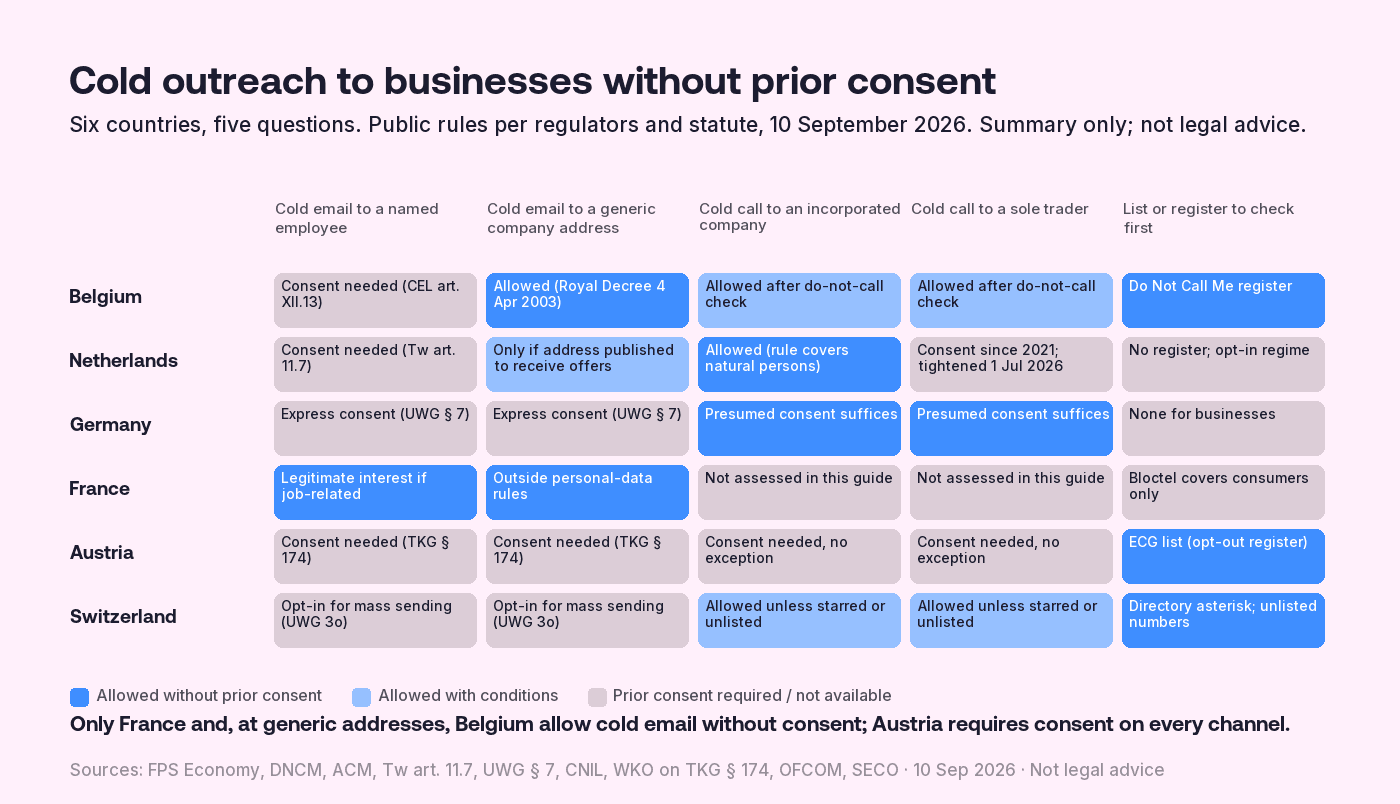
Belgium. Advertising by email is opt-in under article XII.13 of the Code of Economic Law. The Royal Decree of 4 April 2003 provides two exceptions: existing customers for similar products, and addresses of legal persons. The FPS Economy explains that you may send unsolicited email to addresses that clearly concern only the legal person, such as info@ or sales@, but not to an employee's personal work address without consent, and that the burden of proof lies with the sender (FPS Economy). For calls, Belgium runs a do-not-call register that companies can also join; callers must check it and remove registered numbers, with fines up to €80,000 (Do Not Call Me). A bill making calls to consumers opt-in has been before the Chamber since October 2025 and had not been adopted at the time of writing. On the GDPR side, the Belgian Data Protection Authority accepts legitimate interest as a basis for direct marketing, subject to a balancing test and a right to object offered from the first contact (Data Protection Authority). The full picture is in the prospecting guide for Belgium.
Netherlands. Stricter on email, and recently stricter on calls. Article 11.7(1) of the Telecommunications Act bans unsolicited commercial email without prior consent, and it has covered legal persons as well as individuals since 2009, so B2B is not exempt; the only business exception is for contact details the recipient has designated and made public specifically for receiving unsolicited commercial messages (Telecommunications Act art. 11.7). Calling consumers, sole traders and partnerships has required prior consent since 1 July 2021, and since 1 July 2026 the exception for current and former customers is gone too (ACM). Calling an incorporated company such as a BV is not caught by that rule. Given that almost seven in ten Dutch registrations are sole traders, the legal-form filter from step 1 does most of the compliance work here.
Germany. Section 7(2) No. 2 of the Unfair Competition Act (UWG) treats advertising by electronic mail without the addressee's prior express consent as unacceptable harassment, and it makes no exception for business recipients. Section 7(3) allows email to existing customers for similar products under four cumulative conditions. Calls are treated differently by recipient: to consumers only with express consent; to other market participants, meaning businesses, with at least their "presumed consent" (mutmaßliche Einwilligung), which in practice means a plausible business interest in the offer on the recipient's side (UWG § 7). In practice: cold calling a German company about something relevant to its business is possible; cold emailing it is not.
France. The most permissive of the six for B2B email. The CNIL states that prospecting professionals may be based on the legitimate interest of the sender "when the object of the solicitation relates to the profession of the person contacted", provided the person was informed that their details could be used for prospecting and can object simply at any time; generic addresses such as contact@ that concern a legal entity fall outside the personal-data rules altogether (CNIL, 10 June 2026).
Austria. The strictest of the six. Section 174 of the Telecommunications Act 2021 requires the recipient's prior, revocable consent for advertising calls, faxes and electronic mail, and the Austrian Chamber of Commerce notes that for calls "the consent requirement applies without restriction"; the existing-customer exception applies to email only, and even then the sender must check the ECG list (Austria's opt-out register) before sending. Fines run up to €50,000 for unsolicited email and €100,000 for unsolicited calls (WKO).
Switzerland. Not in the EU, with its own rules. Under article 3(1)(o) of the Unfair Competition Act, mass advertising by email, SMS or phone has been opt-in since 2007: the recipient must have agreed, the sender must be identifiable, and a free, simple opt-out must be offered, with no distinction between business and private recipients (OFCOM). The rule targets mass sending; an individually written message is a different case, and worth discussing with counsel. For calls, article 3(1)(u) protects numbers marked with an asterisk in the directory and, since 1 January 2021, unlisted numbers, with existing customers excepted (SECO).
What this means for your channel plan. Cold email to named people works as a first touch in France and, via generic addresses, in Belgium. In the Netherlands, Germany, Austria and Switzerland the first touch has to be something else: a call to the company where allowed (Germany, Dutch BVs, Belgium after the register check), a LinkedIn message, a letter, an inbound path, or a permission-based email. LinkedIn sits outside these laws but inside LinkedIn's own rules, and the extension vendors that pull contact details out of it have had a difficult two years with regulators; see the prospecting tools roundup for the record.
Step 5: Run outreach as a system, not a campaign
The teams that generate leads consistently in Europe do five unglamorous things every week.
One sequence per country and language. Belgium alone needs Dutch and French; DACH needs German with Austrian and Swiss variants. Write the sequence in the buyer's language and lead with a fact from their register entry or their signal, not with your product.
Channel by legal form and country. Tag every account with the channel step 4 permits, and let the sequence branch on the tag. A Dutch BV gets a call; a Dutch sole trader does not.
Suppression before sending. Do-not-call registers where they exist (Belgium, Austria's ECG list, the Swiss directory marker), your own objection list, existing customers, and competitors. Bizzy offers do-not-call cross-checking where the law requires it, such as Belgium and the Netherlands (Bizzy GDPR); whatever you use, keep the check inside the workflow, not in a spreadsheet.
CRM as the single record. Push company, contact, signal and channel into the CRM so the rep never re-keys anything; Bizzy pushes into HubSpot, Salesforce, Pipedrive, Microsoft Dynamics 365, Teamleader Focus and Odoo, and into Lemlist and La Growth Machine for sequences (integrations).
A weekly cadence. New leads arrive weekly, get worked within the week, and go back into the pool with a next-action date. A monthly list dump is where lead programmes go to die.
Step 6: Measure to the qualified opportunity
Count leads last. The chain to watch is companies in universe → companies matching the ICP → leads with a signal → contacts reached → conversations → qualified opportunities → pipeline, and the number that tells you whether the programme works is cost per qualified opportunity, by country. Volume metrics reward exactly the behaviour European law punishes.
Two Europe-specific measures belong on the dashboard. Data decay: in a register where 7.5% of establishments closed in a year, a list refreshed annually is materially wrong by autumn; measure bounce and wrong-number rates per country and refresh against the register on that cadence. Legal-basis coverage: what share of your contacts has a documented basis and channel? If you cannot answer, you cannot defend the programme. Lead scoring gives the qualification side of the measurement; the stages of your sales funnel the downstream side.
Where inbound fits
Outbound is the engine of this guide because it is the part European teams control. Inbound still matters, and two forms of it are specifically European. First, content in the buyer's language about the buyer's rules and registers: a German Mittelstand buyer searching in German will not find your English page. Second, website visitor identification, which turns anonymous visits from companies into a signal you can act on the same week; several tools in the prospecting roundup do this, and Bizzy counts website visits among its signal types. For the wider inbound-versus-outbound question in Europe, see inbound vs outbound marketing in Europe.
Tools, and where Bizzy fits
You can run the six steps with the registers, a CRM and a spreadsheet. Most teams do not, because six registers in six formats is a full-time job. The tools split into three kinds: register-first platforms (Bizzy, and Leadfeeder for its trade-register company database), contact databases (Cognism, Apollo, Lusha, ZoomInfo) and workflow layers (Clay, sequencers). We compare them in the best B2B prospecting tools for European sales teams and, for data only, in B2B data providers in Europe compared; the lead generation tools roundup covers the wider category.
Where Bizzy fits: steps 2 and 3, and the plumbing of step 5. It is built from the registers, adds the signals and the agent, and pushes into the CRM. What it does not do: it publishes no contact or mobile count, so test its contact coverage for your segment in a trial; it covers Europe only; and its pricing is by conversation, with a free start and three plans, Core, Boost and Scale (pricing).
Read next: is B2B cold outreach legal in Europe? The rules for Belgium, the Netherlands and Germany, channel by channel.
Read next: Generating leads: from a company list to a conversation.
Read next: B2B lead generation: what it is and which strategy fits your market.
Read next: Smart ways to increase B2B sales today.
Frequently asked questions
Is cold emailing businesses legal in Europe?
It depends on the country and the address. France allows B2B email on legitimate interest when the offer relates to the recipient's profession; Belgium allows it to generic legal-person addresses such as info@ but not to a named employee without consent; the Netherlands, Germany and Austria require prior consent for business recipients too, with narrow existing-customer exceptions; Switzerland requires opt-in for mass sending. The GDPR applies on top wherever you process a named person's data.
Can I buy a B2B lead list in Europe?
Buying is legal; using it is regulated. The file gives you no legal basis to email or call, so the same country rules apply as if you had built the list yourself, and in the Netherlands the regulator has said the spam rules bind suppliers of address files as well. Prefer register-sourced files with a stated source per record, check the decay rate, and see buying a Dutch business address list.
Do I need consent to cold call a company?
In Germany you need at least the company's presumed consent, meaning a plausible business interest in your offer; in Belgium you must check the do-not-call register first; in the Netherlands you may call an incorporated company but not a sole trader or partnership without consent; in Austria you need prior consent; in Switzerland you must respect starred and unlisted numbers. Rules for calling consumers are stricter everywhere.
Does the GDPR apply to B2B contacts?
Yes. A named person's work email, direct line and job title are personal data. The GDPR allows processing for direct marketing on legitimate interest after a balancing test, requires you to inform the person and to honour objections, and the national rules above decide which channels you may then use.
What is the difference between lead generation and prospecting?
Lead generation is the whole system that produces qualified companies and contacts, inbound and outbound; prospecting is the outbound part, where a rep researches and contacts specific accounts. This guide covers the system; the prospecting guide for Belgium covers the rep's work in one market in depth, and what is lead generation? covers the definitions.
How often should I refresh European lead data?
Against the register, and at least quarterly for lists that include sole traders. The Dutch register lost 7.5% of its establishments to closures in 2025, and turnover is higher among sole traders than among incorporated companies. Track bounce and wrong-number rates per country and let them set the cadence.
Master GDPR compliance without the complexity
GDPR compliance for B2B lead generation follows clear principles once you understand the framework.
Legitimate interest forms your legal basis. You can process business contact information when your offering directly relates to someone's professional role. A sales automation platform can contact sales managers. An HR tool can reach HR directors.
Always include transparent information about data sourcing and provide simple opt-out options in every communication. Document your legitimate interest assessment for each campaign type.
The most efficient approach uses platforms that handle GDPR compliance automatically. They source from verified European business databases, manage data processing requirements, and maintain audit trails. This removes compliance burden while ensuring you stay protected.
Remember: GDPR violations can cost up to 4% of global revenue. But compliance doesn't have to slow you down. Focusing on quality over quantity with the right tools and processes doesn’t just improve lead effectiveness; it accelerates the entire sales cycle. For instance, by automating tedious research, sales reps can save an average of 10 hours per week, freeing them up to focus on building relationships and closing deals. That efficiency leads to faster wins. For example, one AI-recommended could go from being identified to closing in only 56 days.
Transform your European lead generation today
European B2B lead generation rewards preparation and punishes assumptions. Success requires local market knowledge, cultural awareness, and tools built specifically for this complexity.
The best European sales teams spend their time building relationships and closing deals. They let intelligent platforms handle prospect identification, qualification, and enrichment across multiple markets simultaneously.
Ready to find quality European leads? Start by defining country-specific ICPs. Choose a GDPR-compliant lead generation platform built for Europe. Then focus on buying signals instead of static data.
The European market offers massive opportunity for B2B companies willing to do it right. Stop treating it like one market. Start treating it like the diverse, complex, and lucrative region it actually is.
FAQs about finding B2B leads in Europe
How quickly can I start generating European leads?
With proper ICP definition and the right platform, you can generate qualified leads within 48-72 hours. The key is using tools designed specifically for European markets, not generic global solutions. Most teams see their first meetings booked within the first week of implementation.
What's the real cost per lead in European markets?
Cost varies significantly by country and industry. Enterprise software leads in Germany typically cost €150-300 through traditional methods. Automated platforms reduce this by 40-60% while improving quality. SMB leads in Southern Europe often cost €50-100. The key is measuring cost per qualified opportunity, not just raw lead cost.
Do I need separate strategies for each European country?
Yes, but start with regional clusters. DACH markets (Germany, Austria, Switzerland) share similar business cultures. Nordics respond to comparable messaging. Southern Europe has its own dynamics. Begin with 3-4 regional strategies, then refine by country as you scale. One-size-fits-all approaches consistently fail.
How do I verify GDPR compliance when buying lead data?
Request three things from any provider: documented data sourcing methods, proof of business-context-only information, and evidence of EU data protection registration. Legitimate providers share this information readily. If they hesitate or provide vague answers, find another source. Your reputation depends on working with compliant partners.
For a side by side read, see Bizzy vs Dealfront.