The short answer
Looking up a Belgian company's annual accounts is free and takes a minute: through the National Bank's Consult tool, anyone can open any filed set of accounts as PDF, XBRL or CSV. In 2025, 593,323 sets were filed, and Consult was used 4.3 million times (NBB).
Getting the document is not the problem. Reading what is in it is, and above all what is not. For many small companies the turnover figure is missing, the numbers are up to nineteen months old, and a set of accounts that is absent tells you more than one that is present.
This article is written for someone who wants to check a company before a conversation, not for someone who has to prepare the accounts. It covers Belgium: the National Bank, the Crossroads Bank for Enterprises (KBO) and the Official Gazette, with the rules from the Code of Companies and Associations (WVV).
Where do you get the accounts?
Three official sources, each with its own job.
The National Bank's Central Balance Sheet Office collects the annual accounts of almost every legal entity in Belgium and makes them available to anyone free of charge through Consult. You search by name or enterprise number and get the list of every published set of accounts, each openable as PDF, XBRL or CSV (NBB). This is the source virtually every other source, free or paid, takes its annual-account figures from.
KBO Public Search gives you the basics, also free: enterprise number, legal form, status, start date, registered office, establishment units, NACE-BEL codes, the names of founders and office holders, and whatever contact details the company registered itself, down to phone number, email address and website (FPS Economy). One field deserves particular attention, and we come back to it: the ex officio striking off (ambtshalve doorhaling) for failure to file annual accounts.
The annexes to the Belgian Official Gazette show what happens between two sets of accounts. You search by enterprise number, name or postcode and filter by heading: incorporation, appointments and resignations, capital and shares, change of registered office, change of legal form, restructuring, cessation (Belgian Official Gazette). That is not accounting. Those are reasons to call.
The wider picture of the Belgian registers and what they cost is in our guide to the Belgian company register.
When do the accounts appear?
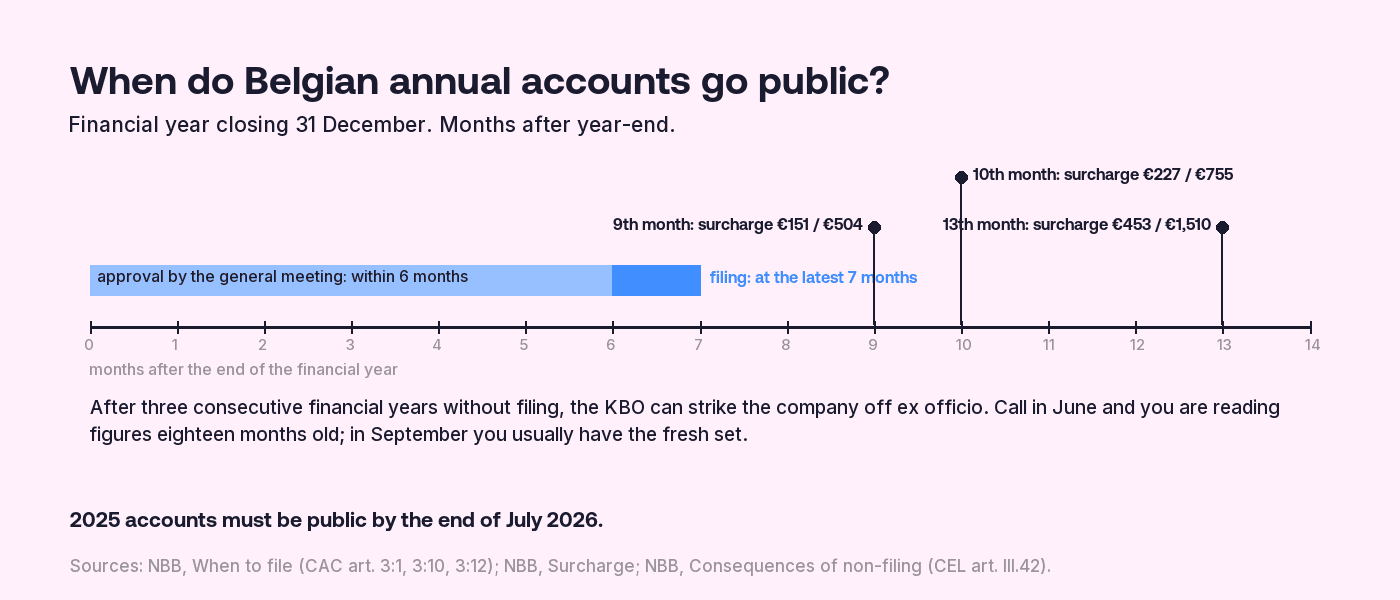
Later than you think. The law stacks two deadlines: the accounts must be put to the general meeting for approval within six months of the end of the financial year, and filed with the National Bank within thirty days of that approval and at the latest seven months after year-end (articles 3:1, 3:10 and 3:12 WVV; NBB).
For most companies, which close their year on 31 December, that means the 2025 figures must be public by the end of July 2026. Call in June 2026 and you are looking at numbers frozen on 31 December 2024, eighteen months old. Call in September and you usually have the fresh set.
Bear that in mind before you judge. A company with "no recent accounts" in March is simply doing what the law allows.
What if they are not there?
That is where it gets interesting. In Belgium a missing or late set of accounts has four consequences, and each one is a signal for you.
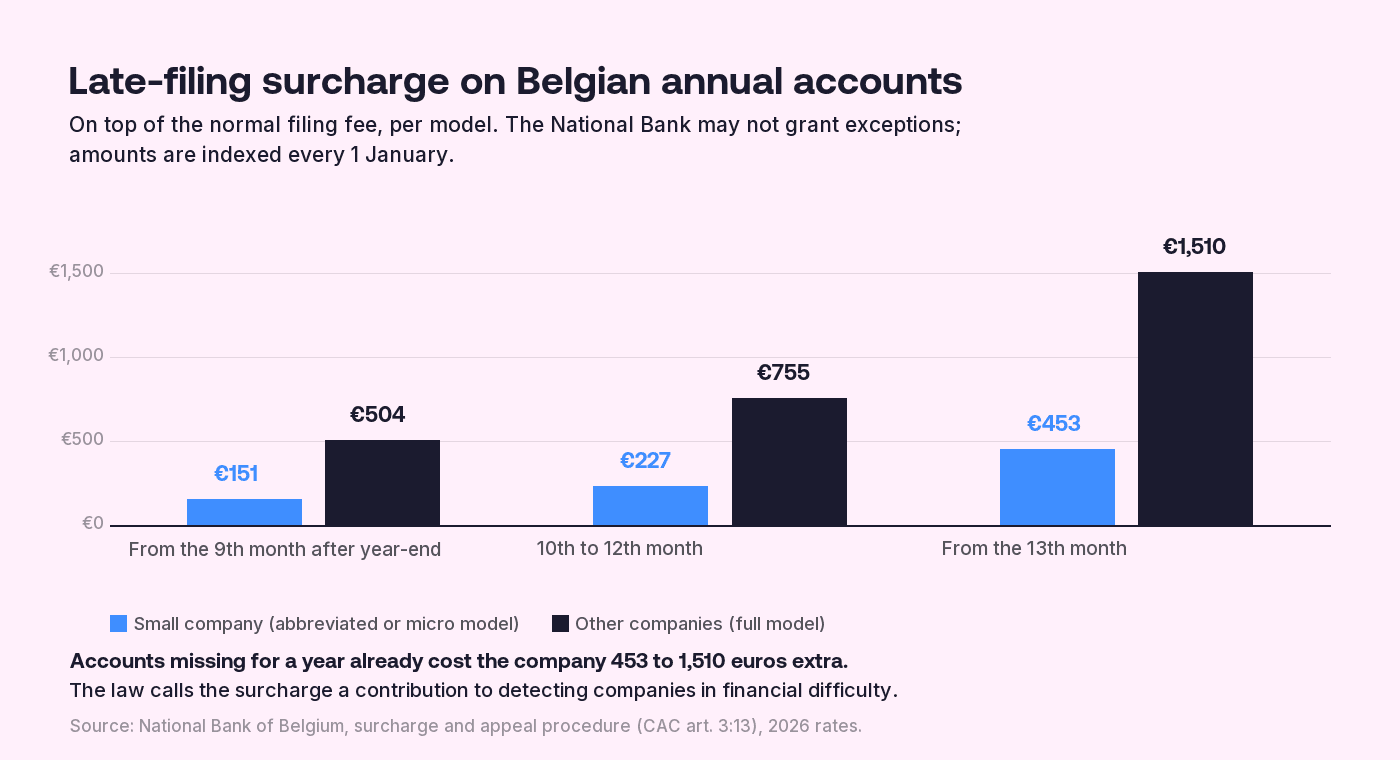
One: a surcharge that climbs. Whoever files late pays, on top of the normal fee, a surcharge the National Bank is not permitted to waive; if you disagree with it, the only route is an appeal procedure. From the first day of the ninth month after year-end (2026 amounts): 151 euros for small companies using the abbreviated or micro model, 504 euros for the others. From the tenth to the twelfth month: 227 or 755 euros. From the thirteenth month: 453 or 1,510 euros. The amounts are indexed every 1 January (NBB). The law describes the surcharge as a contribution to the costs the state incurs in detecting and following up companies in financial difficulty. That says enough about how the legislator reads a late filing.
Two: ex officio striking off from the KBO. A company that fails to file for three consecutive financial years can be struck off ex officio by the KBO. The striking off is published in the Official Gazette and visible in Public Search, and it is only lifted once the accounts are filed (NBB). If you see that flag in the KBO, you know the company has filed no annual accounts for at least three consecutive financial years and has not yet put that right.
Three: a reversed burden of proof. Damage suffered by third parties is presumed, unless the company proves otherwise, to result from the failure to file (article 3:1 WVV). For a supplier delivering on credit, that is not a detail.
Four: judicial dissolution. At the request of any interested party, the court can order the dissolution of a company that does not file its accounts, unless it regularises during the proceedings.
This is general information based on the Code and the National Bank's pages, not legal or accounting advice. To assess a specific counterparty or your own filing obligations, consult an accountant or lawyer.
For a salesperson that comes down to one line: a set of accounts that has been missing for more than a year is not a gap in your data. It is one of the most reliable free signals you can get about a company. We carry that flag in Bizzy's company data, but you can check it yourself.
Which model, and why you usually will not see turnover
This is where most readers go wrong, and it has nothing to do with reading skill.
A Belgian company files its accounts under one of three models, depending on its size. Small is a company that on its balance sheet date exceeds no more than one of these thresholds: 50 full-time employees, 11,250,000 euros annual turnover excluding VAT, 6,000,000 euros balance sheet total; a threshold only counts as exceeded when it is for two consecutive financial years. Micro is a small company that exceeds no more than one of these: 10 full-time employees, 900,000 euros turnover, 450,000 euros balance sheet total. Those amounts apply to financial years starting on or after 1 January 2024; before that they stood at 9,000,000 and 4,500,000, and 700,000 and 350,000 euros (articles 1:24 and 1:25 WVV; NBB).
Large companies use the full model. Small ones may use the abbreviated model, micro companies the micro model. And that is the catch:
Feature | Full model | Abbreviated model | Micro model |
Who | Large, or listed | Small | Micro |
Turnover (code 70) | Mandatory | Optional | Optional |
Gross margin (code 9900) | No separate line (turnover is mandatory) | Mandatory | Mandatory |
Filing fee 2026 (XBRL, NBB rates) | 379.50 euros | 89.40 euros | 67.00 euros |
In the abbreviated and micro models, the first line of the income statement is not turnover but gross margin, in essence: turnover plus other operating income, less goods, raw materials and services. Turnover itself appears in those models as an optional disclosure, recognisable by the asterisk on the official form (NBB, abbreviated model; CBN). In practice many small companies leave it blank; the National Bank publishes no count of how many do, so do not count on finding it.
Because "small" runs up to 50 employees and 11.25 million euros of turnover, it is safe to assume that most Belgian companies file under the abbreviated or micro model. The practical consequence: for many of the companies you will call, the accounts contain no turnover figure. Anyone who tells you they "looked up the turnover in the accounts" was looking at a large company, at a small company that did fill in the optional line, at a database's estimate, or at the wrong number.
The three figures you should read
You do not need to be an accountant. Three questions, three places in the document, and you know more than most of the competitors who call.
1. Can they pay? Look at equity. That is the difference between everything the company owns and everything it owes, and it sits at the top of the liabilities side of the balance sheet. If it is negative, debts exceed assets and the company is living on its creditors. If it is positive but much smaller than a year earlier, either the year showed a loss or money went out to shareholders as a dividend or capital reduction; the result under point 2 tells you which. Always compare with the previous year, which is printed alongside.
2. Do they make money? Look at the result, and at gross margin. The result for the year sits at the bottom of the income statement: profit or loss after tax. One year says little. Pull two or three sets from Consult and put the results side by side. With an abbreviated or micro model, use gross margin (code 9900) as your measure of the size and growth of the business, since turnover is usually not there. A gross margin that grows three years running usually points to a growing business, turnover figure or not; it can also rise from cheaper purchasing or one-off other operating income, so read it alongside the result.
3. Will they get through the next twelve months? Look at the short term. The balance sheet shows current assets (stock, receivables due within one year, cash) against debts due within one year. If debts due within one year exceed current assets, that is a reason to ask about liquidity, however handsome the profit. In sectors that get paid up front it is normal; in a business buying on credit it is not, and that is the company that will ask you to stretch payment terms.
One more thing worth taking: the average headcount in full-time equivalents is in the social balance sheet. It is often a more useful measure of company size than what LinkedIn shows.
What the accounts do not tell you
Be honest about the document's limits, because they decide how you use it.
It contains no contact persons for sales. The directors are listed, as they are in the KBO and the Gazette, but who makes the purchase is nowhere. It is up to nineteen months old. It says nothing about what is happening now: no vacancies, no new branch, no board change last month. For that you look at the Gazette and at the signals a tool tracks for you.
And, as we have seen, for many small companies it says nothing about turnover. Anyone who wants a list of "companies with more than 5 million in turnover" is therefore largely working from estimates, whichever supplier the list comes from. How that plays out for bought lists in general is in what an address list costs and what you may do with it (Dutch market).
From figures to conversation
The accounts are not the goal. They are a filter and an opener. Three ways to use them that work in practice.
As a filter before you call. Negative equity, a striking off in the KBO, or accounts missing for more than a year: those are companies you take out of a prospecting list, or approach with a different question. How to build such a list is in the prospecting guide for Belgium; how to decide who is worth following up is in lead qualification.
As a trigger. A gross margin growing three years running, a capital increase in the Gazette, a new director: those are reasons to call today rather than next quarter. A conversation that opens with "I saw you grew strongly last year" is a different conversation from one that opens with a pitch.
As a check on the rest of your data. Does the size a database gives you match the headcount in the social balance sheet? If not, you know which source to distrust.
We built Bizzy's company data to automate those three steps: the National Bank's accounts, the KBO and Creditsafe in one profile, with the key financials already read and the signals layered on top. Which other tools do that for the Belgian market and how they differ is in our comparison of Belgian prospecting tools. But the source stays free, and this article is meant to teach you to read it.
Read next: the best B2B prospecting tools for European sales teams and how to generate B2B leads in Europe.
Read next: how to search the Belgian Official Gazette, and what each publication category signals.
Read next: is this company financially healthy? Solvency, liquidity and profitability from the filed accounts.
Read next: How to check whether a Belgian company is bankrupt, and Belgian bankruptcies in numbers.
Read next: How to find a Belgian company's statutes and incorporation deed.
Read next: Bizzy vs Qantara: which answers your question?
Read next: Bizzy vs Company.info: breadth or focus?
Frequently asked questions
How do I look up Belgian annual accounts for free?
Through the National Bank of Belgium's Consult tool: search by name or enterprise number, pick the financial year and open the file as PDF, XBRL or CSV. No account or payment is needed. The National Bank makes the accounts available free of charge to anyone interested.
When must Belgian annual accounts be filed?
Within thirty days of approval by the general meeting and at the latest seven months after the end of the financial year. For a year closing on 31 December, that is the end of July of the following year.
What happens if a company does not file its accounts?
A surcharge (2026 amounts) climbing from 151 or 504 euros from the ninth month to 453 or 1,510 euros from the thirteenth, depending on the model. After three consecutive years the KBO can strike the company off ex officio, and any interested party can ask for judicial dissolution. Damage to third parties is also presumed to result from the failure to file, unless the company proves otherwise.
Why is there no turnover in the accounts?
Because small and micro companies may use the abbreviated or micro model, in which turnover is an optional disclosure. The first line of their income statement is gross margin (code 9900). Only the full model, mandatory for large companies, contains turnover as a required line.
What counts as a small company in Belgium?
A company that on its balance sheet date exceeds no more than one of three thresholds: 50 full-time employees, 11,250,000 euros turnover excluding VAT, 6,000,000 euros balance sheet total. A micro company stays under 10 employees, 900,000 euros turnover and 450,000 euros balance sheet total, exceeding at most one. Those amounts apply to financial years from 1 January 2024.
Which three figures should a salesperson read?
Equity, to see whether the company owns more than it owes. The result for the year and, for small companies, gross margin, across two or three years side by side. And the ratio of current assets to debts due within one year, as a first indication of whether the company gets through the next twelve months.