The short answer
Three ratios tell you most of what you need: solvency says whether a company can absorb a shock, liquidity says whether it can pay next month's bills, and profitability says whether it makes money. For Belgian companies you can calculate all three from the filed annual accounts, which are free to consult. Filing and access regimes differ elsewhere in Europe, so check the national rules before assuming the same approach travels.
The calculation is the easy part. The interpretation is where it goes wrong: the figures are months old, small-company filing schemes leave a lot out, and a healthy value only exists relative to a sector. Checked on 11 September 2026. This is not financial advice.
The three ratios
Ratio | Formula | What it measures | Rule of thumb |
Solvency | Equity / total assets | How much of the balance sheet is funded with the owners' own money | Above roughly 25 to 30% is generally seen as comfortable |
Current ratio | Current assets / debts due within one year | Whether short-term obligations are covered | Above 1; below 1 means short-term liabilities exceed current assets |
Return on equity | Profit for the year / equity | What the owners earn on what they put in | Compare with the sector, not a fixed number |
Two warnings about that last column. Those thresholds are practitioner rules of thumb, not standards and not law. And they vary sharply by sector, because a construction firm, a software company and a supermarket have structurally different balance sheets. Belgium's National Bank publishes statistics based on the annual accounts filed with it, and that kind of sector aggregate is the right comparison base for a serious judgement. Equivalent sources exist in some other countries, but not everywhere.
Variants exist for each formula. The quick ratio strips out inventory, which matters for businesses with slow stock turnover. Profitability is calculated on total assets as well as on equity. Pick one definition and apply it consistently, or you will be comparing companies on different bases without noticing.
Where the numbers come from
You need four figures: equity, total assets, current assets, and debts due within one year. Add profit for the year if you want profitability.
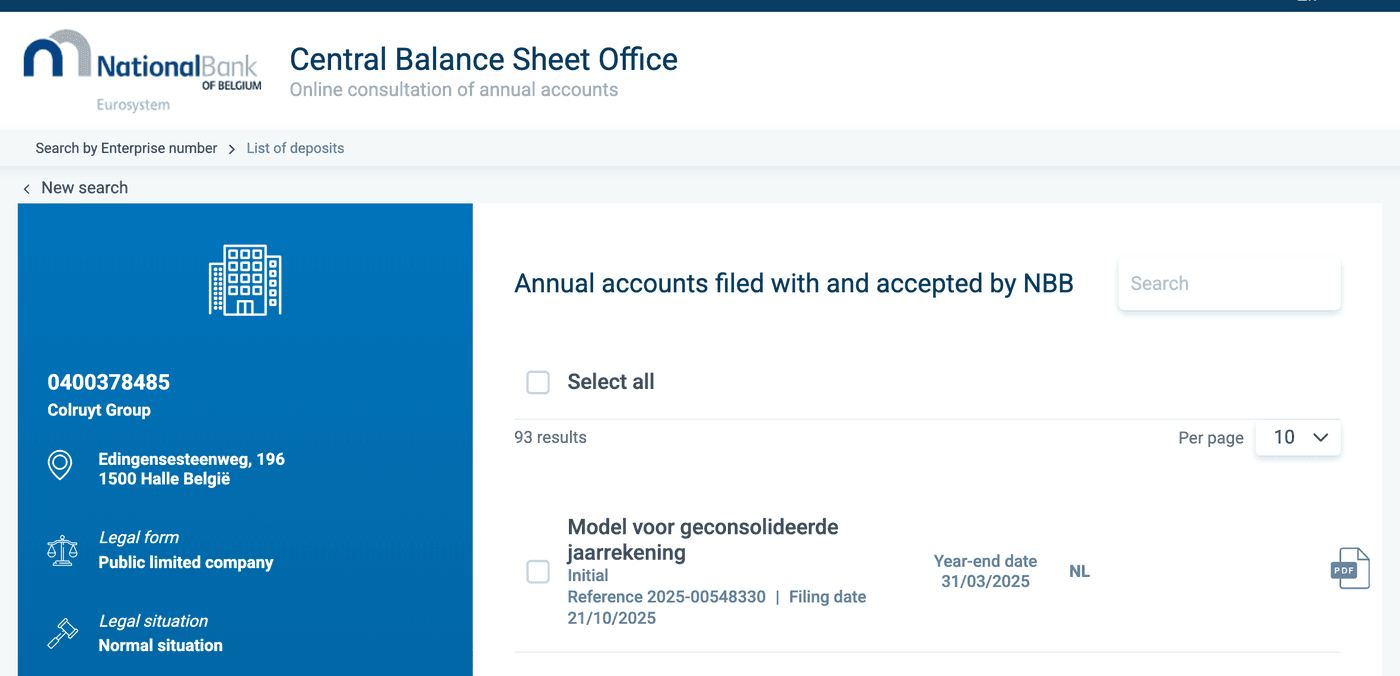
Belgium is a good case to start from, because filed annual accounts are free to consult at the National Bank's Central Balance Sheet Office. How to obtain and read one is in how to read Belgian annual accounts, and whether the company exists and in what legal state is in the Belgian company register guide. Elsewhere the filing regime and the access rules differ, which is worth checking before you assume the same approach travels.
Three traps in small-company filings
Abbreviated and micro schemes leave a lot out. Many small and medium companies file an abbreviated or micro set of accounts. In Belgium, turnover is not a required disclosure in those schemes. You can usually still calculate solvency and liquidity; you cannot do margin analysis.
The figures are old. Belgian accounts must be filed within 30 days of approval by the general meeting, and at the latest seven months after the financial year ends. For a year ending 31 December that means filing by the end of July. Read it in September and you are looking at a snapshot from more than eight months earlier, of a company that may since have had a bad quarter or landed a large order.
One year is not a trend. Solvency of 22% tells you little. Solvency that has fallen from 45% to 22% over three years tells you a great deal. Always read at least two and preferably three consecutive years side by side.
What the ratios do not say
Low solvency is not automatically a problem. A company that has just bought premises with a bank loan will show a lower ratio with nothing wrong. High profitability can come from a single asset sale. A dividend reduces equity without any loss having been made.
And no ratio tells you whether the company still exists today. A dissolution or a judicial reorganisation does not appear in last year's figures but in the official publications, covered in how to search the Belgian Official Gazette; a striking-off appears in the company register itself.
Red flags worth acting on
This is not a credit assessment and it does not replace credit insurance. None of the following is a verdict on its own; they are a reason to ask questions before you ship on invoice.
Negative equity. Liabilities exceed assets.
Current ratio below 1 and falling across consecutive years.
Solvency dropping sharply two years running with no visible investment behind it.
No filing at all. A missing set of accounts is itself a signal, and in Belgium a company that has not filed for at least three consecutive years can be struck off the register (WER III.42, §1, 4°).
A filing that arrives well after the statutory deadline.
What this means for sales
It is the cheapest filter available to you, and in several countries it is public.
Two uses pay for themselves. Before shipping on invoice to a new customer above a certain value, look at solvency, liquidity and the three-year trend. When building a target list, financial criteria make a good segmentation variable: companies with a healthy balance sheet and growing equity buy differently from companies that are shrinking, and you can filter on that rather than hope.
That second use is where Bizzy fits: company data across 33 European countries with signals such as hiring, funding rounds and leadership changes, so you can build and maintain a target list instead of opening filings one at a time. Which financial fields are available differs by country. Bizzy does not issue a credit rating. The full prospecting approach for Belgium is in the prospecting guide.
One adjacent step that often belongs in the same workflow: validate a new customer's VAT number before you invoice. How that works, and what it does and does not prove, is in how to check an EU VAT number.
Read next: How to check whether a Belgian company is bankrupt, and Belgian bankruptcies in numbers.
Read next: Belgian bankruptcies by province: where the increase actually is.
Read next: Bizzy vs Qantara: which answers your question?
Frequently asked questions
What is the solvency ratio?
The ratio of equity to total assets, usually expressed as a percentage. It shows how much of the balance sheet is funded with the owners' own money, and therefore how much loss a company can absorb before it is in trouble.
How do you calculate solvency?
Divide equity by total assets and multiply by one hundred. Both figures appear in the filed annual accounts. Above roughly 25 to 30% is often treated as comfortable, but that is a rule of thumb rather than a standard, so always compare within the sector.
What is the difference between solvency and liquidity?
Solvency is about the long term and the structure of the balance sheet: can the company absorb a blow? Liquidity is about the short term: can it pay the bills falling due in the next twelve months? A company can be solvent and still run into a liquidity problem.
Can I get these figures for free?
In Belgium, yes. Filed annual accounts are free to consult at the National Bank's Central Balance Sheet Office. Access and cost vary by country elsewhere in Europe, so check the national regime before assuming.
Why can I not find the turnover?
Because many smaller companies file abbreviated or micro accounts, and in Belgium turnover is not a required disclosure in those schemes. You can still work with the balance-sheet ratios, but not with margins.
How current are these figures?
Not very. With a filing deadline of at the latest seven months after the financial year ends, you are usually reading figures somewhere between six months and a little over eighteen months old, depending on when the company filed and when you look. Treat them as a structural indication, not a current position.