Every new Belgian company appears in a free public source within about two business days of being incorporated. You get its name, its legal form, its registered address, its enterprise number and the names of its directors.
What you do not get is a way to contact it. We checked forty companies incorporated in late August and early September 2026. Not one had a phone number in the register.
That gap is the whole subject of this article.
First, a warning about the numbers
There is no single Belgian figure for "new companies". Statbel alone publishes three different counts on three different definitions, and the credit agencies publish a fourth. They are not reconcilable, and mixing them is the most common mistake in Belgian business reporting.
Source | What it counts | Latest | Figure |
Statbel, annual VAT | VAT-liable on 31 Dec but not a year earlier | 2024 | 113,289 |
Statbel, monthly VAT | First-time VAT registrations | June 2026 | 7,588 |
Statbel, business demography | Enterprise births, industry and market services | 2023 | 74,552 |
Startersatlas | New sole traders and companies in the register | 2025 | 128,147 |
Two things follow. Statbel has not yet published a 2025 annual figure, so any "official" 2025 number you see is not Statbel's. And the register-based count is roughly 15,000 higher than the VAT-based one, because Statbel counts VAT status while the Startersatlas counts registrations. An entity that never becomes VAT-liable never appears in Statbel's annual series at all.
For 2025 the settled register figure is 128,147 starters against 116,930 cessations, published by GraydonCreditsafe with UNIZO and UCM on 8 September 2026. Net growth was 11,217 companies, under one percent.
For the official statistical picture, Statbel's most recent annual figures cover 2024: 113,289 formations, 94,532 cessations, and 1,187,819 VAT-liable enterprises on 31 December.
More than half of them are one person
This is the finding that changes how you prospect starters. Of Statbel's 113,289 formations in 2024, 61,361 were natural persons, meaning sole traders rather than companies. That is 54.2%.
Legal form | Formations 2024 |
Natural person (sole trader) | 61,361 |
BV | 37,473 |
Partnerships | 7,600 |
Non-profit association | 2,464 |
Foreign-law company | 1,676 |
NV | 821 |
By region, Flanders accounted for 70,712, Wallonia 25,976 and Brussels 14,410, with a further 2,191 registered from abroad.
The practical consequence is that if your product is sold to companies rather than to self-employed individuals, roughly half of the "record number of starters" headline is not your market. It also matters legally, which we come back to below.
They do not start evenly through the year
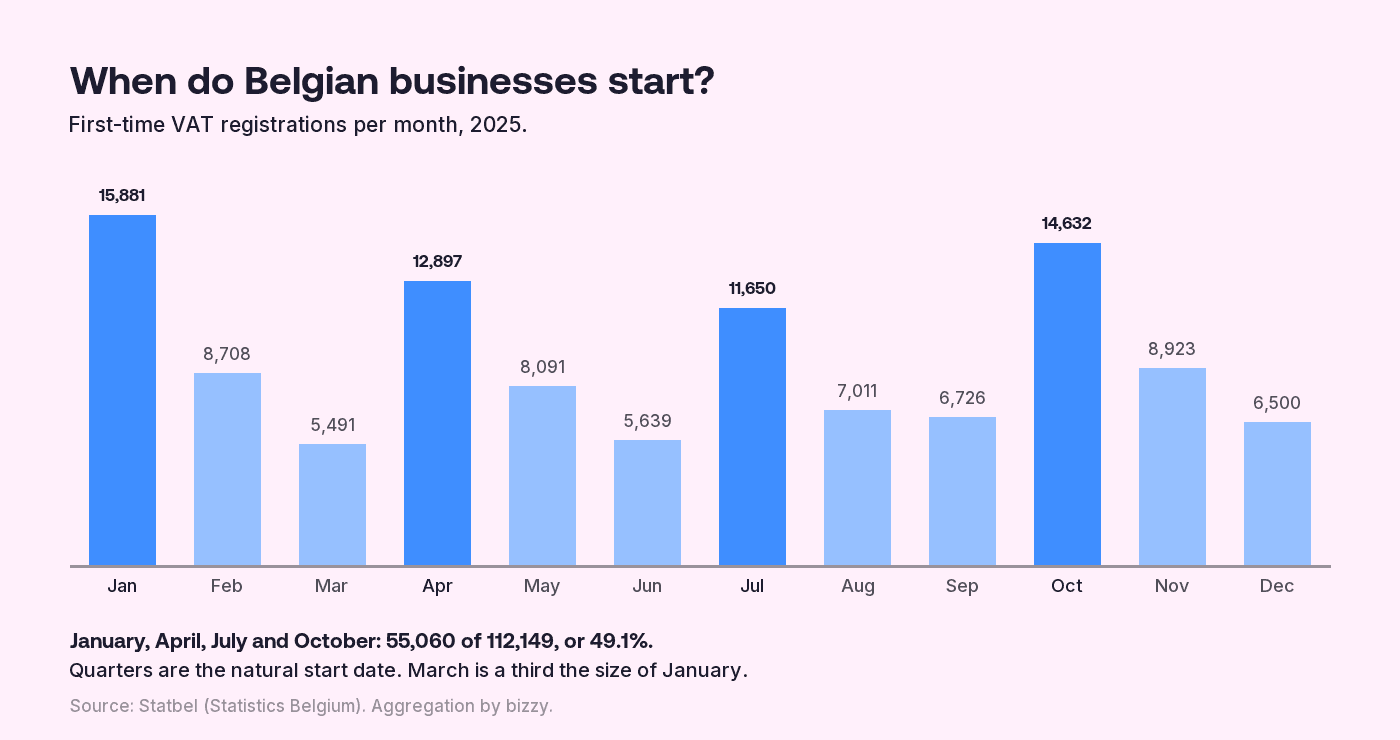
Belgian business formation is strongly seasonal, and the pattern is not subtle. January, April, July and October together accounted for 55,060 of the first-time VAT registrations Statbel recorded across 2025, which is 49.1% of the year in four months. January alone was 15,881. March was 5,491, roughly a third of January.
The reason is administrative rather than economic: quarters are the natural start date for a VAT registration.
For a sales team this is a planning input, not a curiosity. If you prospect starters, your addressable pool roughly triples in the first month of each quarter. Building the workflow in February and running it in March is the worst possible timing.
The most recent month Statbel has published is June 2026, with 7,588 first-time registrations, 1,033 re-registrations and 7,520 cancellations, against a total population of 1,215,958 VAT-liable enterprises.
The three routes to finding them
The Official Gazette, for new companies within days
This is the fastest public route, and it works.
In the legal persons annex, set the subject dropdown to the incorporation rubric and give a publication date range. That returns every newly incorporated legal person published in the window. In August 2026 it returned 3,244 results; across the first half of 2026, 27,878.
Two practical notes. If you build the query as a URL rather than filling in the form, the date parameters expect ISO format with the year first, and a Belgian-style date silently returns nothing rather than an error, which makes the search look broken when it is not. And a result gives you the company name, legal form, full address, enterprise number and a link to the published deed.
We measured the lag rather than assuming it. Every company sampled from the publication of 1 September 2026 had been incorporated on 28 August, and every company from the 8 September publication had been incorporated on 4 September. That is about two business days from incorporation to publication.
Two limits matter. The rubric covers legal persons only, so the sole traders who make up over half of all formations never appear. And it also includes branch openings, so not every result is a new company.
The Crossroads Bank, which cannot do this
Worth stating plainly, because it is the obvious place to look. KBO Public Search has no start-date filter. We checked every one of its six search forms: by number, by name phonetic and exact, by activity, by address, by authorisation. None of them accepts a date.
The start date is shown on a company's detail page, so you can confirm that a company you already know about is new. You cannot ask the register who registered last week. It is a lookup tool, not a discovery tool.
The Crossroads Bank open data, with conditions
There is a free open-data extract of the register, updated daily, and it does carry a start date as a mandatory field on every entity. Files stay available for 31 days and there is both a full file and a daily update file.
Three things to understand before building anything on it.
It requires registration and a licence. You accept usage conditions, and the licence binds you to the purpose you declared when registering.
The start date means different things for companies and sole traders. For a legal person it is the first date the entity was active. For a natural person it is the start of the most recent period of activity, so a sole trader who reactivates a dormant registration gets a fresh start date and looks new when they are not.
There is a direct-marketing restriction, and its edges are not clear. The licence prohibits using personal data for direct marketing, and states that this covers notably all data on registered entities that are natural persons. Sole traders are therefore out. Whether company records fall entirely outside the restriction is a reasonable reading but is not something the licence text settles, and director names attached to a company are personal data in their own right. This is a question for your lawyer, not for a blog post, and we are not going to tell you it is cleared.
The part nobody mentions: you cannot contact them
Here is the original finding, and it is the reason "prospect new companies" is harder than it sounds.
We took forty legal persons incorporated in late August and early September 2026 and read each one's register record.
Field | Populated |
Phone number | 0 of 40 |
Email address | 3 of 40 |
Website | 2 of 40 |
The typical record says, in so many words, that no phone number has been recorded. These fields do exist in the register and are often filled in for established businesses, but a company two days old has not filled them in yet.
So what you actually hold at day two is a name, a legal form, an address, an enterprise number, an incorporation date and the directors' names. That is enough to know a company exists and enough to write to it. It is not enough to call anyone.
This is a small, single-cohort sample of new legal persons, so treat the percentages as indicative rather than as a population statistic. The direction is not in doubt.

What this means in practice
Timing beats volume. The pool triples in the first month of each quarter. Plan around that rather than around a steady monthly average.
Decide early whether sole traders are in scope. They are over half the formations, they are the fastest-growing half, and they carry a direct-marketing restriction that companies may not. If they are not your market, your real starter pool is roughly 58,000 a year, not 128,000.
Budget for an enrichment step. Public sources will tell you who was born and where they live. They will not tell you how to reach them. Any workflow that assumes otherwise breaks on contact with the data.
That last point is what Bizzy does: the register tells you a company exists, and we tell you how to reach the person who runs it.
Related reading
For the other direction of the same data, see Belgian bankruptcies in numbers and how to check whether a Belgian company is bankrupt. For what the Gazette publishes more broadly, see searching the Belgian Official Gazette, and for the register itself, the Belgian company register.
Read next: Bizzy vs Sectora: same register, different job
Frequently asked questions
How many new companies were founded in Belgium in 2025?
128,147 sole traders and companies were registered in 2025 according to the Startersatlas published by GraydonCreditsafe with UNIZO and UCM in September 2026, against 116,930 cessations. Statbel has not yet published its own 2025 annual figure; its most recent is 113,289 VAT-liable formations in 2024. The two count different things and should not be compared directly.
How quickly does a new Belgian company become visible?
About two business days. Newly incorporated legal persons are published in the annexes to the Belgian Official Gazette, and in the cohorts we sampled the gap between incorporation and publication was consistently two working days.
Can I search the Crossroads Bank for companies founded last month?
No. Public Search has no start-date filter on any of its six forms. It will show you the start date of a company you look up, but it cannot list companies by when they registered.
Can I use the Crossroads Bank open data to build a prospecting list?
The data is free and updated daily, but it comes with a licence that restricts use to the purpose you declare at registration and prohibits using personal data for direct marketing, explicitly including data on sole traders. Whether company records sit outside that restriction is not settled by the licence text. Take legal advice before building on it.
Why do different sources give different numbers of new companies?
Because they count different events. Statbel's annual series counts VAT status on 31 December against the year before, so an entity that never becomes VAT-liable is invisible to it, and within-year churn is too. The Startersatlas counts registrations in the register. Neither is wrong; they answer different questions.