
Salespeople are hired to close deals, not to spend hours hunting for contact details on the internet. Yet plenty of commercial teams stay stuck in manual research, because they confuse lead generation with collecting as many names as possible.
A full pipeline means nothing if it is full of companies that will never buy from you. This article covers what lead generation is, why most B2B setups break, and how to build a system that delivers qualified companies every week. With the Belgian rules included, because those decide what you are allowed to do.
What is lead generation?
Lead generation is the process of finding companies and people who fit you, earning their interest, and turning that into a sales opportunity. It is the handover point between marketing and sales: marketing creates the interest, this process turns it into a named company someone can call.
One thing to settle first: a lead is not the same as a company that fits your target market. A company that fits but has done nothing yet is a suspect. Only when a signal of interest arrives and you hold contact details do you have a lead. That distinction is set out in full in what a lead actually is, and it decides whether your system dials cold or dials with a reason.
Two terms get mixed up. Demand generation makes people aware you exist and creates demand. Lead generation captures that demand and attaches a name, a role and a way to make contact.
Why most B2B lead generation breaks
The day tends to look the same: jumping between LinkedIn, company websites and messy spreadsheets. That manual research pulls salespeople away from the job they were hired for.
Three causes stand out:
The list is the problem, not the script. Teams polish their opening line while the list itself is wrong. A perfect conversation with the wrong company is still a lost hour.
There is no trigger. Without a reason to call today rather than next year, every call is an interruption. A trigger is something that changed: they posted a job, raised money, opened a location, or visited your website.
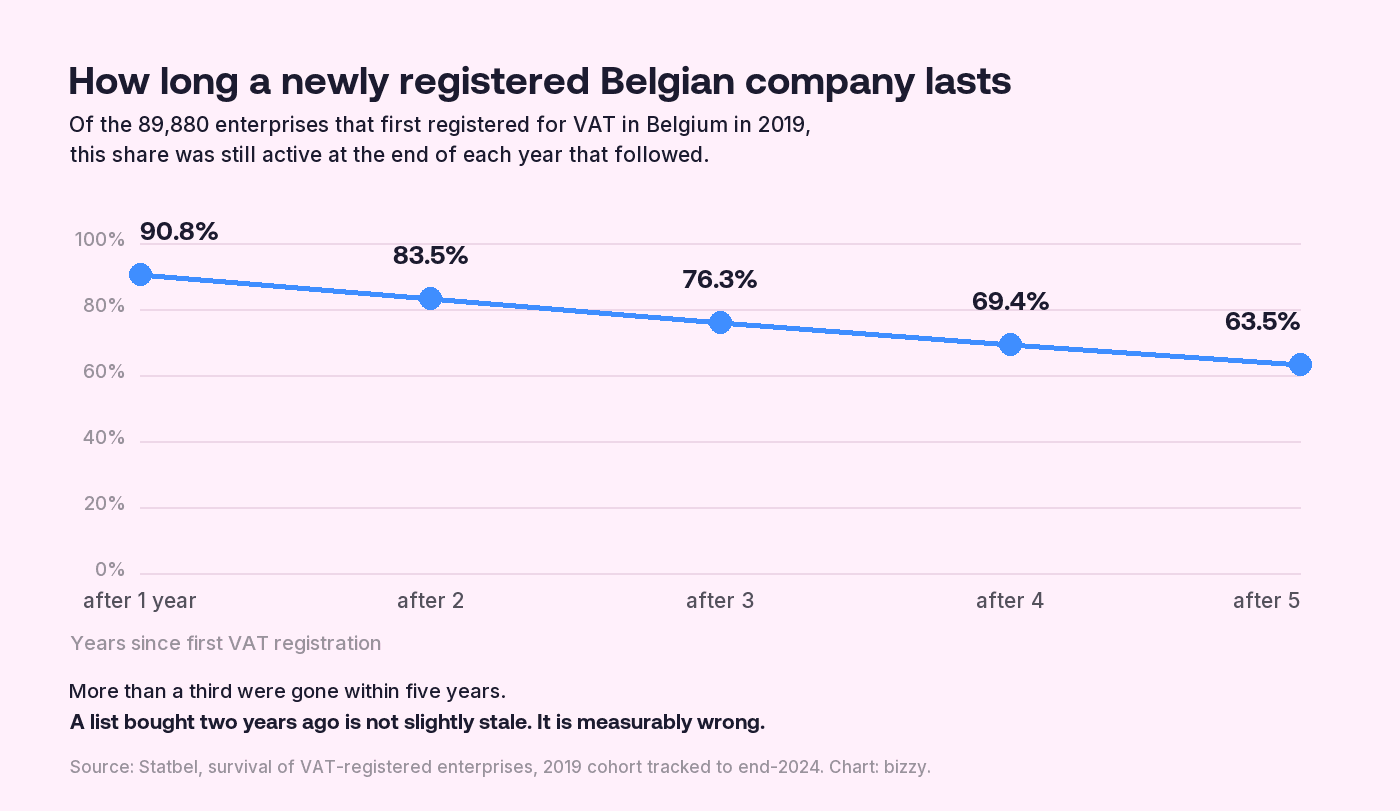
Bought lists decay, and the register says how fast. Of the 89,880 enterprises that first registered for VAT in Belgium in 2019, 90.8% were still active after one year, 76.3% after three and 63.5% after five (Statbel). More than a third were gone inside five years, and sole traders account for most of that: 49.1% of newly registered natural persons reached year five, against 82.2% of legal persons.
What the law allows
The rules below apply to Belgium. If you also work, or only work, in the Netherlands or Germany, different conditions apply there. They are set out per country in the rules for cold outreach in Europe.
Two rules decide what a Belgian outbound plan may actually do, and both are commonly held backwards.
Email: opt-in, with two narrow exceptions. Belgium applies an opt-in for advertising email: without prior consent it is prohibited (article XII.13 of the Code of Economic Law). The Royal Decree of 4 April 2003 makes two exceptions: existing customers for similar products, and addresses of legal persons. So you may send unsolicited email to info@ or sales@, but not to a named employee's personal work address without prior consent, unless they are already a customer for a similar product. The burden of proof lies with the sender (FPS Economy).
Calling: the do-not-call list covers companies too. Unlike many salespeople assume, companies can register their numbers as well. You have to consult the list and strip the registered numbers before you call, and failing to do so risks fines up to 80,000 euros (Do Not Call Me, FPS Economy).
In practice: build your system around calling and around email to general addresses, and take the consent route for personal addresses. The full legal chapter is in the prospecting guide for Belgium. This is not legal advice.
A lead generation strategy in four steps
1. Define who you are looking for
Before you touch a single company, write down who you are looking for: sector and NACE code, size, country, and which problem they have to have. Add the job titles that sign the contract.
This step stops you wasting time on companies that could never buy. In Belgium you can also check financial health up front: annual accounts sit with the National Bank and company status sits in the Crossroads Bank for Enterprises. Which sources those are and how to read them is in our guide to the Belgian company register.
2. Automate finding and qualifying
Manual searching does not scale. Belgium alone has over 1.2 million VAT units (Statbel), so you will not check them by hand.
Search on those triggers rather than on static firmographics alone. They are what says there is budget or need right now. A company hiring twenty commercial roles needs a different conversation from one standing still.
Then agree with marketing where the line sits between an MQL and an SQL, and put that agreement on paper. Without it, "the leads are bad" stays an opinion instead of a number you can measure.
3. Enrich every lead with context
A name and an email address are not enough. You need an answer to one question: why am I contacting this company today? Without it you are interrupting someone, and the call has to carry itself on the script alone.
So enrich with verifiable contact details and with context: recent news, the technology they run, changes in management, financial key figures. Knowing a prospect just opened a new location gives you a concrete reason to call.
4. Put leads straight into the workflow
The best leads are worthless if they sit in a CSV for a week. Speed decides whether a lead becomes a conversation. Qualified leads should land directly in your CRM or your outreach tool, with no export step in between.
Before you go live, check three things: that your data supplier meets the GDPR and the Belgian rules above, that fields map correctly into your CRM, and that your sequences are ready.
What about online lead generation?
Online lead generation is not a separate discipline, it is the inbound half of the same system. Your website, your content and your search ads catch people who are already looking. That produces the highest intent and the lowest volume, and you control it least.
Which is why inbound alone does not work. A team that only waits for website forms has no tap to open when the quarter falls behind. The combination works: inbound for people already searching, signals and outbound for those who are not searching yet but do have a trigger.
One online channel is underrated in B2B: identifying the companies that visit your website without filling in a form. Those are companies with demonstrable interest and no point of contact. How to turn them into pipeline is a subject of its own, covered in building pipeline from anonymous website visitors.
This piece covers the concept and the setup. If you want the execution, how to get from a list to a conversation, see generating leads: from a company list to a conversation.
Stop searching, start selling
What that looks like in practice is in the stories of customers who work this way, for instance how Dropsolid gets a daily flow of sales-ready leads.
We built Bizzy's European company data for exactly that step: company data drawn from the official registers of 33 European countries, combined with Creditsafe and public sources, with signals and two-way CRM sync on top. Which other suppliers exist and how they differ, we set out with each vendor's own published figures and sources in our comparison of B2B data providers in Europe.
Read next: the best B2B prospecting tools for European sales teams and how to generate B2B leads in Europe.
Read next: Generating leads: from a company list to a conversation.
Read next: B2B lead generation: what it is and which strategy fits your market.
Read next: Best lead generation tools in 2026: 10 tools compared.