Sales conversations cheat sheet: 10 powerful questions for successful cold calls
Tips
A cold call is hard, but with the right structure and the right questions you improve your odds considerably. I am Tijs, Senior Account Executive at Bizzy, and this is the cheat sheet I use myself: ten questions that turn a sales conversation from a pitch into an actual conversation.
What a cold call has to achieve
A cold call is first contact with someone who has never dealt with your company. It succeeds when you achieve four things.
Understand the situation. Find out how things run today, where it hurts, and who decides.
Create interest. Give the other person a reason to be curious rather than a reason to politely end the call.
Qualify or disqualify. A fast no is worth more than a slow maybe. Your time is the scarce resource.
Set a concrete next step. When there is a fit, book something specific there and then, for example a discovery call to explore the use case.
Note the order. Most calls fail because the seller starts at step two and skips step one.
The ten questions
Four blocks. You never use all of them in one call.
Opening
1. "This is a cold call. Can I have thirty seconds to tell you why?"
You ask for permission instead of taking it. Almost everyone says yes, and from that moment the other person is listening voluntarily.
2. "Before I called I saw [specific signal]. Is that right?"
This is the most important of the ten. A cold call with a real reason is a different conversation from one without. A vacancy, a move, a new location: something that shows you looked.
Understanding the situation
3. "How do you find new customers today?"
Open, not leading. You let the other person describe their own process in their own words, and you use those words for the rest of the call.
4. "Who does that, and how much time does it take per week?"
This is where the pain surfaces. Time is more concrete than satisfaction, and people answer it more honestly.
5. "And what happens if that falls short for a quarter?"
This makes the stakes visible. Without a consequence there is no urgency, and without urgency there is no second conversation.
Qualifying
6. "Is this on the agenda this quarter, or more likely later?"
A friendly way to test timing. "Later" is a perfectly good answer, because then you know when to call back instead of pushing.
7. "Who else would be involved if you took this further?"
Not "are you the decision maker", which sounds like a test. This asks the same thing without diminishing anyone.
8. "Have you already tried something for this?"
You immediately learn whether a competitor is in play, whether there is an internal project, and which solution was rejected before. That last one is gold.
Closing
9. "What would you need to see to say this was worth it?"
The other person defines their own success criterion. After that you only have to meet it.
10. "Shall we put half an hour in the diary on Thursday to look at it?"
Specific, with a day and a duration. "I will send some information" is not a next step.
How to use them
This is not a script. A script is audible on the other end of the line, and once it is, the call is over.
Use it as a map. You always open with questions 1 and 2, you pick two or three from the middle based on what you hear, and you always close with question 10. Six questions in a five-minute call is a lot. Ten is an interrogation.
The ratio that matters: if you are speaking for more than a third of the time, you are pitching rather than qualifying.
And write down verbatim what they say to questions 3 and 9. Those two answers are the opening of your next conversation.
What I see go wrong most often
Calling with no reason. Without an answer to "why are you calling me, today", question 2 becomes empty and the call collapses back into a pitch.
Pushing past a clear no. Fast disqualification is a win. It saves you three follow-up emails that go nowhere.
Leaving the next step vague. "I will send something over" is the end of the process, not the beginning of it.
Not preparing the list. If a quarter of your list is unreachable or irrelevant, the problem is not your call.
Preparation makes the call shorter
The best cold call starts before you dial. Two things decide almost everything: are you calling the right companies, and do you have a real reason.
For the first, it helps to build your profile on attributes that actually exist in the data rather than attributes you wish existed. We worked that through in building an ICP on filters that actually exist.
For the second, hiring signals are the most usable: a company that is recruiting is changing something. See how to find Belgian companies that are hiring.
For the telephone side more broadly, see B2B cold calling in Europe. And for what is legally allowed in cold outreach in Belgium, the Netherlands and Germany, see the rules for cold outreach.
Frequently asked questions
How long should a good cold call be?
Four to six minutes is normal for a first call. Shorter usually means you jumped to the meeting too quickly, longer means you started pitching. The goal is not the call itself but the next step.
Do I have to ask all ten questions?
No. Use questions 1 and 2 to open, pick two or three from the middle based on what you hear, and close with question 10. Ten questions in a row feels like an interrogation.
What do I do when someone says they are not interested straight away?
Probe once with question 3, how they solve it today. If nothing comes back, disqualify and move on. A fast no is more valuable than a polite maybe.
What is the difference between a cold call and a discovery call?
The cold call is first contact and exists to qualify and book a meeting. The discovery call is that meeting, where you genuinely explore the situation. The ten questions above belong to the first.
Is cold calling allowed in Belgium and the Netherlands?
Business-to-business calling is permitted, but rules apply around registers where numbers are shielded and around what you do with the data afterwards. The detail per country is in the rules for cold outreach.
Why asking the right questions makes a difference
Asking the right questions is crucial to capturing your prospect's attention, building trust, and providing value. Effective questions:
Open the conversation naturally. For example, the Bizzy platform provides insights into recent updates about the company you’re reaching out to. If they have recently opened a new office, raised funding, or expanded their team, mentioning these milestones is an excellent way to start a meaningful conversation.
Help identify the prospect's needs and pain points.
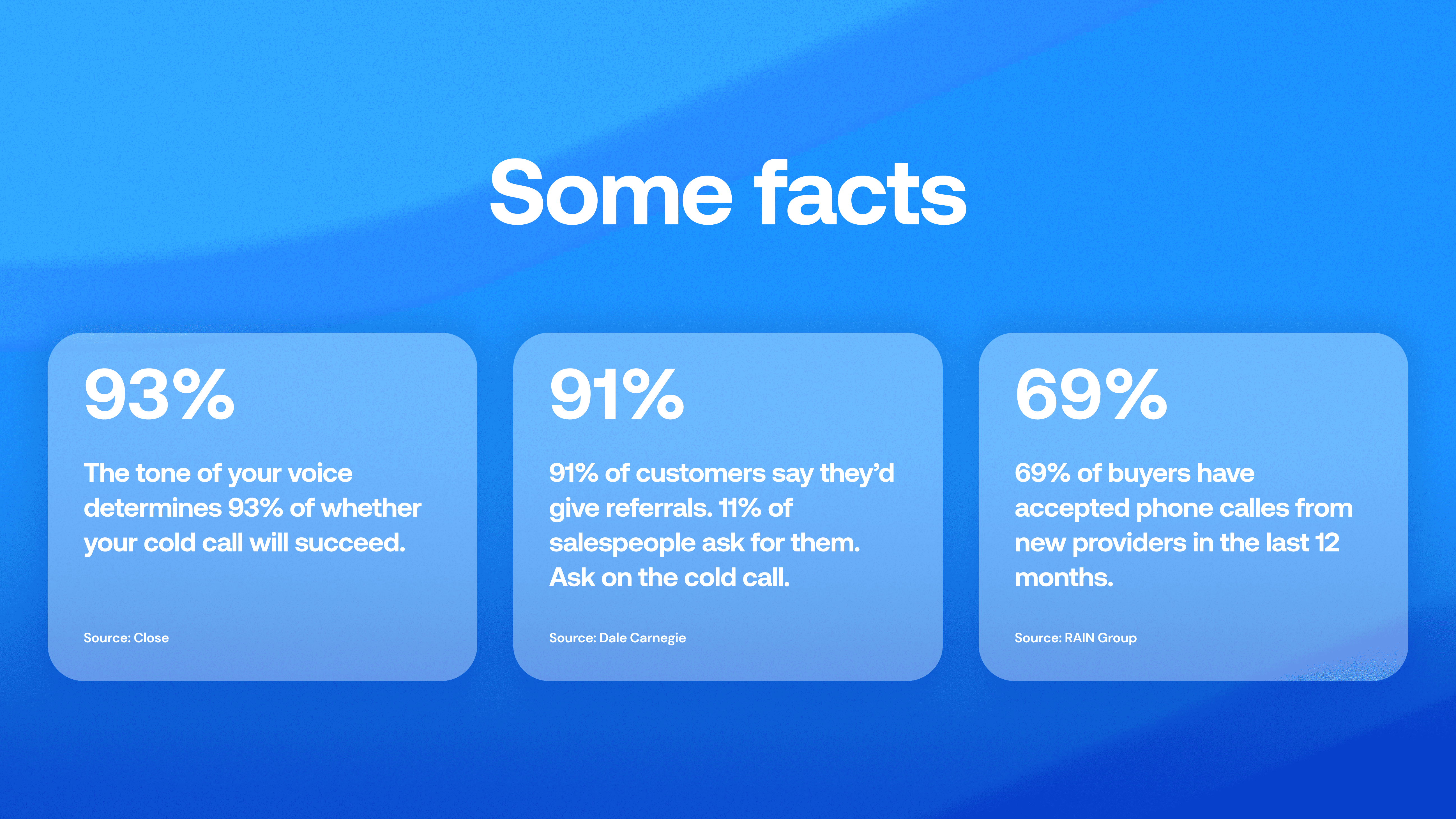
What’s a great cold call?
Respects the prospect's desire for autonomy and makes him/her feel comfortable to want to speak to you.
It’s a conversation (two-way). Don’t trick or manipulate, but try to lead and be in control of the conversation.
Gets your prospect to think differently about the solution they have and what's possible (new opportunities beyond what they have now).
Doesn’t “handle objections” as they are self-inflicted by the seller pushing his or her agenda.
The goal is not to get a meeting but to set a qualified meeting if it works for both parties.
The 10 powerful questions for successful cold calls
Here are ten questions you can use to make your cold calls more effective:
"What are you currently using to solve [specific problem]?"
"How satisfied are you with your current solution?"
"What is your biggest challenge in this area?"
"What priorities have you set for this quarter/year?"
"Have you ever considered using [solution]?"
"What would an ideal situation look like for you?"
"Who is involved in the decision-making process for [specific solution]?"
"What is most important to you when choosing a supplier/partner?"
"How much time or resources does [current process] currently cost you?"
"How open are you to a brief introduction to learn more about a solution that [provides value]?"
Voicemail ❓
Leaving a voicemail, or not leaving a voicemail… As your cold calling you’d need to ask yourself the question: “What’s the added value of my voicemail?” Furthermore out of 100 voicemails, how many people would call back?
Personally, we (almost) never leave a voicemail. Each time you lose at least 30 seconds while leaving a message.
A practical example from Bizzy
At Bizzy, we have refined and optimised this approach using data-driven insights. Here's an example of what this looks like:
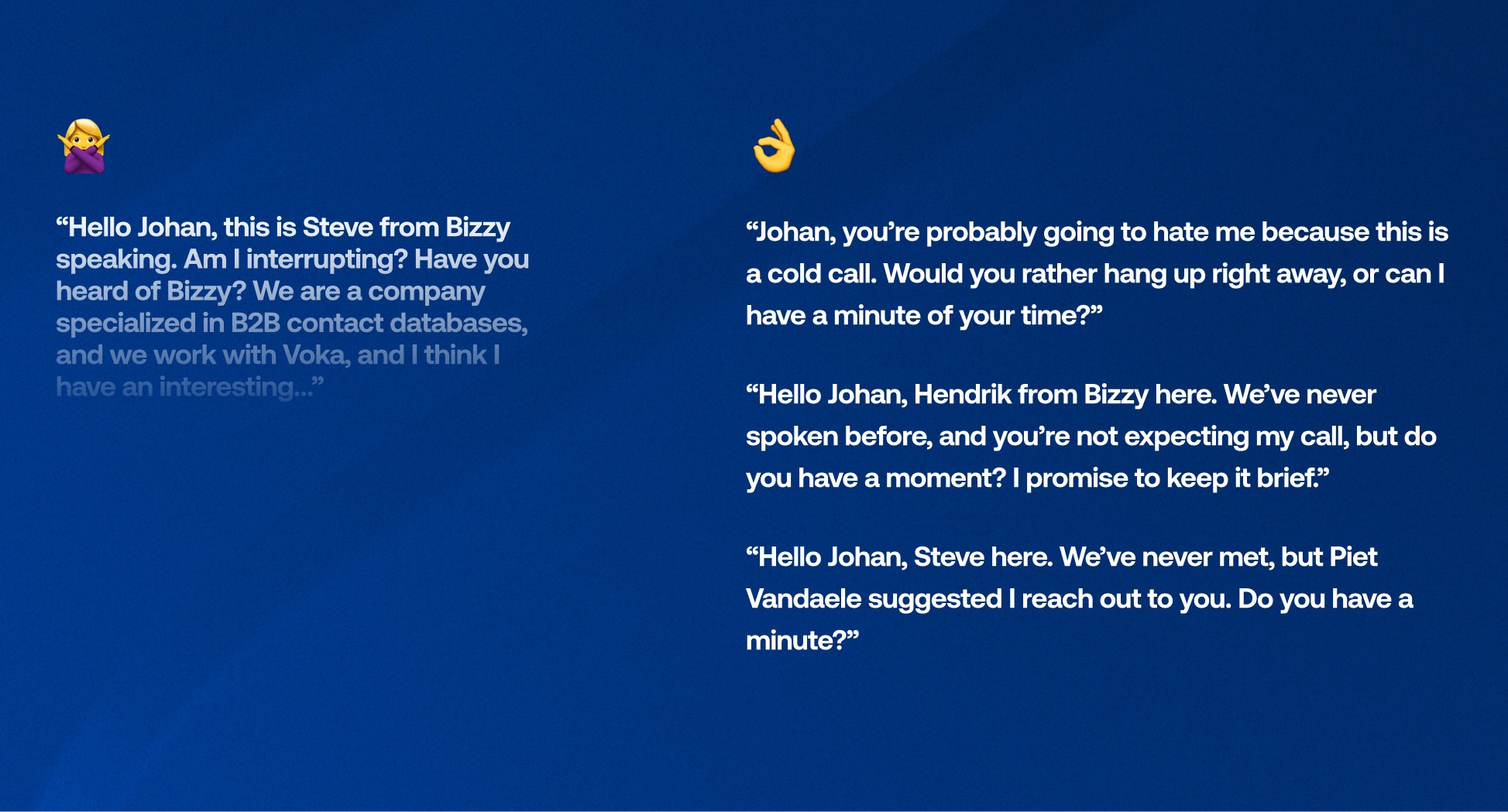
Check out a sample cold call from Bizzy (in Dutch)
Results: Thanks to our approach and data, we have achieved impressive results:
Connect rate: 33%
Meeting rate: 38%
Our data analysis has helped us personalise conversations and truly engage prospects. By focusing on the right prospects from the outset, we ensure that every call is meaningful and impactful. These numbers show that a strategic approach to cold calling, coupled with proper prospecting with Bizzy beforehand, pays off.
Even faster connections with direct phone numbers
At Bizzy, we’re committed to making prospecting faster, smarter, and more effective, which is why we’re thrilled to announce our latest integration: direct dials powered by Prospeo! This new feature provides verified phone numbers for key decision-makers directly within Bizzy, enabling your team to break through barriers and connect more efficiently.
Time is money, and chasing down the right contact information wastes valuable selling time. With Prospeo’s direct dials embedded into Bizzy, your team can quickly reach decision-makers without calling generic numbers or sending unanswered emails, increasing connection rates and boosting sales opportunities. Plus, there’s no need to switch between tools or external databases: the numbers are conveniently available where you already manage your leads.