The short answer
A lead is a person or company that has shown some interest in what you sell, and whose contact details you have. That is the whole definition. Someone who downloads your whitepaper is a lead. A company that visited your pricing page three times is a lead. A name on a purchased list is not, because the interest is missing.
In this article: the definition, how a lead differs from a prospect and a suspect, what MQL and SQL actually mean, the three kinds of lead, when a lead counts as qualified, and what the law says about holding one.
What a lead is made of
A lead is two things at once: a signal of interest and a way to make contact. Take either one away and you do not have a lead.
With contact details but no signal, you have a name from a database. With a signal but no details, an anonymous website visitor for instance, you have an opportunity you still have to convert. Only when you know who it is and that they did something can you get in touch with a reason.
That distinction sounds like hair-splitting and it decides how your team works. In our experience, teams that call every name a lead end up dialling cold, while teams that set the bar at interest dial less often and more often reach someone who was expecting the conversation.
In B2B a lead is nearly always a person and the company behind them. Buying decisions are rarely made by one individual. So you follow up with the person who filled in the form, but you qualify the company they work for.
Lead, prospect, suspect or customer?
The difference is how certain you are and who moved first. Teams use these words loosely, which is fine as long as everyone internally agrees. The common usage:
Term | What it means | Who moved first |
|---|---|---|
Suspect | A company that fits your target market, but you know nothing about them yet | Nobody |
Lead | Someone who has shown interest and whose details you hold | They did |
Prospect | A lead you have checked and confirmed as a real opportunity | You did, through a qualifying conversation |
Customer | Has bought | Both |
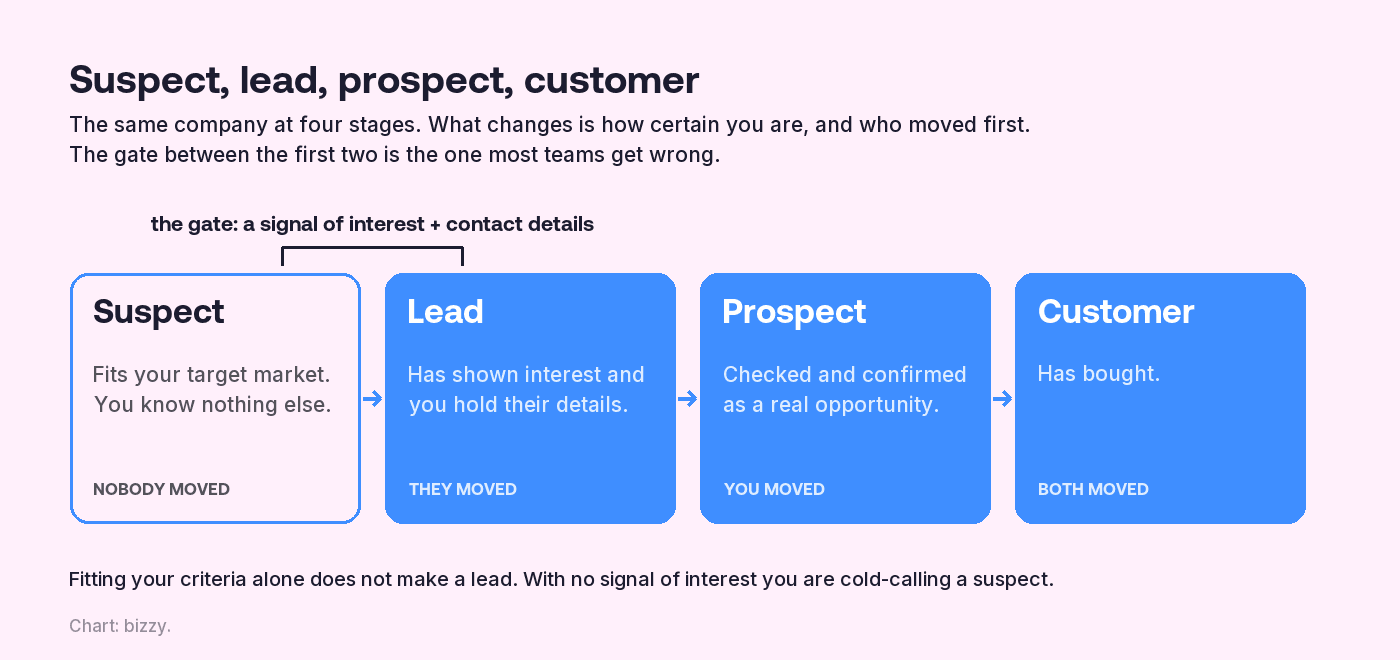
One caveat on that table: "suspect" is mostly marketing jargon and rarely used by sales teams themselves. The other three you hear daily.
The question people ask most is the difference between a lead and a prospect. Briefly: a lead is a trail, a prospect is a trail you have followed. You turn a lead into a prospect with the four questions further down this article. There is more on the process in B2B prospecting explained and in the complete prospecting guide for Belgium.
Outside sales, "lead" also means the opening paragraph of an article, and spelled the same way it is the metal. Different words, same spelling.
What do MQL and SQL mean?
MQL and SQL are not types of lead. They are agreements between marketing and sales about when something gets handed over.
An MQL, marketing qualified lead, is a lead that meets marketing's criteria for being worth passing to sales. Usually a combination of behaviour and profile: the right sort of company, plus an action that means something, a demo request rather than a newsletter sign-up.
An SQL, sales qualified lead, is a lead sales wants to pursue. Sales has looked at it and believes there is a deal in it.
These terms exist for a practical reason, not a taxonomic one. It is the classic argument between marketing and sales: marketing delivers hundreds of leads and sales says they are worthless. A written MQL definition makes that argument solvable, because then you can measure how many MQLs become SQLs. Without one it stays a matter of opinion.
Set the threshold together and put it on one page. Which companies, which job titles, which action, and how fast sales has to follow up.
What kinds of lead are there?
Broadly three, and the difference is who moved first. How to generate them systematically is a separate subject, covered in what lead generation is and how to build a system around it. This is only about the distinction.
Inbound leads. They come to you: a form, a demo request, a download, a chat, a reply to a post. Highest intent, lowest volume, and you control the tap least.
Outbound leads. You go to them: you build a list of companies that fit and make contact. More volume and you can turn the tap up, but you have to create the interest yourself. Strictly, these start as suspects and become leads once someone responds.
Signal-based leads. Something changes at a company, and the change makes a conversation reasonable: they are hiring a commercial role, they raised money, they opened a location, they visited your website. This sits between inbound and outbound. The company did not ask for you, but there is a reason to call now rather than next year.
That third kind is why we built Bizzy the way we did: company data from the official registers of 33 European countries with signals layered on top. We see with our own customers that a lead with a clear trigger turns into a conversation more easily than one without, though that holds whatever tool you use.
When is a lead qualified?
When you have an honest answer to four questions.
Does the company fit? Sector, size, country, and whether they have the problem you solve. You can often establish this before speaking to anyone.
Are you talking to the right person? Not necessarily the decision maker, but someone who feels the problem or knows who decides.
Is there a trigger? Why now rather than in a year. Without one, every deal becomes "maybe later".
Can they pay? In Belgium you can largely check this yourself: annual accounts sit with the National Bank and company status sits in the Crossroads Bank for Enterprises. Our guide to the Belgian company register walks through the free sources.
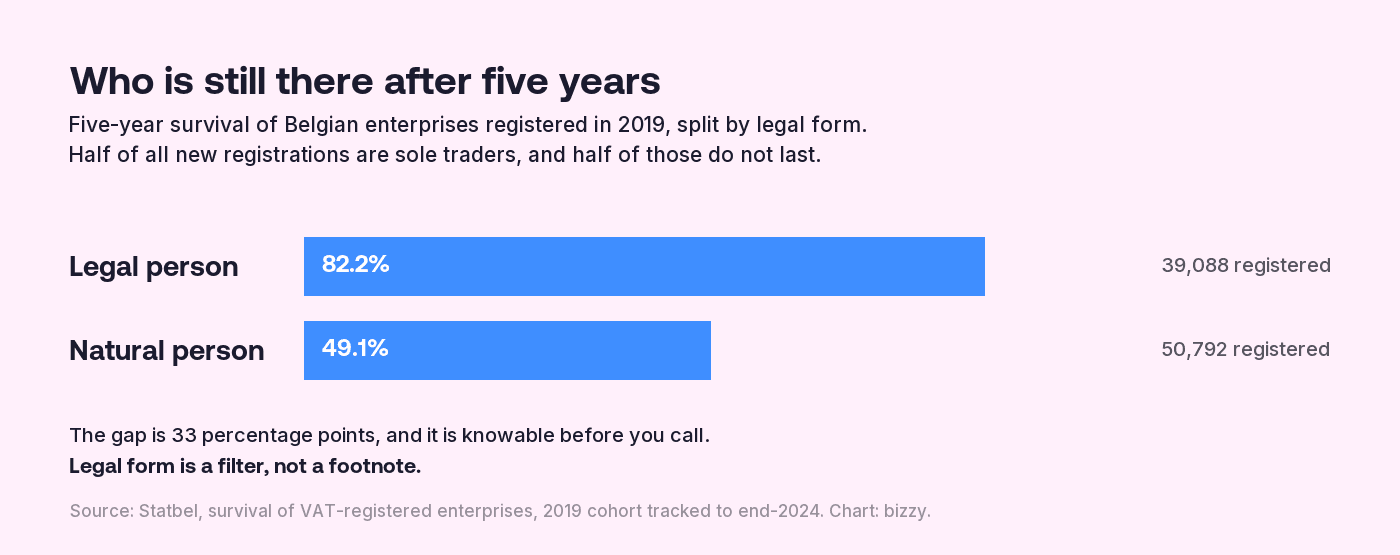
One check is cheaper than the others and most teams skip it: legal form. Of the Belgian enterprises that registered for VAT in 2019, 82.2% of legal persons were still active five years later, against 49.1% of natural persons (Statbel). That is a 33-point difference you can read off the register before anyone picks up the phone.
What we deliberately leave off that list is a score. Lead scoring is useful at volume and misleading without it: at a few dozen leads a month you are mostly measuring noise. Start with the four questions.
A lead is personal data
The moment you store a person's name, email address or phone number, you are under the GDPR. Including in B2B. In Belgium two specific rules sit on top of that, and plenty of salespeople have them backwards.
Email: opt-in, with two narrow exceptions. Belgium applies an opt-in for advertising by email: without prior consent it is prohibited (article XII.13 of the Code of Economic Law). The Royal Decree of 4 April 2003 makes two exceptions: existing customers for similar products, and addresses of legal persons. So you may send unsolicited email to info@ or sales@, but not to an employee's personal work address without consent, and the burden of proof lies with the sender (FOD Economie). Relying on legitimate interest under the GDPR changes nothing about that.
Calling: the do-not-call list covers companies too. Unlike many salespeople assume, companies can register their numbers as well. Telemarketers must consult the list and remove registered numbers, and failing to do so risks fines up to 80,000 euros (Do Not Call Me, FOD Economie).
Beyond that: you must be able to say where you got someone's details and act on a deletion request. And data from a public company register may be used to check a company, but the Belgian FPS Economy explicitly forbids reusing personal data from that register for direct marketing.
This is not legal advice, and the line is moving: on 14 July 2026 the data vendor Lusha was fined €2 million by the Italian regulator over precisely the question of whether legitimate interest covers brokering contact data (Garante). We put ten vendors' positions side by side in our comparison of B2B data providers in Europe. How we handle data ourselves is on our GDPR page, and the full legal chapter for Belgium is in the prospecting guide.
From lead to customer
A lead is the start, not the result. The path is usually: lead arrives, qualify, conversation, proposal, decision. What goes wrong most often is, in our experience, not lead quality but speed and follow-up.
Two things make the most difference in practice. Follow up fast, because a three-hour-old demo request is a different conversation from a three-day-old one. And record why you rejected a lead, because that is the only way your qualification criteria improve.
Read next: the best B2B prospecting tools for European sales teams and how to generate B2B leads in Europe.
Frequently asked questions
What is the meaning of a lead?
A lead is a person or company that has shown interest in what you sell and whose contact details you hold. The word means "a trail": a route to a possible customer, not yet a customer.
What are leads?
Leads are the people and companies that have shown interest in what you sell and that you are able to contact. The plural means nothing different from the singular; in practice teams use "leads" for the whole list still waiting to be qualified.
What is the difference between a lead and a prospect?
A lead has shown interest. A prospect is a lead you have checked and confirmed as a real opportunity, usually after a conversation about problem, budget and timeline. Every prospect was a lead first; not every lead becomes a prospect.
What is a qualified lead?
A lead where you know the company fits, you are speaking to the right person, there is a reason to act now, and they can pay. That is not the same as an MQL or an SQL: those two are internal agreements about when marketing hands a lead to sales.
What does a lead cost?
This varies too much by sector and channel for an average to mean anything. Work it out yourself: all the costs of a channel over a period, divided by the leads that channel produced. Do it per channel, not in total, or your best channel will subsidise your worst.
Can I just email business leads in Belgium?
To general addresses of a legal person, such as info@ or sales@, yes. To an employee's personal work address, not without prior consent, unless they are an existing customer for a similar product. That is how the FOD Economie explains article XII.13 of the Code of Economic Law and the Royal Decree of 4 April 2003, and the burden of proof lies with the sender. For calling, the do-not-call list applies to company numbers too. This is not legal advice.