A CRM knows what your team typed into it. For a Belgian company, a great deal more is on public record (filed headcount, legal form, ownership structure, credit standing, official publications), and none of it arrives on its own.
Bizzy connects to Odoo as one of its CRM integrations, alongside HubSpot, Teamleader Focus, Odoo, Salesforce, Pipedrive and Dynamics 365. This page is about what that is actually worth: which fields are missing from a typical Odoo record, where they come from, and what changes once they are there.
The short answer
Enrichment works because Belgian companies have a single stable identifier: the enterprise number, which is also the VAT number. Match a CRM record to that number and everything the registers publish about the company can hang off it.
Odoo is often the system of record for operations as well as sales, so the same company row drives quotes, invoices and delivery. That raises the cost of a wrong VAT number or a stale address well beyond a missed call.
What is usually missing
These are the fields a Belgian CRM record tends not to have, and what each one is for.
Field | Source | Why it matters |
Enterprise / VAT number | KBO/BCE register | The key everything else joins on |
Legal form and status | KBO/BCE register | Active, in liquidation, struck off |
Filed headcount (FTE) | National Bank filings | The size figure that actually exists: revenue usually does not |
Multi-year financials | National Bank filings | Equity, debt ratio, gross margin, and the direction of travel |
Credit score and limit | Creditsafe | Whether they can pay, before you quote |
Ownership structure | Filings and publications | Whether this entity can decide for itself |
Establishment units | KBO/BCE register | How many sites sit under one company |
NACE-BEL codes | KBO/BCE register | In both the 2008 and 2025 classifications |
The one to look at first is headcount. Most CRMs carry a revenue field, and in Belgium turnover is an optional line on roughly 96% of filings, so that field is empty or guessed far more often than people realise. Filed employee numbers are there for every company that files accounts. More on that in finding a Belgian company's revenue.
Why CRM data decays without it
A company record does not stay correct. Registered offices move, directors change, legal forms change after a restructuring, establishment units open and close, and on 1 January 2025 the whole register moved to the NACE-BEL 2025 activity classification, so any segment built on activity codes before that date is filtering on the older one.
None of that triggers an alert in a CRM, because nothing in the CRM changed. The record simply stops being true. We put numbers on the rate in how fast Belgian B2B data goes stale: 94,532 Belgian enterprises ceased during 2024 alone.
What this changes in practice
Segmentation stops being guesswork. Filtering on a filed headcount band is a different exercise from filtering on a revenue field somebody typed in 2023.
Qualification moves earlier. Credit standing and ownership are on the record before a rep opens the opportunity, not discovered during legal review.
Reporting reconciles. When sales and finance pull the same company from the same identifier, the numbers agree.
Deduplication gets an anchor. Three records for the same company collapse when they all resolve to one enterprise number.
What to set up, and in what order
Match on the enterprise number first. Name matching produces duplicates; the number does not. Where the number is missing, resolve it once and store it.
Decide which fields the CRM owns and which the register owns. Registry fields should be refreshed rather than hand-edited, or you will fight your own enrichment.
Set a refresh cadence per field. Status and address change continuously; filed financials change once a year, after filing season.
Only then automate. Pushing enriched records into workflows before the matching is right propagates the errors faster.
Setup specifics for Odoo are in the Bizzy help centre and the API documentation, which is also the route if you want the data in a system without a native connector.
An honest scope note
Belgium is the deep market here, registry-sourced, at entity level, with filed accounts behind it. Germany, Austria and the UK are covered through Creditsafe data rather than national registers, and they behave differently. If your Odoo portfolio is mostly Belgian, this is as good as company enrichment gets; if it is spread across Europe, expect the depth to vary by country.
Read next: B2B data enrichment: what the register gives you and what it does not.
Frequently asked questions
Can I enrich Odoo records with Belgian company data?
Yes. Bizzy connects to Odoo as one of its CRM integrations, and enrichment is keyed on the enterprise number, which is also the Belgian VAT number.
What is the enterprise number and why does it matter for a CRM?
It is the single stable identifier the Belgian register assigns to a company, and it doubles as the VAT number. Matching CRM records to it is what makes reliable enrichment and deduplication possible.
Can I get Belgian financial data into my CRM?
Filed annual accounts are public, so equity, debt ratio, gross margin and headcount can be carried onto a record. Turnover is an optional line on most Belgian filings, so it is frequently absent.
How often should enriched CRM data be refreshed?
Status, addresses and establishment units change continuously and suit a quarterly check; filed financials change once a year after filing season; directors and restructurings are worth watching monthly on target accounts.
Does this work outside Belgium?
Coverage extends beyond Belgium, but the registry-sourced depth described here is the Belgian picture. Germany, Austria and the UK are covered through Creditsafe data rather than national registers.
Written by Arthur Cremers at bizzy., which builds European B2B company data from official registers.
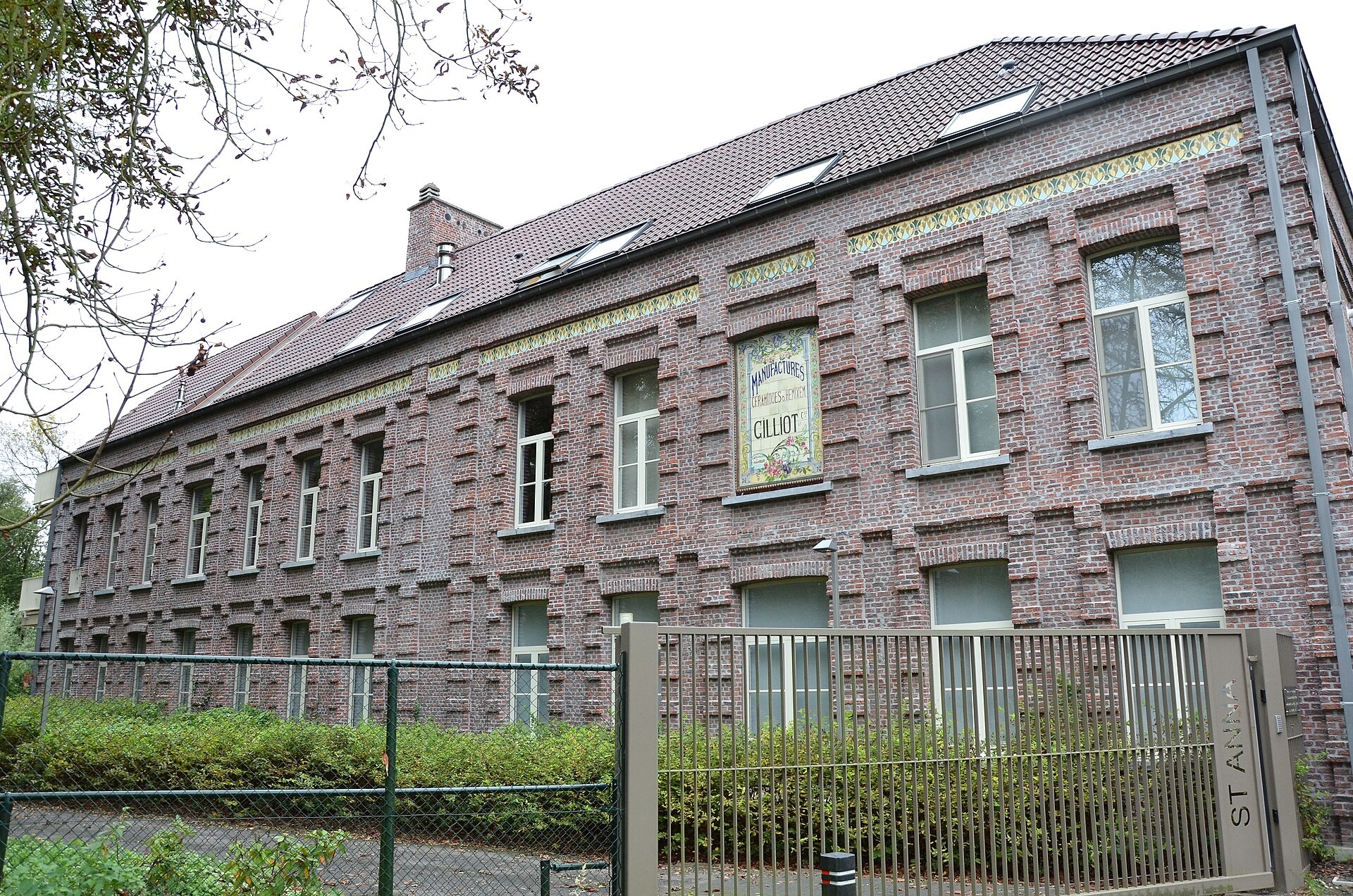
Photo of the former Gilliot ceramics works in Hemiksem by Funkyxian, CC BY-SA 3.0, via Wikimedia Commons