Almost every Belgian company with legal personality files annual accounts with the National Bank. Those accounts are public and free to consult. So finding a company's revenue should be simple.
It usually is not. For most Belgian companies, turnover is a legally optional line and simply is not there. That is not a gap in the database you are searching. It is how the filing rules work, and no tool can show you a number the company never had to publish.
Here is what determines whether the figure exists, where to look when it does, and what to use instead when it does not.

Key takeaways
Small and micro companies file the abbreviated (VKT) or micro (MIC) model, where the turnover line is marked as an optional disclosure.
On those models only gross margin (line 9900) is mandatory. Turnover (line 70) is starred as optional.
Only the full (VOL) model carries turnover as a standard, unstarred line.
Which model a company files is set by size thresholds in the Companies and Associations Code, not by choice.
When turnover is absent you can still get gross margin, balance-sheet total, equity, staff numbers and the full balance sheet.
Why the number is usually not published
Belgian annual accounts come in three standard models, and which one a company must file depends on its size under articles 1:24 and 1:25 of the Companies and Associations Code (WVV). In short: a company is small if it exceeds no more than one of 50 staff, €11,250,000 turnover and €6,000,000 balance sheet total, and micro if it exceeds no more than one of 10 staff, €900,000 and €450,000. Small companies file the abbreviated (VKT) model, micro companies the micro (MIC) model, and everyone else, plus every listed company, the full (VOL) model. The thresholds, the two-consecutive-years rule and the other Belgian SME definitions are set out in what counts as an SME in Belgium.
On the standard MIC and VKT forms, the income statement opens with "Gross margin (+)/(−) 9900" as the mandatory line, while "Turnover … 70" carries an asterisk marked optional disclosure. On the VOL form, turnover appears without that asterisk.
The practical consequence is blunt: if a company files abbreviated or micro accounts, and most Belgian companies do, you are looking at gross margin, not revenue, unless that company voluntarily chose to disclose more.
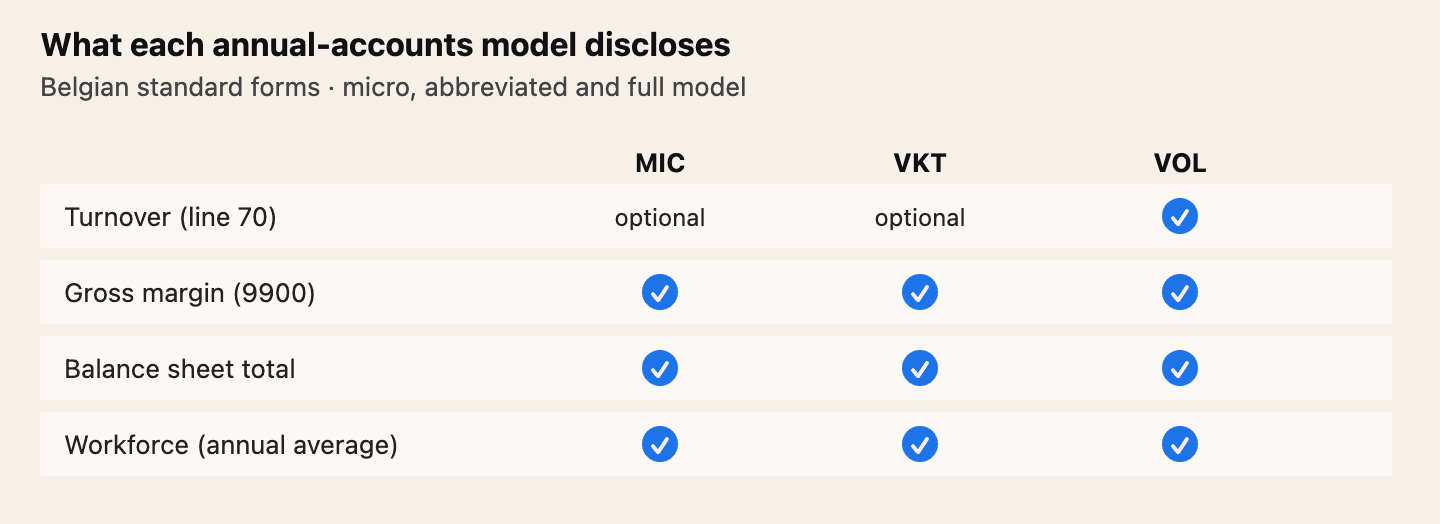
The filing statistics show how normal this is. Of the 593,323 sets of accounts the National Bank received in 2025, around 70% were micro models and 26% abbreviated, together 96% of everything filed. Barely 4% were full models (National Bank of Belgium). The turnover line is therefore optional on the large majority of Belgian filings.
The wider enterprise population is larger still: Belgium had 1,187,819 active VAT-registered enterprises at the end of 2024 (Statbel), but most of those are self-employed people and other entities that file no annual accounts at all, which is why the National Bank's filer count is roughly half that number.
Where to look when the figure does exist
The National Bank's Central Balance Sheet Office is the primary source and it is free. Its Consult application lets anyone inspect filed accounts as PDF, XBRL or CSV. In 2025 it received 593,323 sets of accounts covering 567,501 legal entities, 99% of them filed in XBRL (the machine-readable filing format), and served 4.3 million consultations (NBB).
The Crossroads Bank for Enterprises (KBO/BCE) Public Search does not carry financial figures, but it gives you the enterprise number you need to find the accounts, plus legal form, status, addresses, activity codes and registered contact details. Note that in Belgium, unlike the Dutch register, phone, fax, e-mail and website are public when the company has registered them.
The Belgian Official Gazette carries the corporate events rather than the figures: incorporation, dissolution, capital changes, appointments and resignations, changes of registered office.
Filing itself is deadline-bound: accounts must be filed within 30 days of approval by the general meeting, and at the latest seven months after the financial year ends. Late filers pay an indexed surcharge that the National Bank has no power to waive, starting at €151 for the abbreviated and micro models and €504 for others.
What to use when turnover is missing
A missing revenue line does not leave you blind. The filed accounts still give you:
Gross margin (9900). Mandatory on every model. It is revenue minus the cost of goods and services bought in, so it is not revenue, but for a services business the two can be close, and for any business it is a legitimate basis for comparing scale within the same sector. Compare it against peers in the same NACE-BEL code, Belgium's official activity classification, rather than against companies in different industries.
Balance sheet total. Always present, and one of the three legal size criteria. It is the cleanest proxy for how big a company actually is.
Equity and the full balance sheet. Present on all models, and the basis for solvency and liquidity ratios.
Workforce. The annual average headcount is a size criterion and is filed. For a B2B seller it is often a better qualifier than revenue anyway, because it maps directly onto how many seats, licences or users a deal involves.
Filing behaviour itself. Whether a company files on time, files late, or stops filing is a signal in its own right. A company that stops filing altogether can be struck from the Crossroads Bank register, and prolonged non-filing can be grounds for judicial dissolution.
The practical routine
Find the enterprise number in KBO Public Search, which is free and public.
Pull the accounts from the Central Balance Sheet Office Consult application using that number.
Check which model was filed. MIC or VKT means turnover is probably absent; VOL means it should be there.
If turnover is missing, take gross margin and balance sheet total and compare within the same activity code.
Qualify on workforce where your pricing depends on company size rather than revenue.
If you are building a prospect list rather than researching one company, the same logic applies at scale: filtering a Belgian list on revenue will silently drop most of the market, because most of the market never published a revenue figure. Filtering on workforce, balance sheet total or gross margin keeps those companies in play.
This is the work Bizzy does on the filed accounts: the National Bank's filings are parsed into a comparable multi-year series per company (gross margin, balance sheet total, equity, debt ratio, headcount and new hires alongside turnover where it exists), so you can filter and compare on the fields that are actually populated rather than the one that usually is not.
What this means for market sizing
This is also why Belgian market-sizing exercises go wrong. If you build a total addressable market by summing published revenue, you are summing a field that is empty for most of the population, and the result will be far too small, while a headline company count is far too large. Our guide to TAM, SAM and SOM with real numbers works through the alternative using company counts rather than revenue.
For reading the accounts themselves once you have them, see how to read a Belgian company's annual accounts. For the registers behind all of this, see the Belgian company register explained.
Frequently asked questions
Is a Belgian company's revenue always public?
No. Turnover is an optional disclosure on the abbreviated and micro annual-accounts models, which is what most Belgian companies file. Only the full model carries it as a standard line.
Can I see a Belgian company's revenue if it files micro accounts?
Usually not. On the micro and abbreviated models the turnover line is an optional disclosure, so it is only there if the company chose to include it. Use gross margin (line 9900) instead.
Where can I consult Belgian annual accounts for free?
Through the National Bank of Belgium's Central Balance Sheet Office Consult application, which publishes filed accounts as PDF, XBRL or CSV at no cost.
How do I compare Belgian companies if revenue is missing?
Use gross margin, balance sheet total and annual average workforce, and compare within the same NACE-BEL activity code rather than across sectors.
How long does a Belgian company have to file its accounts?
Within 30 days of approval by the general meeting, and at the latest seven months after the end of the financial year.
Written by Arthur Cremers at bizzy., which builds European B2B company data from official registers.
Sources
National Bank of Belgium: Central Balance Sheet Office
National Bank of Belgium: Size criteria for companies
CBN/CNC: Article 1:24 WVV and Article 1:25 WVV
CBN/CNC: Consequences of the increased size criteria (advice 2024/07)
FPS Economy: KBO Public Search
Photo of National Bank of Belgium, Brussels by Boubloub, CC0 1.0, via Wikimedia Commons