"B2B data decays" is one of those claims everyone repeats and nobody attaches a number to, usually because the number depends on a market nobody has measured. Belgium is the exception. The statistics office publishes how many enterprises appear, disappear and survive each year, so the decay rate on a Belgian list is not an estimate. It is arithmetic.
This page puts the figures on it, separates the two kinds of decay that get confused with each other, and says what to re-check and how often.
Published 12 September 2026. Statbel figures reflect a 31 December 2024 reference date, which is updated annually.
Key takeaways
94,532 Belgian enterprises ceased in 2024, 6.8% more than the year before, while 113,289 were newly registered.
Of the enterprises created in 2019, 63.5% were still active five years later. More than a third were gone.
10.7% of newly registered companies do not survive their first year, so young accounts decay hardest.
Company death is only half the problem. Addresses, directors, legal forms and activity codes change underneath records that stay perfectly valid.
On 1 January 2025 the whole register moved to a new activity classification, and because the conversion was not always one-to-one, code-based segments need rechecking against both.
The measurable half: companies that stop existing
Belgium had 1,187,819 active VAT-registered enterprises at the end of 2024. During that year 113,289 were newly registered and 94,532 ceased.
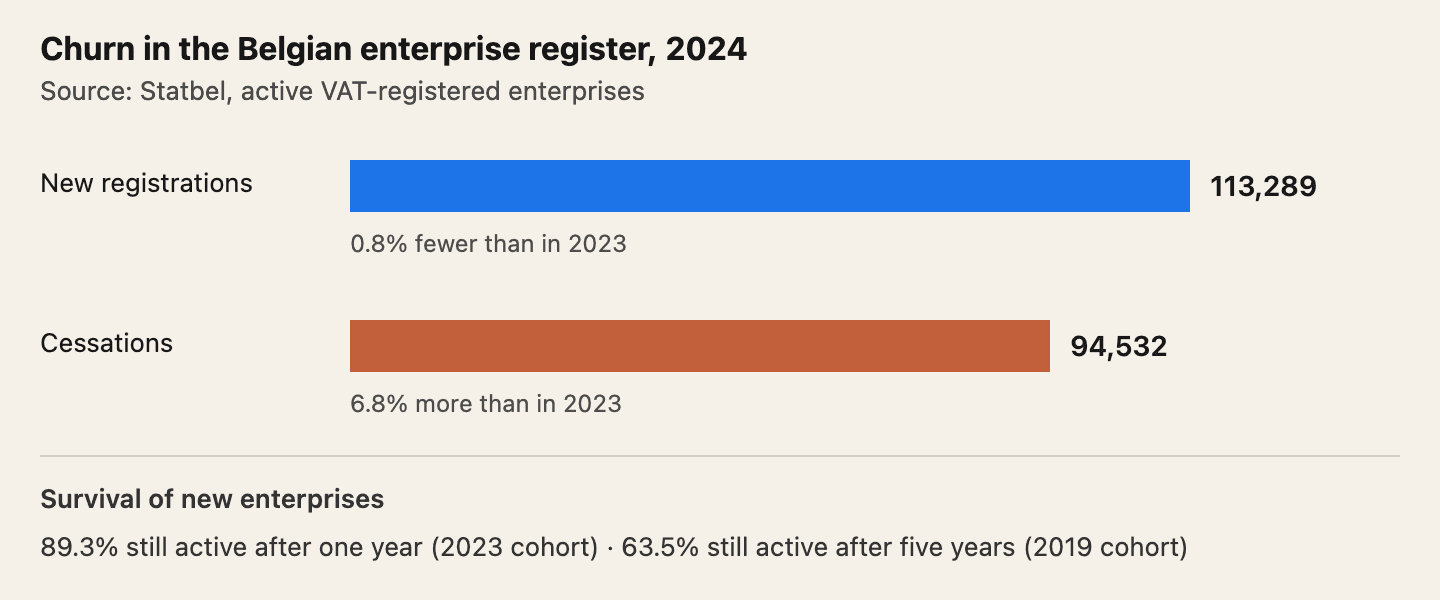
The survival data is the more useful of the two. Statbel follows cohorts of newly created enterprises: 89.3% of those created in 2023 were still active at the end of 2024, and 63.5% of those created in 2019 were still active five years later.
Read that as a decay schedule. On a list of newly registered Belgian companies, roughly one in ten is gone within a year and more than a third within five. The regional spread is narrow and mildly counterintuitive: Wallonia has the highest five-year survival at 65.7%, then Brussels at 62.8% and Flanders at 62.7%.
One caveat that matters for how you apply this. Those cohorts are new enterprises, and business mortality is heavily front-loaded by age. A list of established mid-sized companies will not decay at the cohort rate; a list built from recent registrations will decay faster than it. If you prospect new companies deliberately (and there are good reasons to, covered in finding newly registered Belgian companies), you are working the fastest-decaying part of the register by design, and the refresh cycle has to match.
The half nobody counts: records that stay valid and stop being true
Company death is the visible failure. It is not the common one. Far more often the company is fine and the record is wrong, which is worse, because nothing about it looks broken.
Registered offices move. The address on file is the registered seat, not necessarily where anyone works, and it changes without announcement to anyone holding a list.
Directors change. Appointments and dismissals are published in the Annexes to the Belgian Official Gazette with a date on each one. Your record of who runs the company was accurate when you captured it.
Legal forms and names change. Restructurings, mergers, demergers and transfers of assets all produce entities that are legally different from the ones you stored.
Establishment units open and close. A company can run many locations, each with its own number and activity codes. If you sell per site, a company record that has not been refreshed is wrong about deal size, not just about address. See establishment units explained.
And on 1 January 2025, the whole register moved to a new activity classification. Belgium adopted NACE-BEL 2025, implementing European NACE Rev. 2.1. Existing codes were converted automatically from the 2008 version, and where a 2008 code mapped to several 2025 codes only one successor was written. Any segment built on activity codes before that date is filtering on the older classification, and because the conversion was not always one-to-one, the two do not line up cleanly. It is the largest field-level change we have had to handle in Belgian company data in years, and because the companies themselves did not change, nothing in a CRM flagged it.
Contacts decay faster than companies
The two are different problems with different clocks, and treating them as one is why "our data is stale" is such an unhelpful diagnosis.
A company record goes wrong slowly and in public: the register announces most of it. A contact record goes wrong quickly and silently: people change roles, change employers, change email conventions after an acquisition. Nothing publishes that on a schedule.
The practical split: verify companies against the register, and verify contacts against recency. A company fact sourced from a filing is true until the next filing. A contact fact is only as good as the last time it was confirmed, which is why a "last found" date on a contact is more informative than the contact itself.
There is an upside to the asymmetry. A person leaving is a problem for your database and an opportunity for your pipeline: a new finance director six weeks into the job is a reason to call. Job-change signals turn contact decay from pure loss into timing.
What to re-check, and when
What | Where it changes | Sensible cadence |
Active or ceased | KBO/BCE register | Quarterly, or before any campaign |
Registered office and establishments | KBO/BCE register | Quarterly |
Activity codes | KBO/BCE register | Once now for the NACE-BEL 2025 conversion, then annually |
Headcount and financials | Filed annual accounts | Annually, after the filing season |
Directors and restructurings | Official Gazette Annexes | Monthly for target accounts |
Contact roles and emails | Nowhere public | Continuously; treat undated contacts as suspect |
That table is the Belgian layer: what each register publishes and how often it moves. The pattern underneath it is simple: register facts on a slow, reliable cycle; contact facts on a fast, sceptical one. For the process and ownership side of hygiene, see data hygiene for sales teams.
Why this is worse for imported lists
A purchased or scraped Belgian list carries an additional problem the decay figures do not capture: you usually do not know when it was accurate. A list assembled from an unknown vintage decays from a date you cannot see, which makes the numbers above a floor rather than an estimate.
That is the argument for sourcing company data from the register rather than from a snapshot of one. Bizzy is built that way for Belgium (identity and establishments from KBO/BCE, financials and headcount from the National Bank's filings, appointments and restructurings from the Official Gazette, a credit score from Creditsafe), so a record reflects the current filed state rather than whenever a file was last exported. Both the 2008 and 2025 activity codes are carried on each Belgian entity for exactly the comparability problem above. Contacts carry a "last found" recency, and job changes arrive as dated signals rather than silent corrections.
Worth being precise about the limits: that registry sourcing is the Belgian picture. Germany, Austria and the UK are covered through Creditsafe data rather than national registers.
Read next: B2B data enrichment: what the register gives you and what it does not.
Frequently asked questions
How fast does B2B data decay?
In Belgium, 94,532 enterprises ceased during 2024, against a year-end stock of 1,187,819 active enterprises. Of enterprises created in 2019, 63.5% were still active five years later, so more than a third of that cohort disappeared.
How often should I refresh a Belgian company list?
Check active status and addresses quarterly, refresh financials and headcount annually after filing season, and monitor directors and restructurings monthly for target accounts. Contact data needs continuous verification.
Why do CRM records go wrong even when the company still exists?
Because registered offices move, directors change, legal forms change after restructuring, establishment units open and close, and activity codes get reclassified. The record stays valid-looking while quietly becoming untrue.
What changed with Belgian activity codes in 2025?
Belgium moved to NACE-BEL 2025 on 1 January 2025. Existing codes were converted automatically from the 2008 classification, and where one old code mapped to several new ones only a single successor was written, so code-based segments need rechecking against both.
Do contacts or companies decay faster?
Contacts, by a wide margin. Company changes are mostly published in the register on a predictable schedule; people changing roles or employers is not published anywhere, which is why contact records need a recency date to be worth anything.
Written by Arthur Cremers at bizzy., which builds European B2B company data from official registers.
Sources
Statbel: Annual evolution of VAT-registered enterprises (published 16 October 2025, reference date 31 December 2024)
Statbel: Survivals of VAT-registered enterprises (published 16 October 2025)
Statbel: NACE-BEL 2025
FPS Economy: KBO Public Search
Belgian Official Gazette: Annexes, legal persons search
Photo of archive drawers, Archives of Ontario by Raysonho, CC0 1.0, via Wikimedia Commons