B2B data enrichment: what the register gives you and what it does not
Conseils
Most enrichment projects do not fail on the technology. They fail because nobody settled three questions first: which fields are genuinely available, which fields are estimated, and which field is the key you match on.
This piece answers those three. It is written for anyone filling a CRM with Belgian or Dutch company data who wants to know what is realistic before the budget is committed.
Enrichment is not the same as hygiene
Two different jobs that often land in one project.
Hygiene removes errors from what you already hold: duplicates, misspelled names, contacts who left, missing country codes. The source is your own file.
Enrichment adds what you did not have: the registration number, the legal form, the sector, the website, the number of open vacancies. The source is external.
The distinction matters because the failure modes are opposite. Hygiene fails when you delete too little. Enrichment fails when you overwrite too much.
What the company register gives you
The official register is the most reliable layer, and in the Benelux that layer is generous. In Belgium the Crossroads Bank for Enterprises supplies the name, the enterprise number, the registered office, the legal form, the NACEBEL activities, the start date and the status. In the Netherlands the KVK Handelsregister supplies the KVK number, the statutory name, the establishment address, the legal form and the SBI codes.
These fields have one property the rest do not: they are legally anchored. If the register says the legal form is a BV, it is. Enrich them without hesitation and let them be your source of truth.
Two caveats that hurt in practice. The registered office is not automatically where the work happens, which is what establishment units are for. And the registered activity code is what the company once declared rather than what it does today, as our guide to NACEBEL codes sets out.
What the register does not give you
Everything you actually reach a company with sits outside the register. It has to come from somewhere else, and that is where coverage thins out sharply.
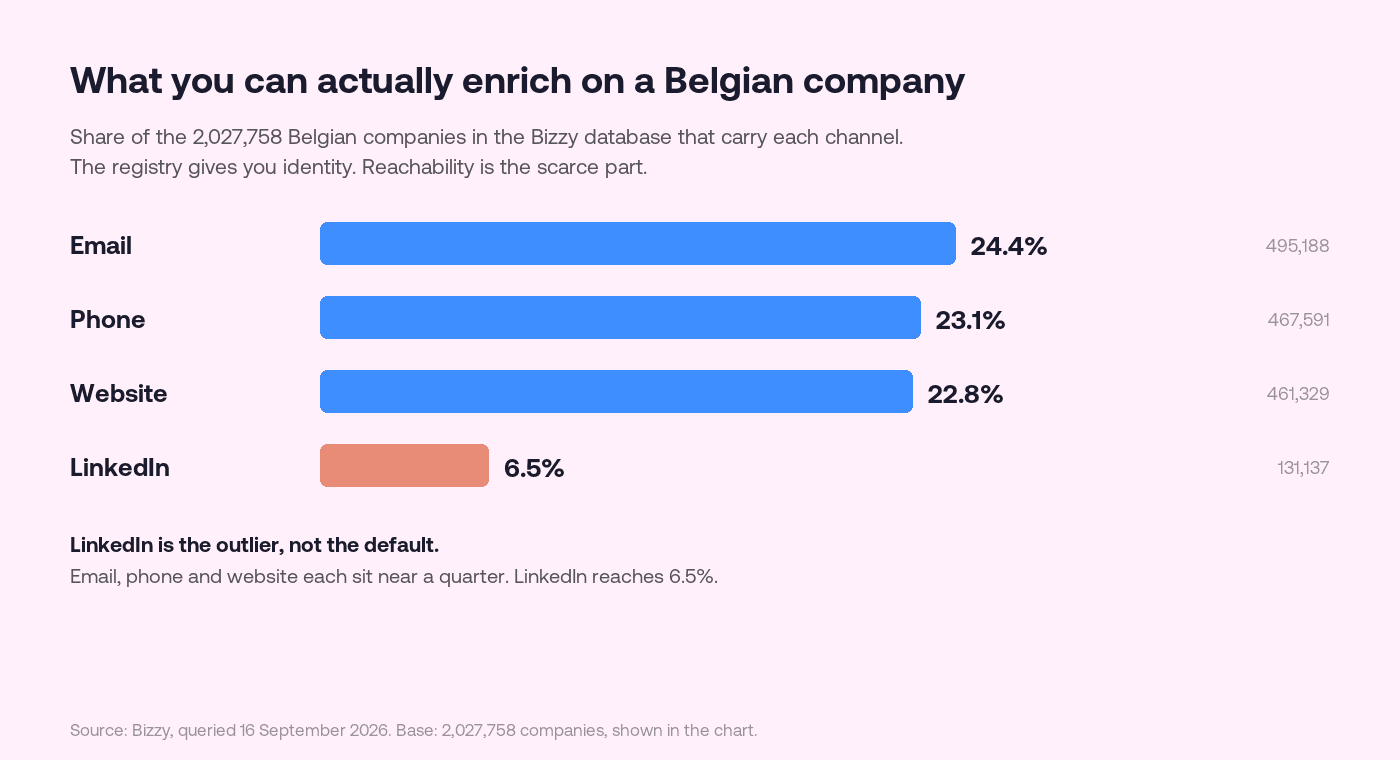
Of the 2,027,758 Belgian companies in our own database, 24.4% carry an email address, 23.1% a phone number and 22.8% a website. LinkedIn sits at 6.5%.
That last one deserves emphasis, because a lot of enrichment plans quietly assume LinkedIn as the backbone. For the Belgian mid-market it is not. Building an enrichment strategy on LinkedIn covers a small slice of the market. We worked that pattern out separately in LinkedIn coverage among Belgian companies.
One expectation worth taking from this: on an arbitrary list of Belgian companies, roughly a quarter are reachable through a channel you can use. A vendor promising 90% coverage on a raw register list is promising something the register cannot carry.
Note the words that matter here. This is coverage on record, meaning what has been captured. It is not a measurement of how many companies really have a website or a phone.
The match problem is bigger than the dataset
Most enrichment stalls on linkage rather than on missing data. You have to attach your record to the right external record, and there are only two usable keys.
The enterprise or KVK number is the only reliable key. It is unique, it survives a name change and it survives a move. If you enrich one field as a priority, this is it.
Matching on name does not work at scale. Company names in a CRM are full of trading names, abbreviations, former names and typos. The same business sits in the register under a statutory name nobody in sales uses. Name plus postcode beats name alone, but it is still a guess.
Two traps that get expensive if you let them run. Group structures mean a name search returns the parent while your customer is a subsidiary. And one company can have dozens of establishments, so an address match can hit the wrong unit.
If you work in HubSpot, Odoo or Teamleader, we have covered the practical side per system: HubSpot, Odoo and Teamleader Focus.
What you never let it overwrite
An enrichment run that overwrites everything destroys the most valuable thing in your CRM: what people put there themselves.
Leave the following alone, or write them to a separate field rather than over the top.
The contact a rep added after an actual conversation
Notes and call summaries
Manually corrected addresses, which are often more accurate than the registered seat
The trading name your customers use, even when the register says otherwise
Ownership, lifecycle stage and anything that drives your own process
The working rule: external sources may fill empty fields and may update register fields. They may never replace human input.
How often to enrich
Company data ages unevenly. The enterprise number never changes. The legal form rarely does. Contacts move constantly, and that is precisely the field sales depends on.
A workable rhythm for most teams: register fields twice a year, company-level signals such as vacancies and website monthly, and contacts continuously or immediately before a campaign. We measured how fast Belgian B2B data actually ages in how fast Belgian B2B data goes stale.
One condition separates a one-off cleanup from a working process: record, per field, where the value came from and when it was last updated. Without those two columns you can never decide later which source wins a conflict.
Where to start
Enrichment pays off if you keep the order. Put the enterprise or KVK number on every record first, because it is the key to everything else. Pull the register fields next, because they are reliable and free. Add reachability and signals last, and budget against the coverage in the chart above rather than against a vendor's promise.
If you first want to know which fields exist in the Belgian sources at all, start with looking up Belgian company data and the company register guide.
Frequently asked questions
What is data enrichment exactly?
Data enrichment means completing existing records with information from external sources: the enterprise number, the legal form, the sector, the website, contact details, or signals such as open vacancies. It differs from hygiene, which removes errors from what you already hold.
Which field should I enrich first?
The enterprise number in Belgium or the KVK number in the Netherlands. It is the only key that is unique, survives a name change and survives a move. Without it, every later enrichment is a guess on a name.
How many Belgian companies have an email address or phone number?
In our own database of 2,027,758 Belgian companies, 24.4% carry an email address and 23.1% a phone number. Website sits at 22.8% and LinkedIn at 6.5%. This is coverage on record in this database, not a measurement of the real world.
Can I enrich by company name?
At small scale with a review step, yes. At scale, no. Trading names, abbreviations, former names and group structures produce wrong links, and a wrongly linked record does more damage than an empty field.
Should an enrichment run overwrite existing fields?
Let external sources fill empty fields and update register fields, but never replace human input. Notes, self-added contacts and manually corrected addresses should be protected.