Establishment units in the Belgian register: why one company is many addresses
Tips
Pull a list of Belgian companies in a given sector and you will often find the same business several times, at different addresses, sometimes under different activity codes. That is not duplication. It is the register working exactly as designed.
A Belgian enterprise has one enterprise number and can have many establishment units, each with its own number, its own address and its own activity codes. Knowing which level you are looking at changes what your list actually contains.

Key takeaways
An establishment unit is a place, identifiable by a Belgian address, where an activity is carried out or from which it is carried out.
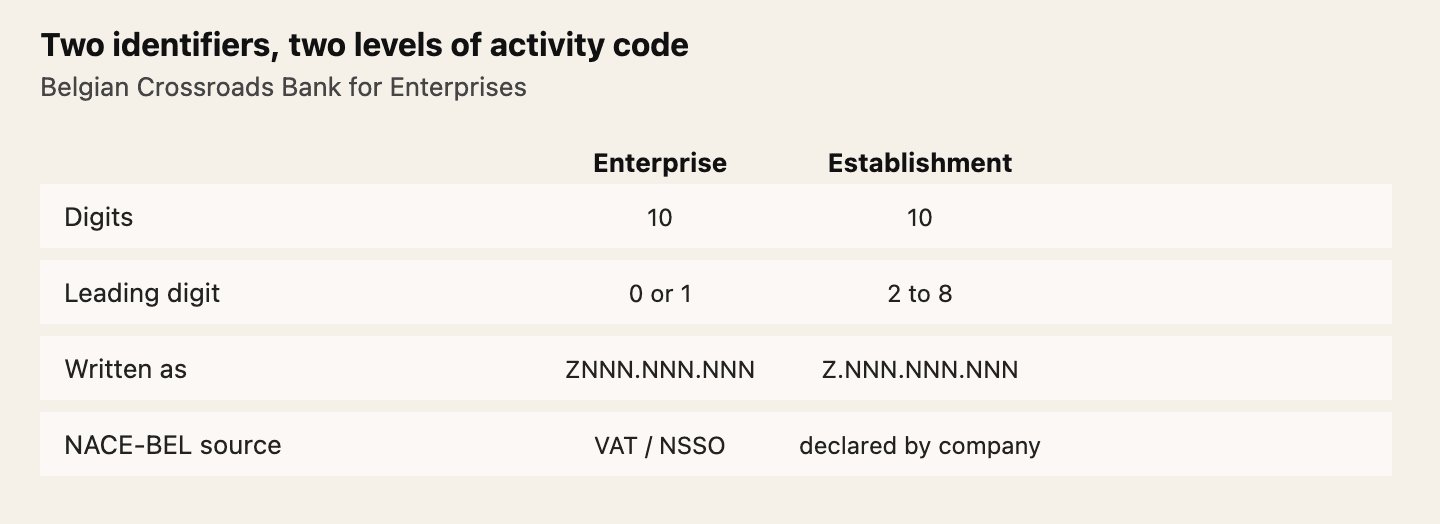
Enterprise numbers start with 0 or 1. Establishment unit numbers start with 2 to 8. Both have ten digits.
NACE-BEL activity codes exist at both levels: and they come from different sources.
Enterprise-level codes are largely assigned by the VAT administration and the social security office. Establishment-level codes are declared by the company itself.
A prospect list built on enterprise codes and one built on establishment codes are not the same list.
What an establishment unit is
The Code of Economic Law (art. I.2, 16°) defines it as a place, geographically identifiable by an address in Belgium, where at least one activity of the registered entity is carried out or from which the activity is carried out.
In Dutch it is a vestigingseenheid, in French an unité d'établissement. The social security administration calls the same thing a local unit (lokale eenheid), which is worth knowing when you cross-reference sources.
The official examples of establishment units are workplaces, shops, offices, seats, agencies and branches. Note that "seats" appears in that list: the registered office address can itself be an establishment unit, and for most small Belgian companies it is the only one. A one-person consultancy operating from home has one enterprise number and one establishment unit at the same address.
Social security's administrative instructions put it carefully: every enterprise, institution or association has in principle at least one establishment unit. The register's own documentation refers to data on the registered office "and any establishment units". The qualifier is deliberate.
The two numbers, and how to tell them apart
Both identifiers are ten digits, set by the Royal Decree of 24 June 2003:
Attribute | Enterprise number | Establishment unit number |
Digits | 10 | 10 |
Leading digit | 0 or 1 | 2 to 8 |
Written as | `ZNNN.NNN.NNN` | `Z.NNN.NNN.NNN` |
Scope | one per entity | one per place; each links to one enterprise |
The leading digit is the quick test. If a ten-digit Belgian identifier starts with a 2 through 8, you are holding an establishment unit number, not a company identifier, and it will not resolve in tools that expect an enterprise number.
Enterprise numbers used to start with 0. They began running out, and the first number starting with 1 was issued on 19 September 2023. Any validation rule that assumes a leading zero is now wrong.
The part that breaks prospect lists: activity codes at two levels
This is the point worth carrying away. NACE-BEL codes are registered at the enterprise level and at the establishment level, and they do not come from the same place.
At enterprise level, the register holds activities assigned by the VAT administration and by the social security office, alongside general activities. At establishment level, it holds the activities the company itself declared for that specific location, through a business counter or the My Enterprise portal.
Each establishment unit has a main activity, and may have secondary activities. The main activity is the one with the highest estimated turnover, the most full-time equivalents, or another criterion the company chooses. Auxiliary activities used to be registrable too, but stopped being an economic activity in the register on 28 March 2025.
The practical consequences:
A head office code can be unrepresentative. For a multi-site retailer, care group or contractor, the enterprise-level code describes the legal entity's fiscal classification. The shop, the ward or the depot may be classified quite differently.
Filtering at the wrong level changes your market. Filter a Belgian dataset on enterprise-level codes and you get legal entities. See TAM, SAM and SOM with real numbers for what that does to a market size. Filter on establishment-level codes and you get locations, which is what you want if you sell to sites rather than to head offices, and badly wrong if you then count each location as a separate company.
The same company can legitimately appear many times. Deduplicating on address or name will merge locations that are genuinely distinct, and deduplicating on enterprise number will collapse a national chain into a single record.
Which you want depends on what you sell. Software licensed centrally is an enterprise-level sale; equipment, signage, cleaning and point-of-sale systems are establishment-level sales.
A live data-quality problem: the NACE-BEL 2025 conversion
On 1 January 2025 Belgium moved to NACE-BEL 2025, implementing the European NACE Rev. 2.1 classification. Existing codes were converted automatically from the 2008 version, and the FPS Economy is explicit that this was not always a clean one-to-one mapping.
Some 2008 codes correspond to several 2025 codes. Where that happened, only one successor was written automatically, so a converted record can be incomplete or simply wrong. The register invites companies to correct their codes, free of charge.
For anyone segmenting on activity codes, that is a live caveat rather than a historical note. A Belgian list filtered on a 2025 code may be missing companies whose automatic conversion sent them elsewhere, particularly in sectors where the 2008 classification was broad. Where a segment matters commercially, it is worth checking both the 2008 and 2025 codes. The register publishes both.
How many establishment units are there?
There is no single published count of establishment units registered in the Crossroads Bank for Enterprises.
Statbel publishes an adjacent figure that is not a count of registered establishment units: roughly 1.41 million establishments linked to economically active legal units in the fourth quarter of 2023, about a third of which are statistical constructs built by Statbel rather than units registered in the Crossroads Bank. About 20% had salaried employment. It is not a like-for-like count of what you would find in the register.
Separately, Belgium had 1,187,819 active VAT-registered enterprises at the end of 2024 (Statbel). The two figures come from different populations and different reference dates, so the ratio between them is not meaningful, which is itself a useful reminder that establishment counts and company counts are different things.
Registering and maintaining them
Establishment units are registered through an accredited business counter of the company's choice. Through the My Enterprise portal, a company can enter and change certain data itself free of charge, including establishment units, their addresses and names, activities, contact details and bank accounts. Activities must be registered before they start, and updated when they change.
The federal business portal also states that a new activity or location must be notified within one month, and that an establishment unit may carry a maximum of five NACE-BEL codes as main activities.
There is no official aggregate, but a provider holding the register can count them: Bizzy shows the establishment count on each Belgian legal entity, with the addresses and activity codes attached to each one, which is the level most prospect lists should be built at.
For the register as a whole, see the Belgian company register explained. For what the accounts behind these entities do and do not disclose, see finding a Belgian company's revenue, and for building a segment from these codes, TAM, SAM and SOM with real numbers.
Read next: NACEBEL codes: how to look them up, and why yours may be wrong.
Read next: B2B data enrichment: what the register gives you and what it does not.
Frequently asked questions
What is a vestigingseenheid?
An establishment unit: a place identifiable by a Belgian address where an activity of the registered entity is carried out, or from which it is carried out. In French, unité d'établissement.
What is the difference between an establishment unit and a registered office?
The registered office is the company's legal seat. An establishment unit is an operating location. They are separate entries in the register, and for most small companies the seat is also the single establishment unit.
How do I recognise an establishment unit number?
Both identifiers have ten digits, but an establishment unit number starts with a digit from 2 to 8, while an enterprise number starts with 0 or 1.
Are NACE-BEL codes registered per company or per location?
Both. Enterprise-level codes come largely from the VAT and social security administrations; establishment-level codes are declared by the company for that specific location.
Can one company have several establishment units?
Yes. Shops, offices, workshops, agencies and branches each count as an establishment unit, each with its own number, address and activity codes.
Written by Arthur Cremers at bizzy., which builds European B2B company data from official registers.
Sources
FPS Economy: Definitions of types of activities
FPS Economy: Content of the Crossroads Bank for Enterprises
FPS Economy: KBO Public Search
FPS Economy: Conversion of NACE-BEL codes 2008 to 2025
FPS Economy: My Enterprise
Royal Decree of 24 June 2003 on enterprise and establishment unit numbers: ejustice
Statbel: Statistics on establishment units
Statbel: NACE-BEL 2025
business.belgium.be: Determining your economic activities
Photo of Rue Neuve, Brussels by Bernard Lee, CC0 1.0, via Wikimedia Commons