Belgium publishes more about its companies than almost any country in Europe, and nearly all of it is free. The problem is not access. It is that the information is split across four registers that were each built for a different purpose, and none of them tells you it is incomplete.
This is a map: which source answers which question, what it costs, and (the part that matters most for anyone building a prospect list) what is not in any of them. It sets the sources against each other rather than working through any one of them; the Crossroads Bank itself is covered in the Belgian company register.
Published 12 September 2026. Statbel figures reflect a 31 December 2024 reference date, which is updated annually.

Key takeaways
KBO/BCE holds identity: who exists, under what number, at which addresses, with which activity codes.
The National Bank holds the money: filed annual accounts, four years deep, free to consult.
The Belgian Official Gazette holds the events: incorporations, appointments, restructurings, each with a date.
VIES confirms one thing only: whether a VAT number is valid for cross-border trade.
None of them holds named contacts, their direct dials, tech stack or intent. KBO does carry a company's phone, e-mail and website where the company registered them.
The map
Question | Source | Cost | What you get |
Does this company exist, and where? | KBO/BCE Public Search | Free | Enterprise number, name, legal form, status, addresses, establishment units, NACE-BEL codes, registered company phone and e-mail |
How is it doing financially? | National Bank, Central Balance Sheet Office | Free | Filed annual accounts as PDF, XBRL or CSV, several years back |
What just changed? | Belgian Official Gazette (Annexes) | Free | Incorporation, capital changes, appointments and dismissals, office moves, mergers and demergers |
Is this VAT number valid? | VIES | Free | Valid or not valid, plus name and address for most member states |
Who runs it and who owns it? | Official Gazette + filed accounts | Free | Directors and mandates; shareholdings where filed |
Can it pay? | Commercial credit providers | Paid | Credit score, credit limit, risk band, payment behaviour |
KBO/BCE: identity
The Crossroads Bank for Enterprises is the spine. Every Belgian enterprise has one enterprise number, and everything else hangs off it. Public Search gives you the registered name, legal form, status, date of incorporation, registered office, every establishment unit with its own address and activity codes, and the authorisations the business holds. Unlike the Dutch register, it also publishes a company's phone number, e-mail address and website where the company has registered them, at company level, not per person.
Two things people miss. The registered office is not where the work happens: a company can hold a Brussels seat while all its staff sit in Flanders, which is what establishment units record separately. And the activity codes changed: Belgium moved to NACE-BEL 2025 on 1 January 2025, converting existing codes automatically from the 2008 version. Where a 2008 code mapped to several 2025 codes, only one successor was written. Anything you segment on activity code needs checking against both classifications for now.
More detail in our guide to the Belgian company register.
The National Bank: the money
Nearly every Belgian company must file annual accounts with the Central Balance Sheet Office, and anyone can read them for free through the Consult application. In 2025 the National Bank received 593,323 sets of accounts covering 567,501 legal entities, 99% of them filed in XBRL, and served 4.3 million consultations (NBB).
The size of that number relative to the register is itself informative. Belgium has 1,187,819 active VAT-registered enterprises. The two counts cover different populations, so treat the comparison as an order of magnitude rather than a ratio: a large share of the register files no accounts at all, because self-employed people and several other entity types have no filing obligation.
What you get: balance sheet, income statement, equity, debt, and the annual average headcount with the number of new hires. What you often do not get is turnover, because it is an optional line on the models most companies file. That is worth understanding properly before you build anything on it. See finding a Belgian company's revenue and how to read Belgian annual accounts.
The Official Gazette: the events
The Annexes to the Belgian Official Gazette are where corporate life is announced: a company is formed, a director is appointed or dismissed, the registered office moves, capital changes, two companies merge, a business is transferred. Each publication carries a date.
For a seller this is the most under-used source in Belgium, because it is the only one that tells you when something happened rather than what is true today. A new finance director appointed six weeks ago is a reason to call now. Our note on searching the Belgian Official Gazette covers how to work it.
VIES: one narrow job
VIES answers a single question: is this VAT number valid for intra-EU trade. It is not a company-information service, it does not carry financials, and a valid result is not a solvency check. Useful at invoicing, close to useless at prospecting. See checking an EU VAT number.
What the registers do not contain
This is the half of the picture the free sources cannot give you, and pretending otherwise is how prospect lists go wrong.
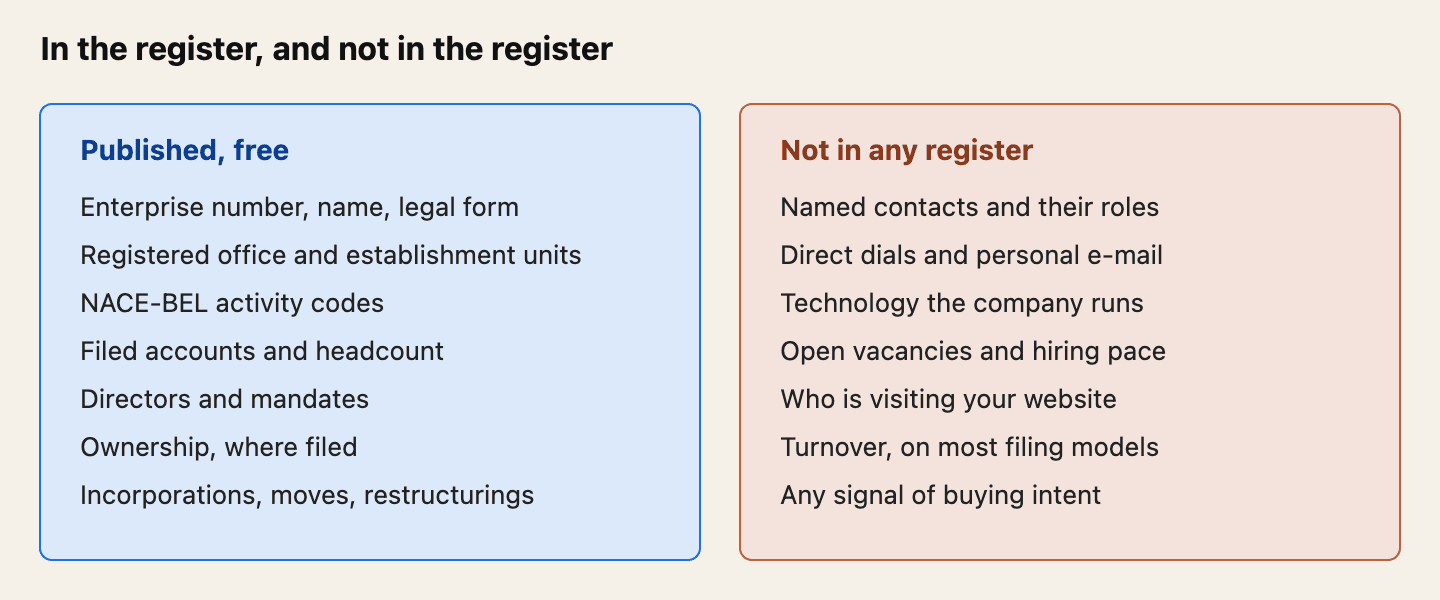
The right-hand column has to come from somewhere else: company websites, job boards, professional networks, detection of the technology a site runs, and your own web traffic. A registered company mailbox is not the same thing as a named buyer's address. That is not a gap in the Belgian registers: no company register anywhere holds those things. But it is the reason a register lookup is the start of prospect research and not the end of it.
Going from one company to a segment
Every source above answers questions one company at a time. You type in a name, you get a record. That is fine for checking a prospect before a call and useless for building a list of four hundred of them.
Turning public data into a segment means being able to ask the opposite question: which companies match a size band, a sector, a region, a growth pattern. That inversion is the actual work, and it is where a lookup tool stops and a data platform starts.
Bizzy is built around that inversion for Belgium. The identity fields from KBO, the filed financials from the National Bank, the official publications, a Creditsafe credit score and the things no register holds (contacts, detected tech stack, open vacancies, website visits) sit on one company record, and the same fields work as filters across the whole population rather than one company at a time. Two of those filters are specifically Belgian: joint committee codes, which map to sector-level collective bargaining and segment an HR or payroll market far better than any activity code, and topic search, which reads what a company actually says it does when its NACE code says something it stopped doing years ago.
One honest limit worth knowing: Belgium is the deep market here, registry-sourced and entity-level. Germany, Austria and the UK are covered through Creditsafe data rather than national registers, and they behave differently.
A working order
If you are checking a single Belgian company before a meeting, this sequence takes about five minutes.
KBO Public Search: confirm it exists, is active, and which establishment unit you actually care about.
National Bank Consult: open the latest filing. Check which model it is, read headcount and its direction, then the balance sheet.
Official Gazette: scan the last two years of publications for appointments, moves and restructurings.
The company's own site and job ads: what they say they do now, and what they are hiring for.
Steps one to three are free and definitive. Step four is where the reason to call usually comes from.
Read next: NACEBEL codes: how to look them up, and why yours may be wrong.
Read next: Which Belgian city is easiest to find online?.
Read next: B2B data enrichment: what the register gives you and what it does not.
Frequently asked questions
Where can I look up Belgian company data for free?
KBO/BCE Public Search for identity and addresses, the National Bank's Consult application for filed annual accounts, and the Annexes to the Belgian Official Gazette for appointments and restructurings. All three are free.
Is Belgian company information public?
Yes. Enterprise identity, registered addresses, activity codes, filed annual accounts, directors and official publications are all public and free to consult. Credit scores and payment behaviour are commercial products.
What is the difference between KBO and the National Bank?
KBO/BCE is the identity register: who exists, where, under which number and activity codes. The National Bank's Central Balance Sheet Office holds the filed annual accounts: the financial picture.
Can I find a Belgian company's turnover in the register?
Usually not. Turnover is an optional line on the micro and abbreviated filing models, which together account for roughly 96% of everything filed. Gross margin, balance sheet total and headcount are present.
What is not in Belgian company registers?
Named contacts and their roles, direct dials and personal e-mail addresses, the technology a company runs, its open vacancies and any signal of buying intent. KBO does publish a company's own phone number, e-mail and website where these were registered.
Written by Arthur Cremers at bizzy., which builds European B2B company data from official registers.
Sources
FPS Economy: KBO Public Search
National Bank of Belgium: Central Balance Sheet Office in figures
Belgian Official Gazette: Annexes, legal persons search
European Commission: VIES VAT number validation
Statbel: NACE-BEL 2025
Photo of university library reading room by Thaler, CC BY-SA 3.0, via Wikimedia Commons