Most advice on generating leads starts with the channel. Call more, email more often, advertise more cleverly. That is the wrong order. Who you approach shapes your result more than how you do it, and the list is the only part you fully control.
This piece runs through the order that works in practice: who first, then whether they are reachable, and only then the channel.
Start with the list, not the channel
A campaign to a thousand arbitrary companies and a campaign to two hundred well chosen ones cost roughly the same time. The second one produces more, and the difference is not in the copy.
Three things decide whether a list is any good.
Do the attributes you filter on actually exist? Many ideal customer profiles are full of criteria that appear in no dataset, such as growth ambition or digital maturity. Build your profile on attributes a source genuinely holds. We worked that through in building an ICP on filters that actually exist.
Is the list big enough to fill a quarter? A profile that yields forty companies is not a segment, it is an account list. How to work that out is in TAM SAM SOM.
Is there a trigger? A company that is hiring, moving, or opening a location is changing something. That is the difference between a cold conversation and a relevant one.
Which channels are actually open
This is where most planning trips up. You pick a channel and only afterwards discover you cannot use it on a large share of your list.
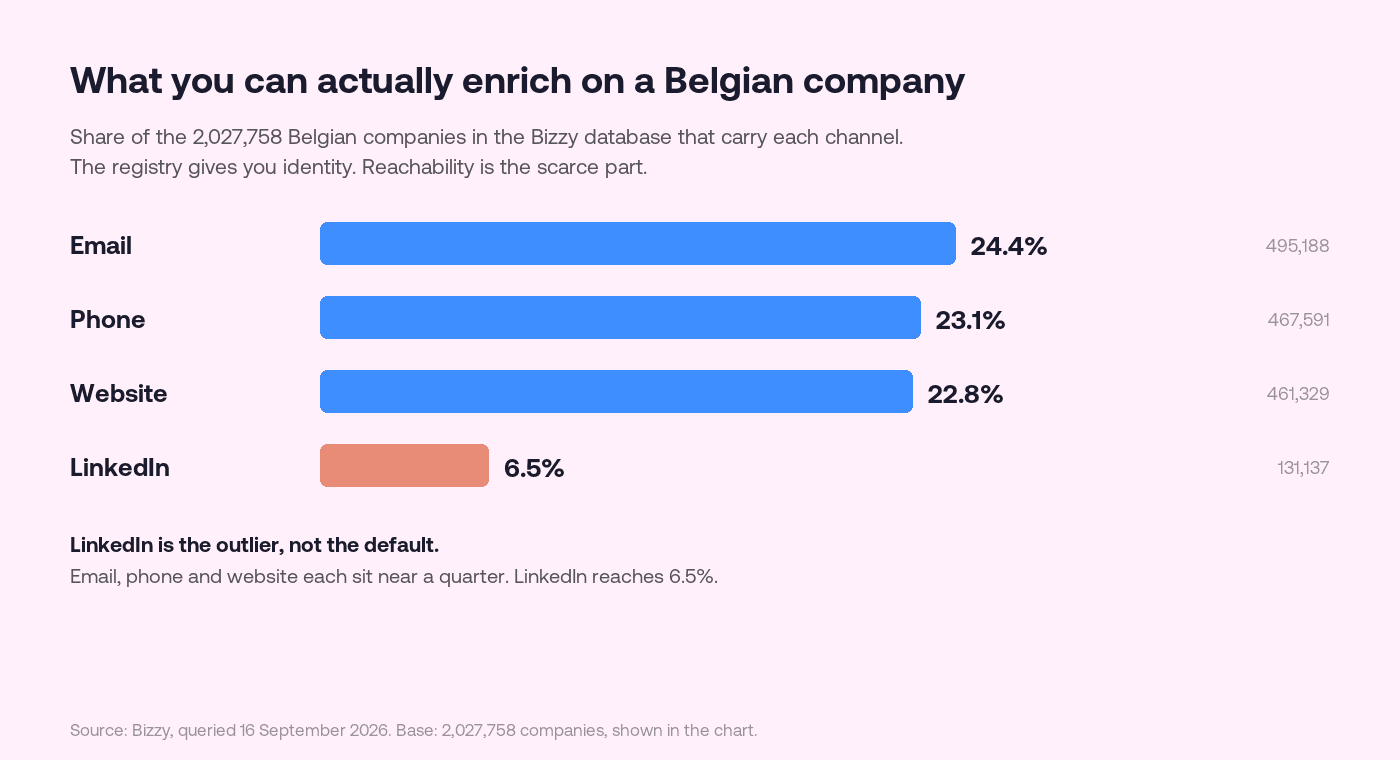
In our own database of 2,027,758 Belgian companies, 24.4% carry an email address, 23.1% a phone number and 22.8% a website. LinkedIn does not get past 6.5%.
Two consequences for planning. First, budget for roughly a quarter of usable contact points on a raw list, not ninety percent. Second, a strategy leaning entirely on LinkedIn covers a small slice of this segment. We described that pattern separately in LinkedIn coverage among Belgian companies.
The practical lesson is not that channels are bad. It is that you pick the channel after you know what is available, and you base your numbers on that.
From list to conversation
The order that works, in four steps.
1. Segment small enough to write one message. If your message has to fit the whole segment, the segment is too broad. Twenty to a hundred companies per message is workable.
2. Enrich before you start, not during. Put the registration number, the sector and the available contact points on every record before the first email goes out. How to approach that is in B2B data enrichment.
3. Choose the channel per record, not per campaign. A company with only a phone number gets a call. A company with only a generic inbox needs a different approach. One channel for the whole list means wasting three quarters of it.
4. Make sure the first conversation goes somewhere. A lead with no agreed next step is not a lead. The questions that force one are in ten questions that make a cold call work.
What to measure
Most teams measure the number of leads. That number steers badly, because it rewards volume over fit.
Three numbers that do steer.
Reachable share of the list. How much of your segment has a usable contact point? If it drops below a quarter, you fix that with better data rather than more activity.
Reply rate per segment, not per campaign. An average across the whole campaign hides which segment is working.
Share that reaches a concrete next step. This is the only number that correlates with revenue.
And track how fast your list ages. Contacts move constantly, and that is exactly the field this process leans on. We measured it in how fast Belgian B2B data goes stale.
Where it usually goes wrong
Picking the channel first. You then build the list towards the channel instead of the other way round, and end up with the companies that happen to be reachable rather than the right ones.
Making segments too broad. One message for a thousand companies is not a message.
Raising volume when it is not working. If a segment does not respond, more volume into that same segment is the most expensive way to get the same answer.
Forgetting to disqualify. A list that only grows gets worse on its own.
For the wider frame, see what lead generation is for the concepts and how to generate B2B leads in Europe for the channel side per market.
Frequently asked questions
How do you generate leads without an advertising budget?
By making the list do what an advertising budget otherwise does: filter out the right companies. A sharp segment with a genuine trigger usually produces more through direct outreach than broad reach with no selection.
How many companies do I need in a segment?
Enough to fill a quarter without approaching the list twice. Work back from your target: with a quarter of records reachable and a reply rate in the low single digits, you quickly need several hundred companies per segment.
Which channel works best for B2B?
It depends on what your data holds. In our Belgian database 24.4% carry an email address and 23.1% a phone number, while LinkedIn stays at 6.5%. Choose the channel per record based on what is available, not per campaign based on preference.
What is the difference between generating leads and lead generation?
In practice the same subject, but the search differs. "Generating leads" is usually about execution, "lead generation" about the concept and the strategy. This piece is about execution.
How often should I refresh my list?
Company attributes such as the registration number and the sector rarely change. Contacts move continuously. Refresh contact details just before a campaign rather than once a year.