Most pieces on B2B lead generation hand you a list of tactics. Content, SEO, LinkedIn, email, calling, events. That list is roughly the same everywhere, and that is the problem: which tactic works depends on something that almost never comes up.
That something is the size of your market. In B2B you can count it, and once you have counted it, half the tactics fall away.
What B2B lead generation is
B2B lead generation is the process of identifying companies that can use your solution and turning them into conversations with a real next step.
Three things make it different from B2C.
You sell to a group, not a person. Any purchase of size involves several people with different interests. One enthusiastic contact is not a deal.
The cycle is long and the numbers are small. A B2C campaign measures in thousands of conversions, a B2B campaign in dozens of conversations. That makes averages dangerous: one unusual deal distorts the whole report.
Your market is finite and countable. This is the difference that matters, and the next section is entirely about it.
Your market is countable, and that changes everything
In B2C you never reach everyone, so you buy attention. In B2B your audience is often a definable list of companies. You can count it before you spend a euro.
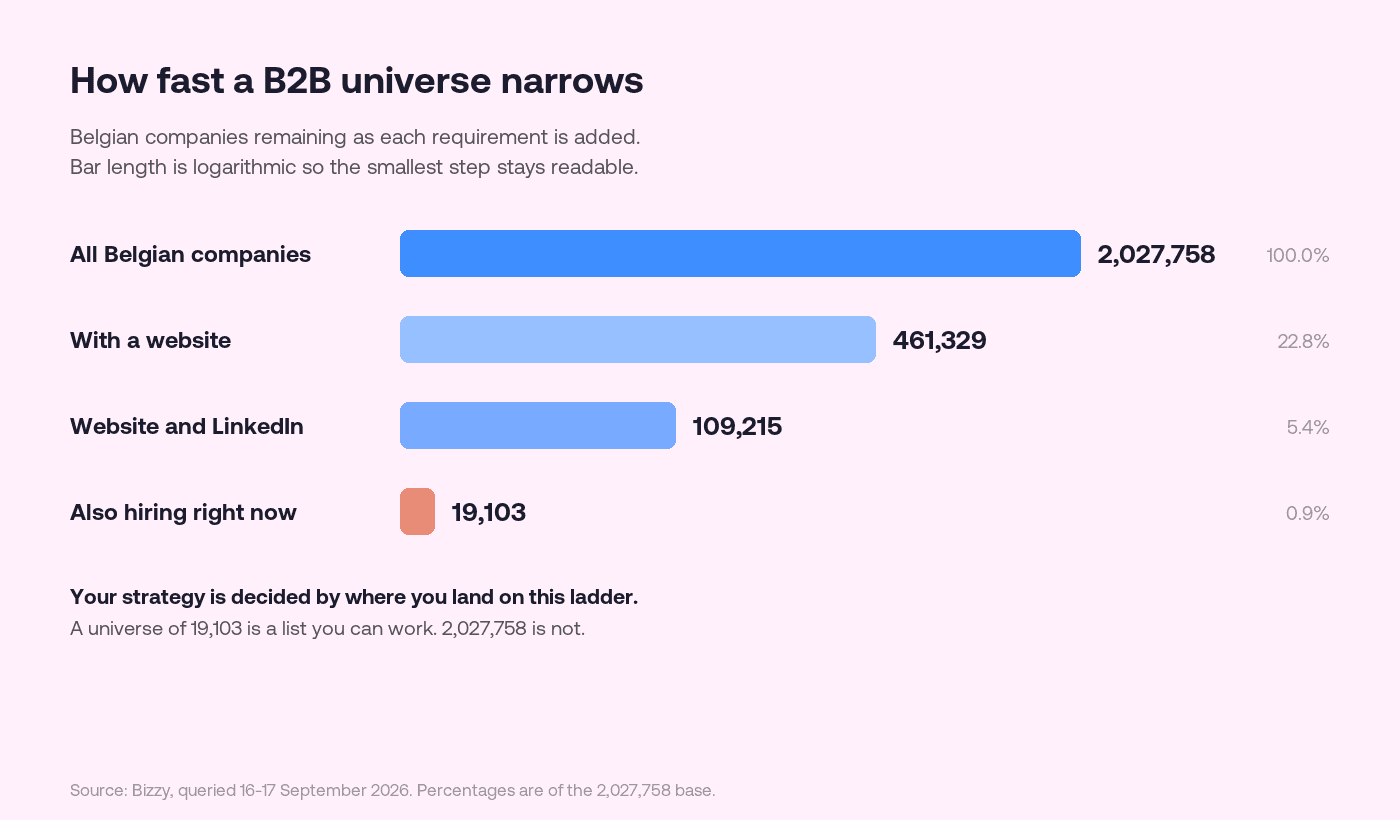
Four steps on one market. Of 2,027,758 Belgian companies, 461,329 have a website, 109,215 have both a website and a LinkedIn page, and 19,103 of those are hiring right now.
Notice what happens. Every condition you add because it helps your sales makes your universe an order of magnitude smaller. That is not a problem, it is the point. But it does mean your strategy flips somewhere along the way.
Which strategy fits which size
Not a law, but a usable rule of thumb to base the decision on.
Fewer than roughly 2,000 companies. You can reach all of them. Direct outreach and account-based work are more efficient here than any channel. You still make content, but as material you use in a conversation rather than a channel expected to deliver leads. Waiting for this market to find you is waiting.
Roughly 2,000 to 50,000 companies. Too large to approach everyone personally, too small to leave to chance. Here you earn it on segmentation and sequencing: you split the universe into pieces you can write one message for, and use signals to decide who comes up this month.
More than roughly 50,000 companies. You cannot work this by hand. Inbound and paid reach become necessary, and direct outreach targets a filtered slice rather than the whole.
The mistake this framework prevents is common: a company with a universe of 800 accounts building a content machine to get found, when it could simply have called those 800. And the reverse, a team trying to work 200,000 companies one at a time.
How to size your market is in TAM SAM SOM.
The four strategies, described honestly
Direct outreach. You choose who you speak to. Works for small and mid-sized universes, and lives or dies on the list. What you need for it is in generating leads: from a company list to a conversation.
Inbound and content. They find you. Scales well on large universes and on topics people actively search for. Slow to start, and rarely worth it on a small universe.
Signals and timing. You approach not everyone, but whoever is changing something now. Hiring is the most usable signal, because it is visible and it means something. See how to find Belgian companies that are hiring.
Partners and referral. The highest conversion and the least control. Fine as a supplement, never as your only plan.
Most teams need two of these, not four.
What to measure
In B2B the numbers are too small for averages across the whole funnel. Three that do work.
Coverage of your universe. What share of your target list has actually been approached this quarter? This is the number inbound teams never calculate and the one that makes outbound teams honest immediately.
Conversations with an agreed next step, not the number of leads. A lead with no next step is a row in a system.
Conversion per segment. An average across a campaign hides which part of your market is working.
Where it goes wrong
Choosing the tactic before the market. Almost every article on this starts with the tactic. Start with the size.
Trying everything at once. Four channels done halfway produce less than two done well.
Measuring quality as volume. More leads at the same revenue is not progress.
Letting the list age. Contacts move constantly, see how fast Belgian B2B data goes stale.
For the concepts and the wider frame, see what lead generation is and how to build it. For the channel side per European country, see how to generate B2B leads in Europe.
Frequently asked questions
What is B2B lead generation exactly?
The process of identifying companies that can use your solution and turning them into conversations with a concrete next step. It differs from B2C in that you sell to a group of decision makers, the cycle is longer, and your market is countable.
What works better in B2B, inbound or outbound?
It depends on how large your market is. Below roughly 2,000 companies direct outreach is more efficient, because you can reach everyone. Above roughly 50,000 you cannot work it all by hand and inbound becomes necessary. In between you usually use both.
How many companies are in a typical B2B universe?
Filters decide that. As an illustration: Belgium holds 2,027,758 companies in our database, of which 461,329 have a website, 109,215 also a LinkedIn page, and 19,103 of those are hiring right now. Each condition shrinks the universe sharply.
Is LinkedIn enough for B2B lead generation?
Not in this segment. Of the Belgian companies in our database, 6.5% carry a LinkedIn page. For the mid-market, LinkedIn alone covers a small slice. See LinkedIn coverage among Belgian companies.
How long before B2B lead generation shows results?
Direct outreach gives you a signal within weeks on whether your segment and message are right. Inbound needs months before it tells you anything. That difference in feedback speed is one more reason to base your approach on the size of your market.