Why international prospecting tools miss Belgian SMEs
It is a complaint you hear constantly from Belgian sales teams: we tried Lusha, or Cognism, or Apollo, and our own customers were not in it.
That is not imagination, and it is not a quality failure on their side. It is structural, and you can check the arithmetic. This piece explains the cause, with figures from our own database, and how to test it yourself in ten minutes.
The problem is the source, not the quality
International B2B databases are largely assembled from two sources: professional profiles on LinkedIn, and whatever can be extracted from company websites. That works very well in markets where nearly every business has a LinkedIn page and a maintained website.
Belgian company data lives somewhere else. It lives in the Crossroads Bank for Enterprises, a register every business is legally required to join. That register is not scraped the way LinkedIn is, and it is the only place the full population exists.
The consequence is predictable. A database built from LinkedIn contains the Belgian companies that are on LinkedIn. Nothing more.
What a LinkedIn-built database can see in Belgium
This is the number that settles the argument.
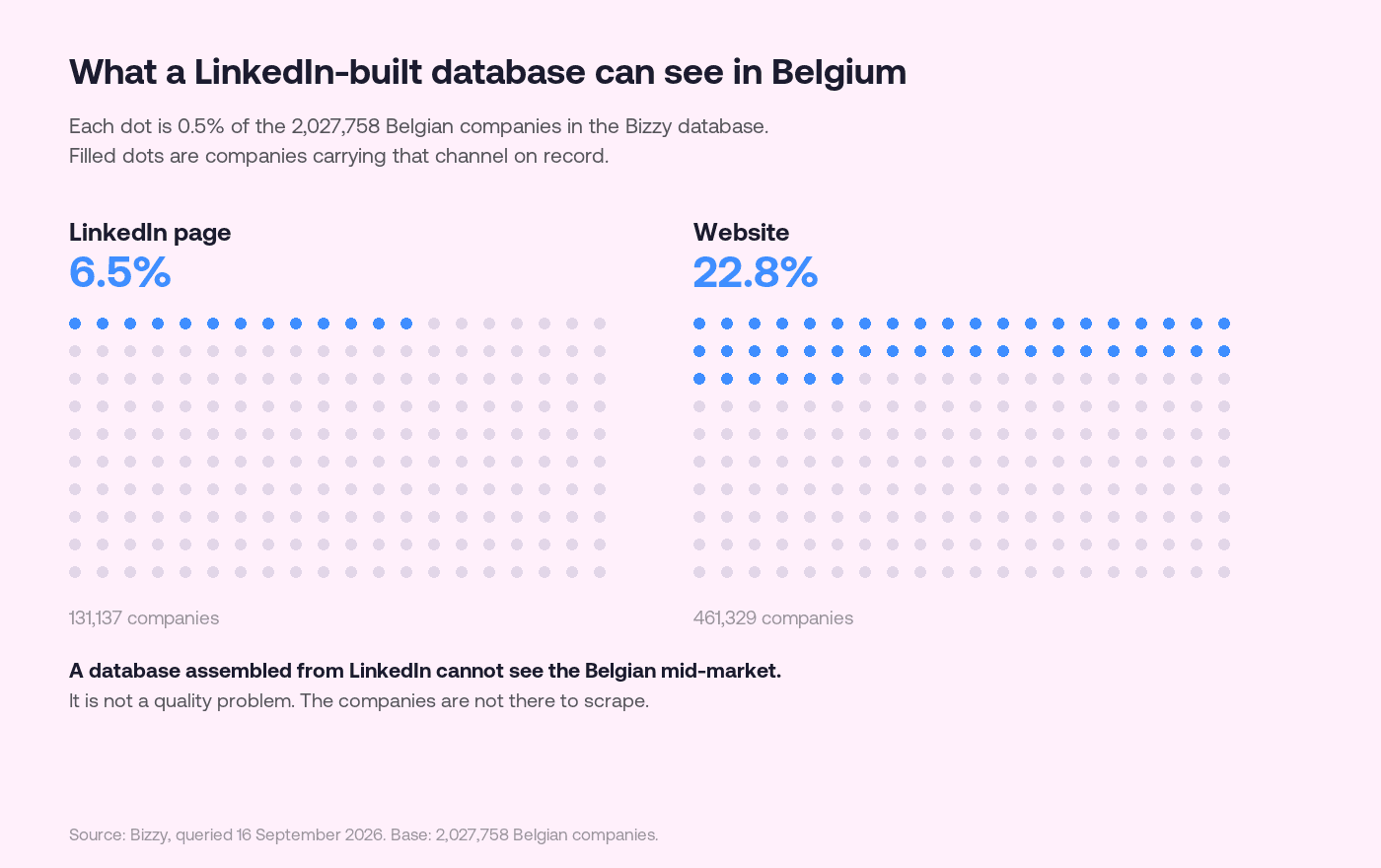
Of the 2,027,758 Belgian companies in our database, 6.5% carry a LinkedIn page. That is 131,137 of them.
Sit with that for a moment. A tool that sources its company records from LinkedIn can see, at best, roughly one in fifteen Belgian businesses. The other fourteen exist, pay VAT, hire staff and buy software. They are simply not on LinkedIn.
If your customers sit among those fourteen, no amount of data quality on the vendor's side fixes it. The records are not there to collect.
Web scraping does not get past a quarter either
The second source helps, but less than you would expect.
Channel | Belgian companies | Share |
Email address | 495,188 | 24.4% |
Phone number | 467,591 | 23.1% |
Website | 461,329 | 22.8% |
131,137 | 6.5% |
About a quarter of Belgian companies have a website. So a tool that discovers companies by crawling the web sees roughly a quarter of the market, and only the part that has put itself online.
That beats 6.5%, but it is still a minority. And it is a selective minority: larger and more digitally active businesses are over-represented, which is precisely the group everyone else is already chasing.
Why the register is the only complete view
The Crossroads Bank works the other way round. Registration is not a choice, it is an obligation. Every business operating in Belgium is in it, whether it has a website, uses LinkedIn, or can only be reached by phone.
That is why the register is the starting point for Belgian prospecting rather than an afterthought. You begin with the full population and filter down, instead of beginning with whatever happened to be visible online and hoping the rest did not matter.
How that register is structured, and what it does and does not contain, is covered in our guide to the Belgian company register and in looking up Belgian company data.
When an international tool is the right choice
This is not an argument that international tools are bad. They are built for a different problem, and for that problem they are often better than we are.
If you sell to large Belgian enterprises, LinkedIn coverage there is far higher and an international tool works well.
If you are looking for specific people and job titles rather than companies, that is exactly what these tools excel at. We start from the company.
If you sell across many countries with a profile that is not country-specific, the breadth of an international database matters more than Belgian depth.
The mistake is not choosing one of these tools. The mistake is expecting it to cover the Belgian SME market, then concluding that market is small when in fact you simply cannot see it.
How to test this yourself in ten minutes
Do not take our word for it. The test is simple and works with any vendor.
Take twenty existing customers who are representative of your ideal profile. No outliers, just your average customer.
Look each one up in the tool you are considering, by enterprise number where possible and by name otherwise.
Count how many are found, with usable data attached.
Find sixteen or more and that tool covers your market. Find fewer than ten and you will be building a large part of your pipeline by hand, however good the tool is otherwise.
This takes half an hour and saves a year's subscription to the wrong choice. Run it against every vendor you are considering, including us.
What this means for your shortlist
Start from your own customer base rather than from a feature list. If your average customer is a Belgian SME, the first question to any vendor is not how many contacts they hold, but where their company records come from. If the answer amounts to LinkedIn and web data, the figure above is the ceiling.
To compare more broadly, see our comparison of Belgian prospecting tools, and for building a profile on attributes that genuinely exist in the data, building an ICP on filters that actually exist.
Frequently asked questions
Why do Lusha and Cognism find so few Belgian SMEs?
Because their company records are largely assembled from LinkedIn profiles and web data, and only 6.5% of Belgian companies have a LinkedIn page. The missing companies exist, just not in those sources.
Does this mean those tools are bad?
No. They are built for markets and use cases where LinkedIn coverage is high, and for large enterprises or finding people by job title they work well. The problem only arises when you expect them to cover the Belgian SME market.
How many Belgian companies have a website?
461,329 of the 2,027,758 in our database, or 22.8%. Email sits at 24.4% and phone at 23.1%. This is coverage on record in this database, not a measurement of the real world.
What is a complete source for Belgian companies then?
The Crossroads Bank for Enterprises, because registration is a legal obligation. Any tool claiming full Belgian coverage has to be built on that rather than on what is visible online.
How do I check whether a tool covers my market?
Look up twenty existing customers in it and count the hits. Below ten out of twenty, the tool does not cover your segment, whatever the headline number on its website says.