There is no single Belgian definition of an SME. There are at least three in active use, they set different thresholds, and a company can comfortably be an SME under one while failing another.
That is not a technicality. It decides whether a company qualifies for subsidies, which annual accounts it has to publish, and how much you can find out about it.

Key takeaways
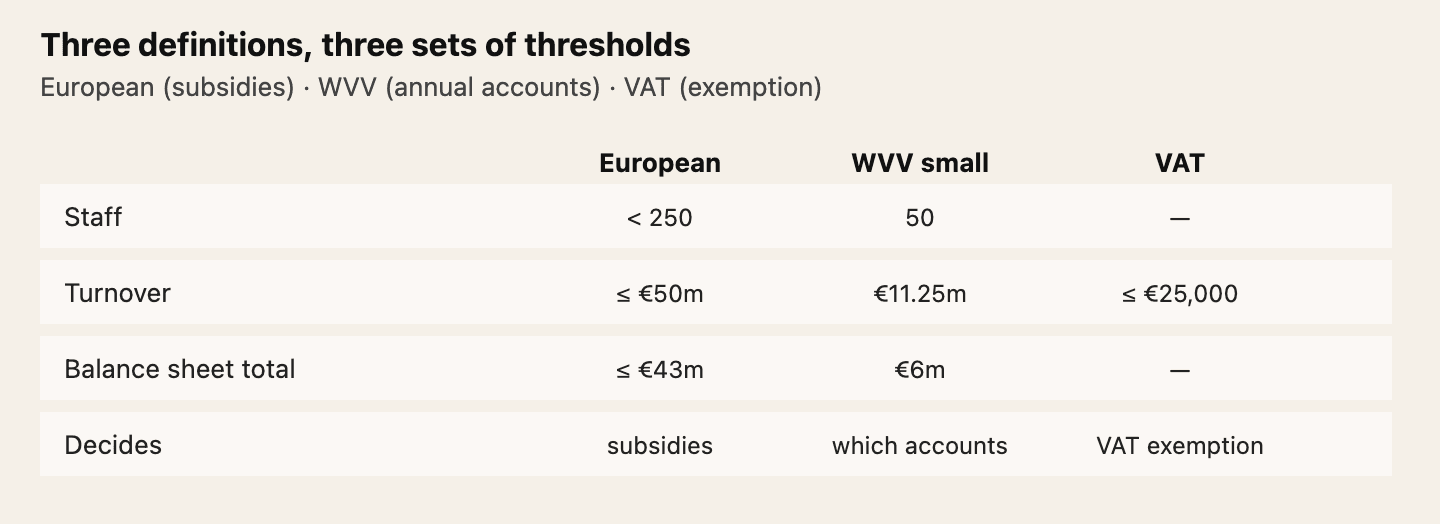
The European definition governs subsidies and state aid: fewer than 250 staff, turnover up to €50m or balance sheet total up to €43m.
The Companies and Associations Code (WVV) decides which annual accounts a company files: small is 50 staff / €11.25m turnover / €6m balance sheet.
VAT uses "small enterprise" for something else entirely, an exemption scheme with a €25,000 turnover ceiling.
Belgian tax law does not set its own thresholds; for "small company" it refers across to article 1:24 WVV.
The headcount condition is always binding in the European definition. The WVV lets you exceed one criterion of three.
1. The European definition (for subsidies and state aid)
This is the one most people in Belgium mean by "KMO" (kleine of middelgrote onderneming). It comes from Commission Recommendation 2003/361/EC and it has three tiers:
Category | Staff | Annual turnover | Balance sheet total |
Micro | < 10 | ≤ €2m | ≤ €2m |
Small | < 50 | ≤ €10m | ≤ €10m |
Medium-sized | < 250 | ≤ €50m | ≤ €43m |
Two rules matter. The staff headcount condition is mandatory: you must be under it. For the financial ceilings you may use turnover or balance sheet total, whichever suits you.
Flanders applies this framework through article 3 of the Decree of 16 March 2012 on economic support policy, which reproduces the same tiers and routes the independence test through Annex I of the General Block Exemption Regulation (EU) No 651/2014.
That independence test is where most surprises happen. A small Belgian company owned by a large group is assessed together with the enterprises it is linked to or partnered with, not on its own figures. A twenty-person Belgian subsidiary of a large international group is generally not an SME for subsidy purposes, however small it looks on its own accounts.
2. The WVV company-size criteria (for annual accounts)
Belgian company law sets entirely separate thresholds, and they decide which of the three annual-accounts models a company must publish. For financial years starting on or after 1 January 2024:
Criterion | Micro company (art. 1:25) | Small company (art. 1:24) |
Annual average workforce | 10 | 50 |
Net turnover excl. VAT | €900,000 | €11,250,000 |
Balance sheet total | €450,000 | €6,000,000 |
Here the logic is the opposite of the European test: a company qualifies as long as it exceeds no more than one of the three criteria. Exceeding more than one only has consequences when it happens in two consecutive financial years.
A micro company must additionally be neither a parent nor a subsidiary.
These figures went up recently. The turnover and balance-sheet ceilings were raised by the Act of 28 March 2024 (Belgian Official Gazette, 29 March 2024), transposing Delegated Directive (EU) 2023/2775. The headcount criteria did not change. The two-consecutive-years consistency rule was suspended once, for accounts closed after 31 December 2023, to let the new figures take effect immediately.
The consequence is visible in public: micro companies file the micro model, small companies the abbreviated model, everyone else the full model. Which model a company filed is one of the first things worth checking on a Belgian prospect. See the Belgian company register explained. And the abbreviated and micro models do not require turnover to be disclosed, which is why a Belgian company's revenue is so often missing.
3. VAT: the same words, a different meaning
Belgian VAT law also uses "small enterprise", and it has nothing to do with either definition above. It refers to the exemption scheme for businesses whose annual turnover does not exceed €25,000 excluding VAT. A company can be a medium-sized enterprise under the European definition, a small company under the WVV, and nowhere near the VAT threshold, all at once.
Tax: no thresholds of its own
Belgian corporate tax law does not set its own size thresholds. For the concept of a "small company" it refers across to article 1:24 WVV, the same test that decides which accounts get filed. The practical effect is that the company-law definition carries tax consequences too, which is why the two-consecutive-years rule matters more than it first appears.
Where the definitions actually collide
These are worked illustrations using the thresholds above, not case law.
Company | European (subsidies) | WVV (annual accounts) |
40 staff, €45m turnover, €20m balance sheet | SME: medium-sized, under 250 staff and under €50m | Large: exceeds two of three |
60 staff, €8m turnover, €4m balance sheet | SME: medium-sized; it fails the small tier only because the under-50 staff condition is binding | Small: exceeds only one criterion |
20 staff, €3m turnover, majority-owned by a large foreign group | Not an SME: assessed with linked enterprises | Not micro: a micro company may be neither a parent nor a subsidiary (art. 1:25) |
Freelancer trading through a BV, €30,000 turnover | Micro | Micro company, but over the €25,000 VAT threshold |
The first row is the one that catches people: a company can draw SME subsidies while being legally obliged to publish full annual accounts.
A freelancer who trades as a sole trader rather than through a company falls outside the WVV test altogether. Natural persons are not companies and file no annual accounts. Under the European definition they are enterprises like any other. That is a fourth way the definitions part company.
What the test looks like on a real company
Silverfin, the Ghent software company, is a clean illustration of why ownership decides this. Its own filed figures read like a comfortable mid-sized SME: an average of 99 employees in the latest filed year and revenue of €47.2 million. On those numbers alone it sits inside the European medium-sized tier.
It is also wholly owned by Visma Belgium Holding, which holds around thirty Belgian legal entities. That makes it a linked enterprise, so the European test is not run on Silverfin's figures at all. It is run on the group's. Whether the group clears the ceilings is a separate question needing the consolidated accounts, and the point here is narrower: you cannot answer the SME question from the company's own accounts once ownership is in the picture.
This is why a group-structure view matters more than another financial ratio. Bizzy publishes the ownership tree for Belgian entities: parent, percentage held, country and the subsidiaries beneath. That is the field this test actually turns on.
How to think about it
The three tests are asking different questions.
The European definition asks how big is the economic group you belong to, which is why ownership matters so much.
The WVV asks how much detail must you publish: which is why it tolerates exceeding one criterion.
VAT asks are you small enough to skip VAT administration, a far lower bar.
If you are qualifying Belgian companies commercially, the WVV definition is usually the one to work with, because it is the one visible in the public register. It also sets the ceiling on how large a segment of genuinely small companies can be. See TAM, SAM and SOM with real numbers. It tells you which accounts exist, and therefore how much you can learn about a company before you ever speak to it.
One thing to watch: a new "small mid-cap" category is taking shape between SME and large enterprise. The Commission has already adopted Recommendation (EU) 2025/1099, setting it at under 750 staff with turnover up to €150 million or a balance sheet total up to €129 million. The legislation that would give the category legal effect is still going through Parliament and Council, and MEPs have pushed for higher figures, so treat the category as unsettled even though the recommended thresholds are fixed.
For how the size class determines what a company publishes, see finding a Belgian company's revenue and how to read Belgian annual accounts.
Frequently asked questions
What is the European SME definition?
Fewer than 250 staff, with annual turnover up to €50 million or a balance sheet total up to €43 million. The staff condition is mandatory; the two financial ceilings are alternatives.
What is a "small company" under Belgian company law?
A company that exceeds no more than one of: 50 employees on annual average, €11,250,000 net turnover excluding VAT, or €6,000,000 balance sheet total, for financial years starting on or after 1 January 2024.
Can a company be an SME and still file full annual accounts?
Yes. A firm with 40 staff and €45 million turnover is a medium-sized enterprise under the European definition but a large company under the WVV, so it must file the full model.
Did the Belgian size thresholds change?
Yes. The turnover and balance-sheet criteria rose for financial years starting on or after 1 January 2024, through the Act of 28 March 2024 transposing Delegated Directive (EU) 2023/2775. The headcount criteria stayed the same.
What is a small enterprise for Belgian VAT?
A business whose annual turnover does not exceed €25,000 excluding VAT, which may use the VAT exemption scheme. This is unrelated to the European and company-law definitions.
Written by Arthur Cremers at bizzy., which builds European B2B company data from official registers.
Sources
European Commission: SME definition (Recommendation 2003/361/EC)
Flemish Codex: Decree of 16 March 2012 on economic support policy, art. 3
CBN/CNC: Article 1:24 WVV and Article 1:25 WVV
CBN/CNC: Consequences of the increased size criteria (advice 2024/07)
National Bank of Belgium: Size criteria for companies
FPS Finance: VAT schemes and the exemption for small enterprises
European Parliament: Simplified rules for small mid-cap companies