Company credit check: how to check a customer in the Netherlands and Belgium
Tips
The short answer
A company credit check answers one question: will this customer pay your invoices? You do it in three layers. First, check the public registers for free: does the company exist, does it file its annual accounts, is there a bankruptcy on record. Then get a credit score and a credit limit from a credit bureau. And for customers who stay, keep watching those figures instead of looking once. The biggest difference between the two countries sits in the first layer: in Belgium the annual accounts are free at the National Bank, while in the Netherlands you pay per document and most small companies file only a balance sheet. For a sales team, timing matters more than the source: check before you send a quote with payment terms, not after the first invoice goes unpaid.
Checked on 23 September 2026. This is not financial advice and it does not replace credit insurance.
What a credit check is, and what it is not
A credit check estimates short-term payment risk. That is a different question from whether a company is structurally healthy, which you answer with solvency, liquidity and profitability ratios from the annual accounts; how that works is in is this company financially healthy? A credit check uses those figures too, but adds things no annual report contains: payment experiences reported by other suppliers, recent official publications, and a model that condenses all of it into a score.
A credit score is a probability, not a verdict. A company with a poor score may pay you perfectly well, and a company with a good score can still fail next quarter.
Layer 1: what you can check yourself for free
Question | Netherlands | Belgium |
|---|---|---|
Does the company exist, and who runs it? | The KVK Business Register. Searching is free; an extract listing directors and signing powers is paid | The KBO/CBE (Crossroads Bank for Enterprises), free, including legal status and functions |
Does it file annual accounts, and what is in them? | KVK, paid per document. BVs, NVs and cooperatives must file, sole traders do not. A micro company files only a limited balance sheet, a small company an abridged balance sheet with notes | The National Bank's Central Balance Sheet Office, free. Companies file; in the micro and abridged formats turnover is not a mandatory item |
Is there a bankruptcy or restructuring? | The judiciary's Central Insolvency Register, free: bankruptcies, suspensions of payments and debt rescheduling | The Belgian Official Gazette, free. How to search it is in how to check whether a Belgian company is bankrupt |
Does it owe social security or tax? | No public source | Check inhoudingsplicht, free, by company number |
Is the VAT number valid? | The European Commission's VIES, free | VIES, free. What it does and does not prove is in how to check an EU VAT number |
Sources: KVK, who must file and KVK, micro and small; Central Insolvency Register; Check inhoudingsplicht. All consulted on 23 September 2026.
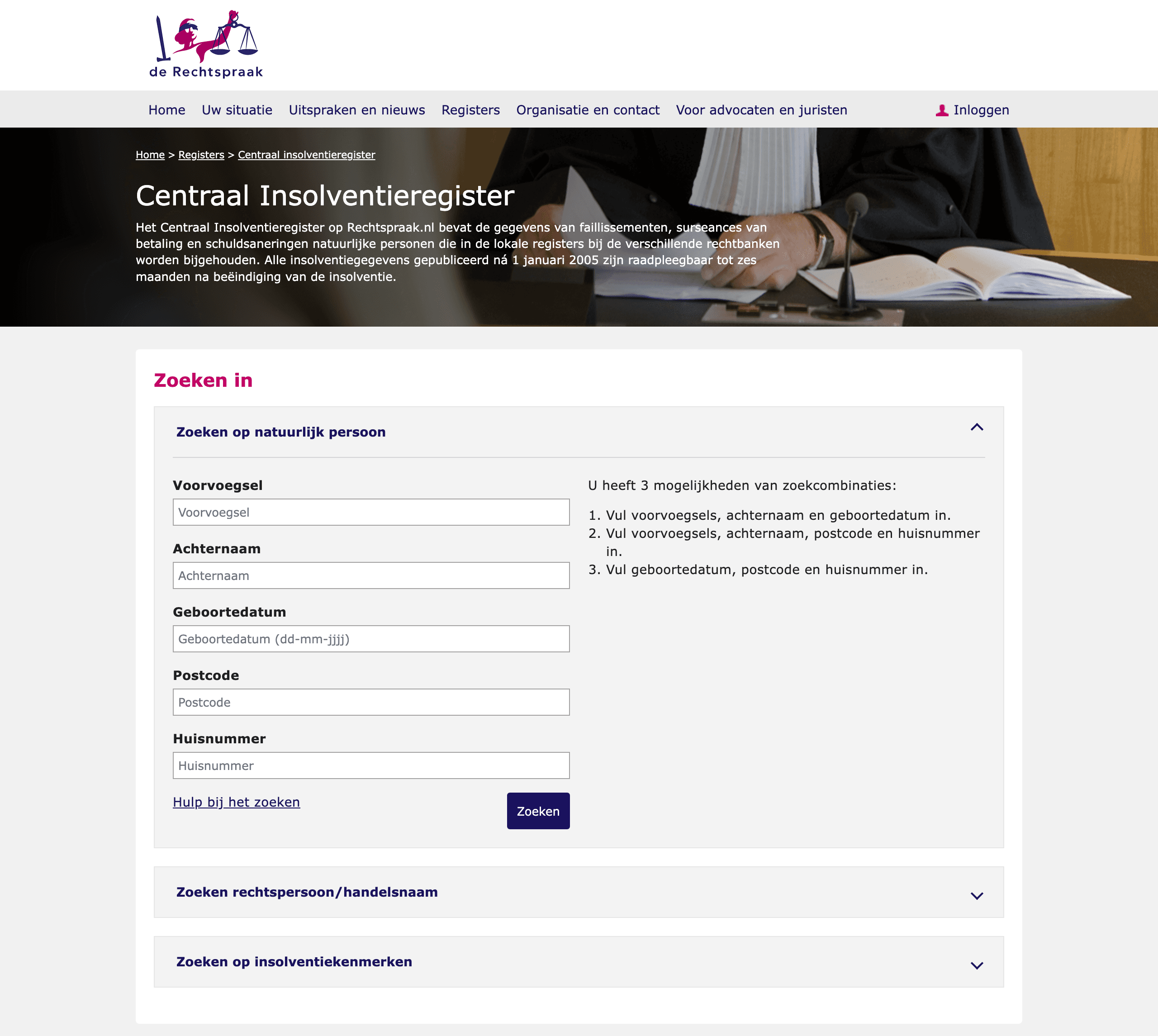
To look up a company in the Central Insolvency Register, open "Zoeken rechtspersoon/handelsnaam" (legal entity or trade name); the form opens on natural persons by default. Screenshot of rechtspraak.nl, 23 September 2026.
The Belgian row on social security and tax debt needs a sentence of context. Check inhoudingsplicht exists for clients in sectors such as construction, cleaning, security and meat processing: before every payment they must check whether their contractor owes the social security office (RSZ/ONSS) or the tax authority, and if so withhold part of the invoice. But the result also tells you something about a customer. A company with unpaid social or tax debt is already not paying the state on time.
What this layer cannot show. Payment behaviour. Whether a company pays its suppliers within 30 days or 90 is not recorded as such in any public register; credit bureaus and credit insurers collect those payment experiences from suppliers. And recency: in Belgium the accounts must be filed within seven months of the year end, in the Netherlands within twelve. Pull a Dutch company's accounts in September and you may be reading the year before last. How to pull and read Belgian accounts is in how to read a Belgian company's annual accounts.
Layer 2: a credit score and a credit limit
A credit bureau combines register data with payment experiences and publications, and condenses the result into two numbers: a score expressing the likelihood of insolvency, and a credit limit, the amount the bureau considers reasonable to extend on credit. In the Netherlands and Belgium the active bureaus include GraydonCreditsafe, Dun & Bradstreet and CreditDevice, and platforms such as Company.info resell their reports. The credit insurers Atradius and Allianz Trade also offer a limited free check.
Route | What you get | Conditions |
|---|---|---|
Atradius, free creditworthiness check | A green, orange or red rating for a Dutch organisation, with an advisory call within five working days | One-off; unlimited if you take out credit insurance |
Allianz Trade, free check | A score from 1 (excellent) to 10 (bankrupt) for three customers or prospects | Aimed at companies with more than EUR 100,000 in B2B revenue; their team contacts you |
A single credit report | A full report per company. A reseller such as kredietrapportaanvragen.nl charges EUR 12.95 for a Dutch company, based on Dun & Bradstreet and Creditsafe data | Per report, no subscription |
A bureau subscription | Reports, scores and monitoring across your customer base, often through an integration with your accounting software or CRM | Price on request |
Sources: Atradius, Allianz Trade, kredietrapportaanvragen.nl, Company.info. Terms and prices as listed on 23 September 2026.
How to read a score. Every bureau uses its own scale, so never compare one bureau's score with another's. Creditsafe's international score runs from A to E: A is the lowest risk, D the highest, and E means the company is unrated. The score expresses the likelihood that a company becomes insolvent within the next twelve months (Creditsafe). Mind that E: an unrated company is not the same as a badly rated one. It means Creditsafe has no score, for example because there is too little data. Check the company's status before you read anything into it.
How to use a credit limit. Compare the limit with what the customer will owe you at any one time, not with the total contract value. An annual contract of EUR 60,000, invoiced monthly on 30-day terms, rarely means more than two monthly invoices open at once. If the limit is below that, it is not a reason to walk away from the deal, but it is a reason to discuss terms: prepayment, a shorter payment period or smaller deliveries.
Check the right entity. This is a common mistake. A group consists of several legal entities, and the parent's score is not the score of the subsidiary that receives your invoice. Look at the quote or contract to see which company or KVK number signs, and check exactly that number.
When to check in a sales cycle
Many companies run a credit check only when finance sets up a new customer. By then the deal is signed and the only outcome left is an awkward conversation. Four moments work better.
When you build your target list. The cheapest credit check is the company you never approach. When you build a prospect list, you can filter out high-risk companies before anyone spends time on them. That saves your reps time on deals that would stall on payment terms at the end anyway. How to build that list is in the prospecting guide for Belgium.
Before the quote. The payment terms are in the quote, so that is where you need to know what you can offer. A quick look at score and limit is enough.
Before the first delivery on invoice. Certainly above an amount you set yourself. This is where the full report belongs, and for large amounts the question of whether your credit insurer covers the customer.
For existing customers, continuously. A customer who was healthy two years ago is not automatically healthy today. Look again when new accounts are filed, when you want to raise the credit line, and when something changes: a new director, a change of address, a publication in the Official Gazette. Credit bureaus offer monitoring for this; for Belgian companies you can also follow director changes and publications yourself, as explained in how to search the Belgian Official Gazette.
Red flags worth a second look
None of these is a verdict on its own. Each is a reason to ask questions before you deliver on invoice.
The annual accounts are missing, or arrive well after the legal deadline.
Equity is negative: the company owes more than it owns.
The score has dropped since your last check, or the credit limit has been cut.
The signing entity was incorporated recently, while you are talking to a business that has existed for years.
In Belgium: a negative result on Check inhoudingsplicht, or a publication about a judicial reorganisation.
For the ratios themselves, and what they do not tell you, see solvency and liquidity.
Credit checks in Bizzy
Bizzy is a prospecting platform, not a credit bureau, but it moves the credit check earlier in the sales cycle. For Belgian companies, the legal entity record shows the Creditsafe credit score with its risk band and the credit limit, next to four years of financials from the accounts filed at the National Bank and the publications from the Belgian Official Gazette. Because each company in Bizzy is linked to its legal entities, you can also see straight away which entity you are actually checking.
The most useful part is in search. You can filter on the Creditsafe score, so high-risk companies never make it onto your prospect list before someone calls them. The score remains Creditsafe's assessment, not Bizzy's. For a credit decision on a large contract, a full report or credit insurance is still the right route. These credit fields apply to Belgian companies; which financial fields Bizzy shows in other countries differs by country.
For Dutch customers, check the Dutch insolvency register; for Belgian ones, how to check a Belgian bankruptcy.
A check is one step in a process: credit management and DSO, and what to do when an invoice stays unpaid.
Frequently asked questions
What is a company credit check? An estimate of the likelihood that a company will not pay its invoices. You combine public register data, such as annual accounts and bankruptcy publications, with a credit score and a credit limit from a credit bureau.
Can I check a company's credit for free? Partly. In Belgium the KBO, the annual accounts at the National Bank, the Official Gazette and Check inhoudingsplicht are free. In the Netherlands, searching the Business Register and the Central Insolvency Register is free, but an extract and the annual accounts are paid. Atradius and Allianz Trade each offer a limited free check. A credit score that includes payment behaviour only comes from a credit bureau or credit insurer.
What does a credit score from A to E mean? At Creditsafe, A is the lowest risk and D the highest; E means there is no score, for example because there is too little data. The score expresses the likelihood of insolvency within twelve months. Other bureaus use other scales, so only compare scores from the same bureau.
What is a credit limit? The amount the credit bureau considers reasonable to extend to a company on credit. Compare it with what the customer will owe you at any one time, not with the total contract value.
How often should I re-check a customer? At least when new annual accounts are filed, when you want to raise the credit line, and when a change is published, such as a new director or a restructuring. For customers with large outstanding balances, monitoring through a credit bureau is the most reliable route.