Every account-based marketing programme is described as one of three types: one-to-one, one-to-few, one-to-many. Most explanations treat them as a menu: pick the one that fits your ambition.
They are better understood as a trade between two things you do not control. How much attention you can afford to give a single account, and how many accounts of that calibre exist in your market at all. Get the second one wrong and the first is academic.
This page sets out what each type actually is, and then does the part usually left out: counts how many accounts each one can draw from in Belgium.
Published 12 September 2026. Statbel figures reflect a 31 December 2024 reference date, which is updated annually.

Key takeaways
One-to-one is a bespoke programme for a single named account. In Belgium the genuine giants number 57 at 5,000+ staff.
One-to-few clusters five to fifteen accounts that share a problem. Belgium has 390 enterprises at 1,000+ staff.
One-to-many runs programmatically across a defined segment. 1,720 Belgian enterprises have 250+ staff, and 7,896 have 50+.
The types are not a maturity ladder. Most working programmes run two at once.
Choose by arithmetic: deal size against cost per account, then check the population can sustain it.
The three types
One-to-one
A programme built for one named account. Research is bespoke, content is written for that company's situation, and the campaign is signed off by someone who can name every person in the buying group.
It is the only type where the account knows it is being marketed to individually, and where that is the point. Custom microsites, executive briefings, research commissioned about their specific market.
What it costs: the most expensive thing a marketing team can do per account, and the reason it is reserved for deals where a single win changes the quarter.
Where it goes wrong: run on an account that cannot authorise the purchase. In Belgium this is a live risk, because many of the largest entities are subsidiaries of foreign groups. See the largest companies in Belgium.
One-to-few
A cluster of accounts, usually five to fifteen, that share a problem specific enough to write to once. A regional bank and four of its peers facing the same regulation. Six logistics companies that all opened a site in the same port.
Content is written for the cluster rather than the company: the industry is named, the pressure is named, the numbers are theirs, but the page is not built for one firm.
What it costs: meaningfully less per account than one-to-one, because the research amortises across the cluster. The skill is picking clusters that are genuinely alike.
Where it goes wrong: clusters assembled on a shared attribute rather than a shared problem. "Manufacturers in Flanders with 200 staff" is a filter, not a cluster. If you cannot write one paragraph true of all of them and false of most other companies, it is not a cluster.
One-to-many
A defined segment, run programmatically. Hundreds or low thousands of accounts, targeted by firmographics and signals, with personalisation applied by field rather than by hand.
This is where ABM stops looking different from good segmented marketing, and that is fine. The account-based part is that success is measured at account level rather than by lead count.
What it costs: the least per account, and the most in data quality. One-to-many degrades quietly when the underlying list rots, because nobody is reading the records. See how fast Belgian B2B data goes stale.
Where it goes wrong: treated as a volume channel with an account-based label. If you are reporting on leads, you are not running ABM.
What each type can draw from, in Belgium
Here is the part the frameworks leave out. A programme type is only viable if enough accounts of that size exist.
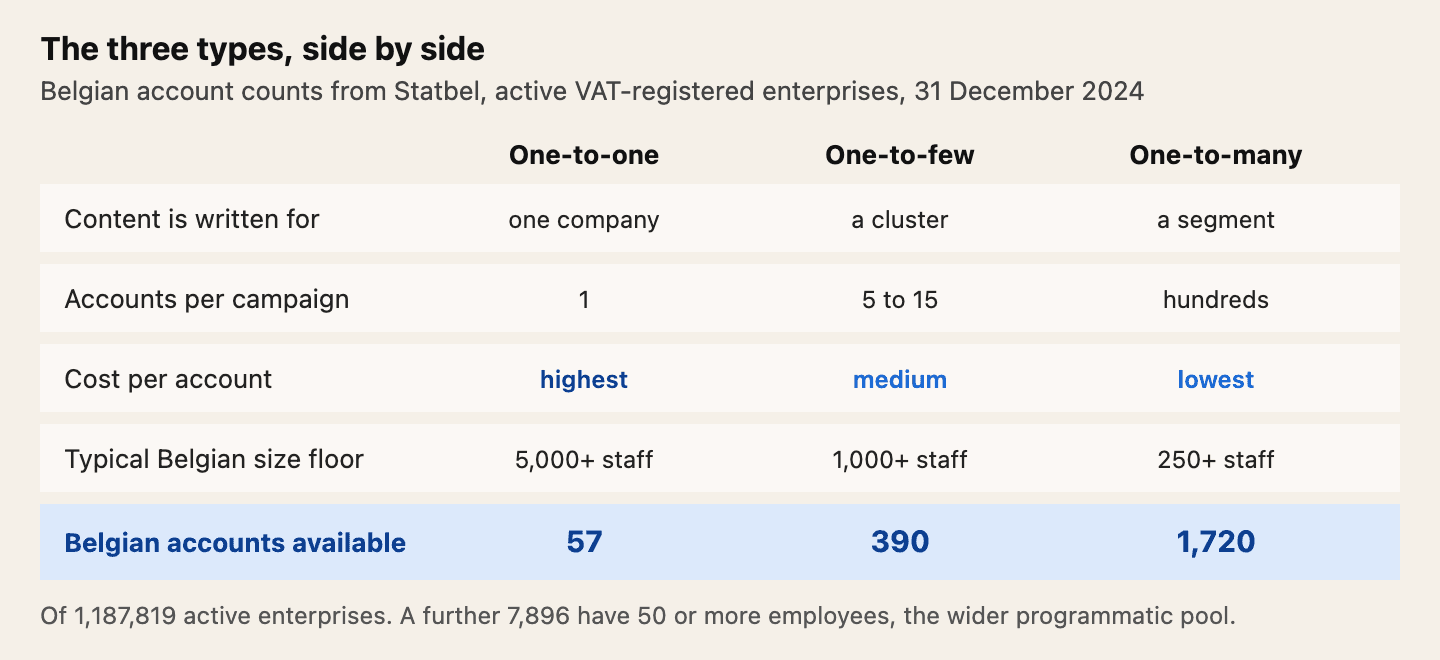
Fifty-seven Belgian enterprises employ 5,000 people or more. If your one-to-one tier is meant to hold the country's genuine giants. It holds dozens of names, and every competitor you have is working the same dozens.
That is not an argument against one-to-one. It is an argument for knowing the number before you design the tier. The full population ladder, and what each successive filter costs you, is in how many Belgian accounts are worth an ABM programme.
Choosing between them
Two questions settle it, in this order.
Does the deal justify the cost per account? A bespoke programme for an account worth €15,000 a year is a loss you have chosen deliberately. Work from annual contract value against what the programme costs to run, not from how important the logo looks.
Does the population support the tier? This is the one that gets skipped. Take your size floor, apply your sector and region filters, and count what survives. If a one-to-one tier needs fifty accounts to justify its existence in a market that has fifty-seven of that size in total, the tier is describing the whole market rather than a selection from it. TAM, SAM and SOM with real numbers works the subtraction through.
They are not a maturity ladder
The common mistake is reading the three as stages: start one-to-many, graduate to one-to-one as the team matures. Most working programmes run two at once, and the second is usually chosen to compensate for the first.
A typical shape: one-to-few as the engine across thirty or forty clustered accounts, with one-to-one reserved for the handful where a win reshapes the year, and one-to-many running underneath to keep the next tier warm.
What makes that work is that the tiers share their inputs. The same account list, the same ownership resolution, the same signals, read at different depths. A company that maintains three separate lists for three tiers has three things to keep current and will keep none of them current.
What every type needs underneath
Whichever type you run, the same four facts have to be right about every account on the list.
Size, from something filed. Employee count rather than revenue in Belgium, because turnover is an optional line on roughly 96% of filings and is frequently missing, while headcount is filed by every company that files accounts.
Ownership. Whether the Belgian entity can authorise a purchase or sits under a foreign parent. This is decisive for one-to-one and merely useful for one-to-many.
A timing signal. Appointments, a jump in headcount, a hiring burst. Timing decides sequence within a tier, not membership of it.
Recency. A tier is only as good as the date on its data.
Bizzy is built so those four come off one record rather than four projects: filed headcount with its multi-year trend, the ownership tree with percentages and countries, open vacancies and appointment signals, all as filters over the same Belgian population. Lookalike search is the practical shortcut for building a one-to-few cluster: point it at the account you already understand and let it find the ones that resemble it.
For the strategy layer around all of this, see account-based marketing explained, and for the software, the 10 ABM tools that actually work for small teams.
Frequently asked questions
What are the three types of ABM?
One-to-one, built for a single named account; one-to-few, written for a cluster of five to fifteen accounts sharing a problem; and one-to-many, run programmatically across a defined segment with personalisation applied by field.
What is the difference between one-to-one and one-to-few ABM?
One-to-one produces content for a single company and carries the highest cost per account. One-to-few writes for a cluster that shares a specific problem, so the research amortises across five to fifteen accounts.
How many accounts should each ABM tier have?
It depends what your market can supply. In Belgium, 57 enterprises have 5,000 or more employees, 390 have 1,000 or more and 1,720 have 250 or more, so a one-to-one tier is realistically dozens of accounts.
Is one-to-many ABM just segmented marketing?
Operationally it is close. The difference is that success is measured at account level rather than by lead volume, and that the segment is built from account fit rather than from channel performance.
Should I run one type of ABM or several?
Most working programmes run two at once, commonly one-to-few as the engine with one-to-one reserved for a handful of accounts. What makes that sustainable is sharing one account list and one data source across the tiers.
Written by Arthur Cremers at bizzy., which builds European B2B company data from official registers.
Sources
Statbel be.STAT: Active enterprises by economic activity and employee size class (reference date 31 December 2024)
Statbel: Annual evolution of VAT-registered enterprises (published 16 October 2025)
National Bank of Belgium: Central Balance Sheet Office in figures
Photo of matryoshka set by Wilfredor, CC0 1.0, via Wikimedia Commons