Clay vs Apollo: they are not the same kind of tool
Clay and Apollo turn up on the same shortlists, which is understandable and slightly misleading. Apollo owns a database and sells you access to it. Clay owns no data at all and sells you orchestration across other people's.
Once that lands, most of the comparison answers itself. The interesting question is not which is better but whether you need a database, a workflow engine, or both.
The short answer
Apollo is a database plus the sending tools. Around 240 million contacts and 30 million companies, published pricing from $0 to $119 per user per month, and sequences built in. You buy coverage and outreach in one product.
Clay is a GTM orchestration layer. It calls 150 or more third-party data providers through a credit marketplace, runs waterfall enrichment across them, and automates the workflow around the result. You buy flexibility and automation, then buy the data separately.
They are frequently used together. Plenty of teams run Clay as the workflow engine with Apollo as one of the providers inside it. If you came here expecting either/or, that is worth knowing before you choose.
What each actually is
Apollo is a conventional data vendor. It collects and maintains its own contact and company records and charges for access, with sequencing, a dialer and CRM integration layered on top. The product is the coverage.
Clay is explicitly not that. In its own words it lets you buy data from providers in one place, and customers can bring their own API keys to bypass Clay's credit system entirely and pay only for the orchestration. The product is the plumbing.
That difference drives everything else, including the pricing model.
Pricing works differently, not just at different levels
Apollo | Clay | |
Free tier | yes, 900 credits a year | yes, 500 actions and 100 data credits a month |
Entry paid | $49 per user per month | Launch, $167 a month, or from $54 on annual |
Next tier | $79 and $119 per user per month | Growth, $446 a month, or from $185 on annual |
Billed on | seats | actions and data credits |
Data cost | included in the seat | charged per provider call |
Apollo prices per person. Clay prices per volume of work, with 15,000 actions and 3,000 data credits on Launch and 40,000 actions and 6,000 credits on Growth.
That has a practical consequence people discover late: with Clay your data spend is variable and sits on top of the subscription. With Apollo it is bundled, but the credits expire at the end of each billing cycle rather than rolling over. Neither is cheaper in the abstract. It depends on whether your volume is steady or spiky.
The waterfall, and what it does and does not fix
Waterfall enrichment is Clay's signature feature and it is genuinely clever. Rather than trusting one provider, it queries them in sequence until one returns a match, and only charges for the provider that succeeded. Clay reports this routinely triples coverage compared with a single source, and the mechanism is sound: cheap broad sources handle the easy records, and only the hard ones reach the expensive specialist at the bottom.
It is worth being precise about what that solves. A waterfall fixes patchiness, where any single provider has gaps that another happens to fill.
It does not fix a shared blind spot. If every provider in the sequence is built from the same raw material, querying 150 of them returns the same answer 150 times. The waterfall improves your hit rate within what those sources collectively cover; it cannot conjure records none of them hold.
That distinction matters most outside the United States.
Where both land on European data
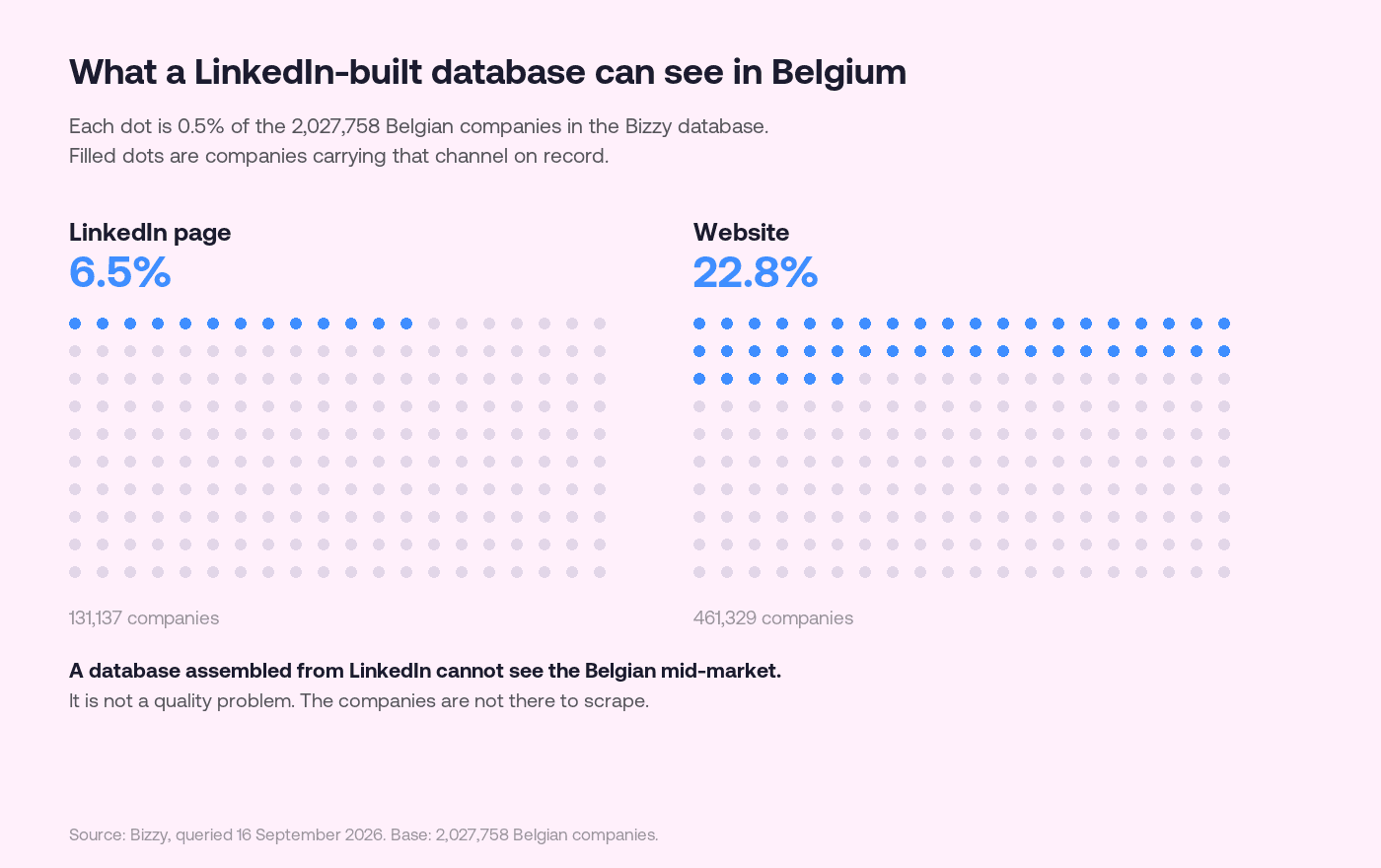
Of the 2,027,758 Belgian companies in our database, 6.5% have a LinkedIn company page and 22.8% have a website. Most of the providers in a typical waterfall are built from professional profiles and web crawling, so that is roughly the ceiling they share.
For Apollo the consequence is direct: what it holds is what you get. For Clay it is one step removed but the same in practice, because the waterfall inherits the coverage of whatever sits inside it.
The honest and more useful framing for Clay is that this is a provider choice rather than a platform limitation. Clay is source-agnostic by design, so if you add a registry-based European source to the waterfall, the gap closes. The question is not whether Clay covers Belgian SMEs, it is which provider you put in the stack to do it. Our own guide to why international prospecting tools miss Belgian SMEs explains where that gap comes from.
Which should you choose?
Apollo if you want one product that finds contacts and emails them, you are a small or mid-sized team, and you would rather not assemble a stack. Start on the free tier.
Clay if you already have data sources you trust, your workflows are non-standard, and the bottleneck is automation rather than coverage. It rewards teams with someone willing to build.
Both if you are running enough volume that orchestration pays for itself, with Apollo or another vendor as a provider inside Clay.
Neither on its own if your market is European SMEs, because that is a source question rather than a tooling question, and both inherit the same ceiling until you add a registry-based provider. That is the gap we built Bizzy to fill, and our comparison of Belgian prospecting tools shows how the local options line up.
Whatever you shortlist, the honest test takes half an hour: take twenty existing customers matching your ideal profile, look each up in the tool, and count the usable results. That number settles it faster than any comparison table.
Frequently asked questions
Does Clay have its own data?
No. Clay is a marketplace and orchestration layer that calls third-party providers, of which it lists 150 or more. You can also bring your own API keys and bypass Clay's data credits, paying only for the orchestration actions.
Is Clay cheaper than Apollo?
They are not directly comparable. Apollo charges per seat with data included, from $49 to $119 per user per month. Clay charges for actions and data credits, from $167 a month on Launch, or from $54 on annual billing, with data spend on top. Steady per-person usage favours Apollo; spiky high-volume workflows can favour Clay.
What is waterfall enrichment?
Querying several data providers in sequence until one returns a match, and paying only for the one that succeeded. It raises coverage substantially compared with a single provider, but only within what those providers collectively hold.
Can you use Clay and Apollo together?
Yes, and many teams do. Clay acts as the workflow engine and Apollo sits inside it as one data provider among several. The comparison is often less either/or than the search term suggests.
Do Clay or Apollo cover European SMEs well?
Both inherit the limits of their sources, which are mostly professional profiles and web data. In Belgium only 6.5% of companies have a LinkedIn page and 22.8% have a website. With Clay you can improve this by adding a registry-based provider to the waterfall, since it is source-agnostic. With Apollo you are limited to what Apollo holds.