The short answer
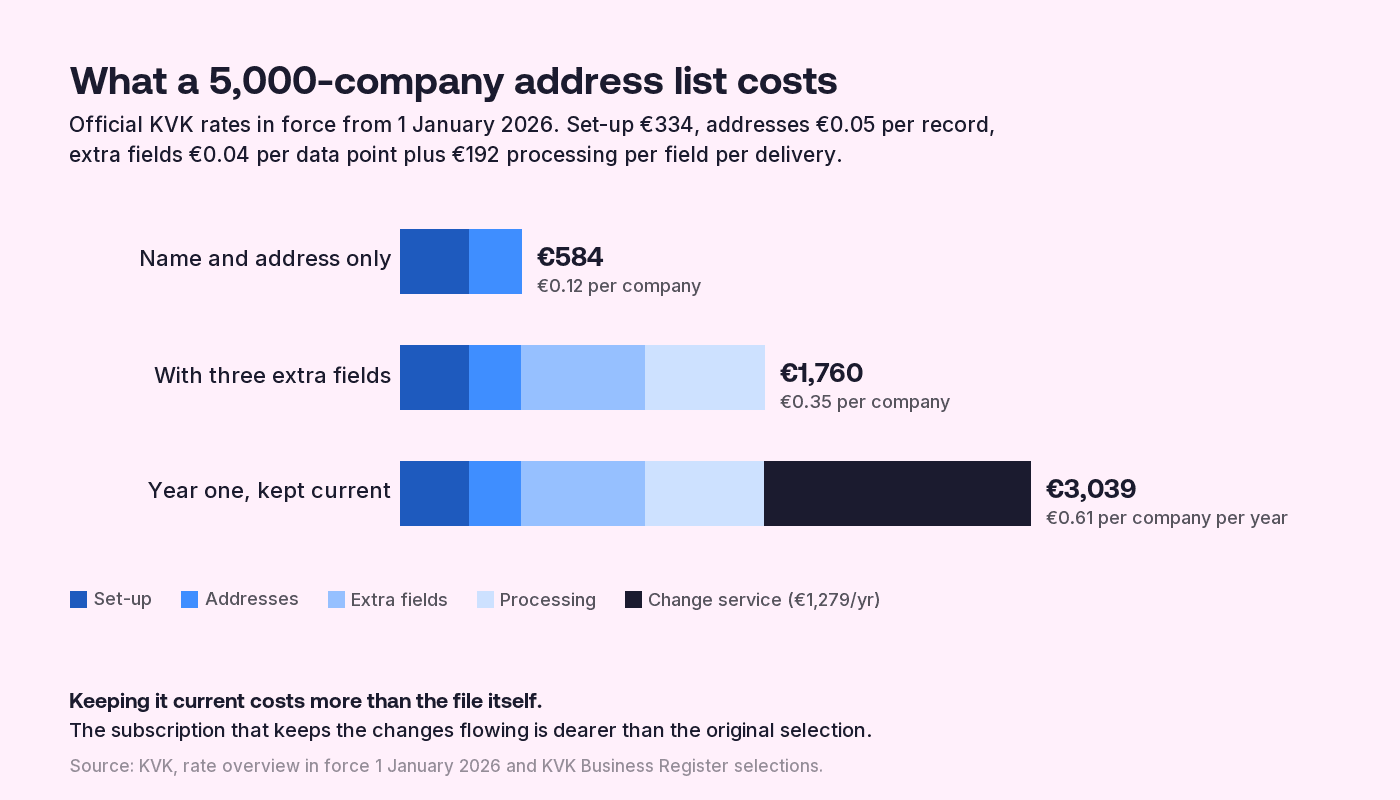
Buying a business address list is legal and cheaper than most people expect: the Dutch chamber of commerce charges €334 to open an order plus €0.05 per address. A file of 5,000 companies with just name, address and town costs €584, about twelve cents a row.
The price is not the problem. What you get, how long it stays usable, and what the law lets you do with it are the problem. And the last of those changed materially on 1 July 2026: calling with a commercial offer now needs prior consent, and that catches sole traders and partnerships too. An incorporated company such as a BV falls outside it.
This article is about the Netherlands. The prices come from KVK's official rate overview, the rules from the Dutch Telecommunications Act. Belgium differs on important points; that is covered below and in our prospecting guide for Belgium.
What does a business address list cost?
KVK, the Dutch chamber of commerce, sells selections from the Business Register itself. That register is a significant source for commercial vendors of Dutch company data, so it is a fair starting point for a price comparison. The rates in force from 1 January 2026 (KVK):
Item | Rate |
Set-up cost per order | €334.00 |
Addresses (registration number and name/address), per record | €0.05 |
Extra fields, per data point delivered | €0.04 |
Processing cost per extra field, per delivery | €192.00 |
Two worked examples for a selection of 5,000 companies:
Name and address only. €334 + (5,000 × €0.05) = €584, or €0.12 per row.
With three extra fields, say industry code, legal form and headcount: €334 + (5,000 × €0.05) + (15,000 data points × €0.04) + (3 × €192) = up to €1,760, or €0.35 per row. Up to, because you pay per data point delivered: if a field is empty for many companies, the total comes out lower.
You order by email, KVK returns a count and cost estimate within two working days, and once you sign the quote the file arrives within five working days as Excel or CSV (KVK). Each request includes up to two free counts.
What you do not get
This is where the misunderstanding usually sits. An address file from the Business Register contains no phone numbers, and that is a legal constraint rather than a product decision. KVK states that a phone number held in the Business Register is not public data, and is visible only to organisations with permission, such as the tax authority or notaries (KVK).
That makes a useful test question for any vendor selling call lists or lead lists. If a bought Dutch file contains phone numbers, they did not come from the register. They came from websites, directories or other collected sources. Ask which, because under the GDPR you have to be able to answer that question yourself.
The same goes for email addresses and named contacts. What you buy is a list of companies, not a list of people. The difference between a company that fits your target market and a lead with a reason to call is set out in what a lead actually is, and that difference is precisely what a bought file does not solve for you.
Watch the non-mailing indicator as well. When ordering you state whether you want the data with or without it: companies carrying the indicator may not be approached for marketing purposes such as postal advertising or door-to-door visits. KVK itself calls it a kind of digital no-junk-mail sticker (KVK).
How fast a bought file decays
A bought file is a photograph of one moment. The register keeps moving underneath it, faster than you would guess.
Across 2025, 194,057 establishments in the Netherlands closed, from a register that began the year with 2,579,735. That is 7.5% of all establishments in a single year. Over the same period new registrations fell 10%, with closures up in every sector (KVK Bedrijvendynamiek).
On a 5,000-row file that is more than 370 establishments that no longer exist a year later. Before anyone has changed jobs or relocated.
For sole traders the rate runs higher: their closures rose 19% in 2025 and their new registrations fell 13%, against 18% and 10% for the register as a whole. A broad Dutch company file consists largely of exactly that group, so 7.5% is a floor rather than an average.
KVK puts its own price on fixing that. Keeping a bought file current means subscribing to its change service at €1,279 per year, which allows two free changes to the population per year and charges €320 for each one after that. Reconciling an existing customer file against the register through file comparison costs €1,293 fixed plus €0.03 per record submitted, plus the same per-address and per-field rates as a selection.
Include that and the picture shifts. The 5,000-company selection with three extra fields costs not €1,760 but €1,760 + €1,279 = €3,039 in year one once you keep it current. That is €0.61 per company per year, and you still have no phone number, no named contact and no reason to call today.
What are you allowed to do with a bought list?
This is the part that moved in 2026, and where plenty of sales teams are still working from outdated assumptions. Two rules, both from the Dutch Telecommunications Act.
Email: prior consent, businesses included. The spam ban in article 11.7(1) has covered legal entities as well as individuals since 1 October 2009. Unsolicited commercial email is therefore prohibited unless you can demonstrate the recipient consented in advance, and you must be able to prove that consent for up to five years after sending (ACM).
There is one business exception, and it is narrower than most people assume. Article 11.7(3) derogates from both 11.7(1) and 11.7(2), and permits unsolicited communication to a legal entity or to someone acting in the course of their profession or business. But only where you use contact details that the recipient has designated and made public for the purpose of receiving unsolicited commercial, ideological or charitable communication, and only where you use them in line with that purpose (Telecommunications Act art. 11.7). The provision has a second limb too: recipients established outside the European Economic Area, provided you comply with that country's rules.
Note the word "designated". An address a company explicitly publishes in order to receive offers can fall within the exception. An info@ or sales@ address sitting on a contact page as a general route in is not automatically designated for unsolicited advertising, and the burden of proof is yours. Separately, you may email your own customers about your own similar products, provided you give them an easy opt-out both when you collect the address and in every message.
Important: this is the Dutch rule, and Belgium departs from it. There, the Royal Decree of 4 April 2003 exempts all addresses of legal persons from the opt-in in article XII.13 of the Code of Economic Law, so unsolicited commercial email to a published address of a legal person is permitted in Belgium. In the Netherlands it is not. If you prospect in both countries, keep the two regimes apart; the Belgian side is covered in the prospecting guide for Belgium.
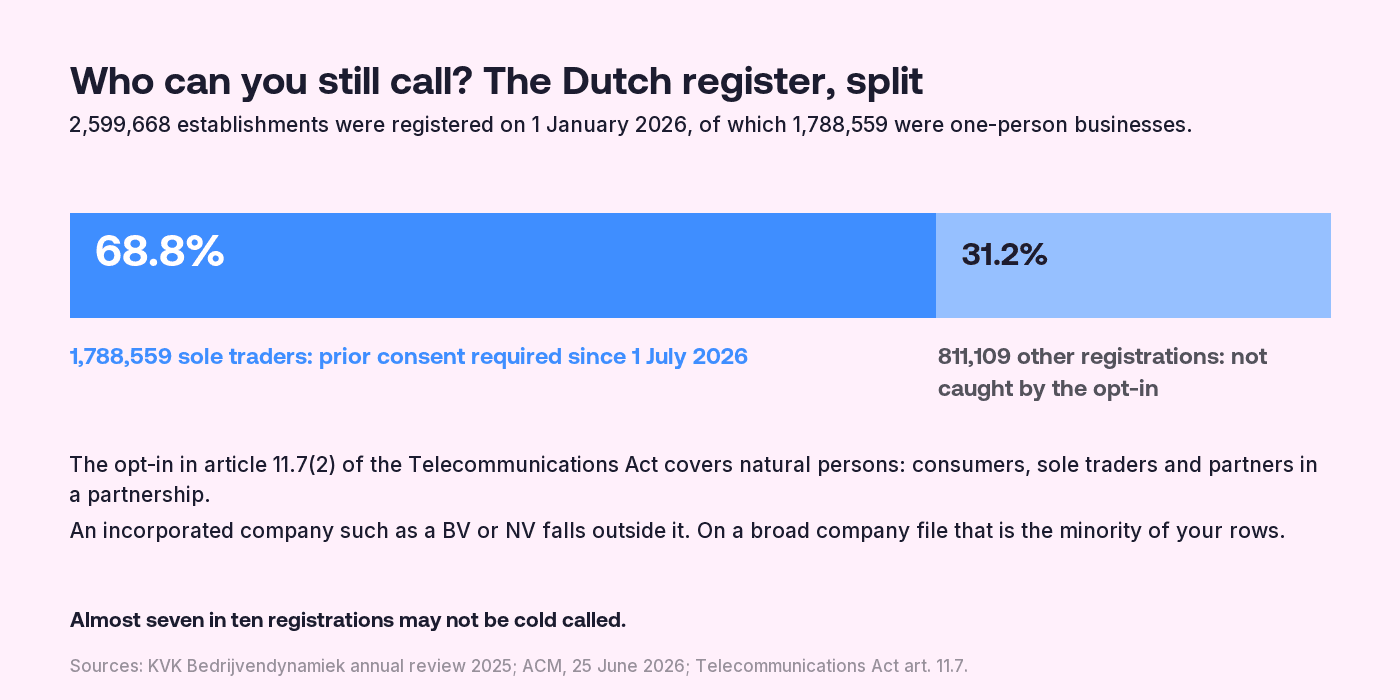
Calling: opt-in for sole traders and partnerships since 1 July 2026. This is the significant change. Since 1 July 2026, consumers and small entrepreneurs, meaning sole traders and partnerships without legal personality, may only be called with a commercial offer if they have given prior explicit consent. Where you were previously allowed to call current and former customers, that is no longer permitted without consent (ACM, 25 June 2026). The only exceptions are charities, lotteries that fund charities, and publishers of newspapers, weeklies and magazines.
Incorporated companies fall outside this: calling a BV is not caught by the rule, because article 11.7(2) applies only to unsolicited communication to natural persons. In theory 11.7(3) offers a route for sole traders as well, but in practice it closes itself: the phone number would have to have been designated and made public for receiving unsolicited offers, and a number held in the Business Register is not even public.
And that is what sits underneath any broad Dutch address list. On 1 January 2026 the Business Register held 2,599,668 establishments, of which 1,788,559 were sole traders (KVK Bedrijvendynamiek). Almost seven in ten. Buy a file of "every company in sector X" and the majority of your rows are sole traders or partnerships you may not call without prior consent. Note that someone self-employed who trades through a BV is a legal entity, and so falls outside the opt-in.
A BV falling outside article 11.7 does not mean you are unconstrained, incidentally. The name and direct line of the contact you call remain personal data under the GDPR, in B2B as much as anywhere.
Two more things. The regulator states that the spam rules bind not only the sender and the party pressing send, but also companies that assist in sending, "for example suppliers of address files" (ACM). Your vendor is in the same chain, not outside the risk. And the line is moving: on 14 July 2026 the data vendor Lusha was fined €2 million by the Italian regulator over precisely the question of whether legitimate interest covers brokering contact data (Garante).
This is not legal advice. Worth noting that step 2 of KVK's own ordering process is to establish whether you have to comply with the GDPR and the Telecommunications Act; the register leaves that assessment to you.
When buying a list does make sense
Buying an address file is not a mistake. It is just rarely a lead list. Where it genuinely works:
Market research and sizing. How many Dutch companies fit your profile, in which sectors and provinces? A count or selection is exactly the right instrument for that, and KVK's free company counter answers the first version of the question at no cost.
Cleaning your own customer file. Reconciling against the register strips closed businesses and stale addresses out of your CRM. That is measurably useful work, and why it pays off is covered in data hygiene for sales teams.
Finding suppliers or partners. No marketing purpose, so no non-mailing question and no consent question.
Where it does not work is as a substitute for prospecting. A list tells you who exists, not who has a problem right now that you solve.
The alternative: a flow, not a list
The real objection to a bought file is not the price, or even the law. It is that a list stands still while your market moves: of those 5,000 rows, 370 disappear each year, and the rest change without your seeing it.
We built Bizzy's European company data for the opposite: company data from the official registers of 33 European countries, updated continuously rather than delivered once, with signals and two-way CRM sync on top. How to build that system is in what lead generation is, how to decide who is worth following up is in lead qualification, and what it looks like in practice is in how Dropsolid gets a daily flow of sales-ready leads. Which other vendors exist and how they differ, we set out with each one's own published figures in our comparison of B2B data providers in Europe.
Read next: the best B2B prospecting tools for European sales teams and how to generate B2B leads in Europe.
Read next: is B2B cold outreach legal in Europe? The rules for Belgium, the Netherlands and Germany, channel by channel.
Read next: how to check an EU VAT number, and what a valid result does not prove.
Frequently asked questions
How much does a 5,000-company file cost?
At KVK you pay €334 to open the order plus €0.05 per address for name-and-address data, per the rates in force from 1 January 2026. A file of 5,000 companies therefore costs €584. Extra fields cost €0.04 per data point delivered plus €192 processing per field per delivery. Commercial vendors charge more, but often supply fields the register does not hold.
Is it legal to buy addresses?
Buying addresses is legal. What you do with them is regulated. Unsolicited commercial email in the Netherlands needs prior consent, businesses included, with a narrow exception for addresses a company has designated and made public specifically to receive such messages. Calling has required opt-in for consumers, sole traders and partnerships since 1 July 2026. Companies carrying a non-mailing indicator may not be approached for marketing purposes such as postal advertising or door-to-door visits. This is not legal advice.
Can I buy business email addresses and email them?
You can buy them, but the file itself gives you no basis to send. Article 11.7 of the Dutch Telecommunications Act requires prior consent, legal entities included. The business exception applies only to contact details the recipient has designated and made public for receiving unsolicited commercial messages, and the burden of proof lies with the sender. The regulator also notes that the spam rules apply to suppliers of address files. Belgium applies different rules.
Can I still cold call companies in the Netherlands?
Calling an incorporated company such as a BV or NV is not caught by the opt-in in article 11.7(2), because that provision covers natural persons only. Calling a sole trader, or the partners in a partnership, has required prior explicit consent since 1 July 2026. Since almost seven in ten registrations in the Business Register are sole traders, that affects most of a broad company file. The GDPR also continues to apply to the details of the person you call.
How fast does a bought address list decay?
In 2025, 194,057 of the 2,579,735 registered establishments closed, so 7.5% in a single year, and closures were up 18% on 2024. Expect roughly one row in thirteen to be gone after a year, separate from relocations and job changes. For sole traders it runs higher: their closures rose 19%.
Are phone numbers in the Dutch Business Register?
Not publicly. KVK states that a phone number held in the register is not public data and is visible only to organisations with permission, such as the tax authority or notaries. If a bought file contains phone numbers, they came from other sources, and your vendor should be able to tell you which.