Apollo vs ZoomInfo: pricing, coverage, and the question neither answers well
Apollo and ZoomInfo are the two names that come up in almost every B2B data shortlist. They are genuinely different products sold to different buyers, and the choice between them is usually decided by budget and company size long before anyone compares a feature list.
A note on what this is. We have not run a thousand-lead accuracy test on either, and several good comparisons have. What we can add is the dimension most of those comparisons skip: what both look like outside the United States, which is something we measure directly.
The short answer
Apollo is self-serve, transparently priced from $0, and combines data with the sending tools. It suits small and mid-sized teams who want to start this afternoon.
ZoomInfo is enterprise software with quote-based pricing, deeper intent and workflow tooling, and the account coverage larger US sales organisations rely on. It suits teams with procurement and a budget cycle.
Neither is built on European company registers, which is where both thin out if your market is the Benelux, and the section below puts numbers on that.
Pricing is the clearest difference
Apollo publishes its prices. ZoomInfo does not.
Apollo | ZoomInfo | |
Entry | Free, 900 credits a year | no free tier |
Paid tiers | $49, $79, $119 per user per month (annual) | quote only |
Typical annual cost | a few hundred to a few thousand | reported in the tens of thousands |
Pricing transparency | published | quote-based |
Apollo's tiers are Basic at $49, Professional at $79 and Organization at $119 per user per month on annual billing, with 30,000, 48,000 and 72,000 credits a year respectively. Credits are consumed per action, an email costing one and a phone number eight, and they expire at the end of each billing cycle rather than rolling over.
ZoomInfo does not publish list pricing, so any figure you see is an estimate. Third-party trackers put the Professional tier in the region of $15,000 a year and Elite above $35,000, with Vendr reporting a median contract of $31,875 across more than 1,300 verified purchases. Treat those as indicative, not official. ZoomInfo also signalled on a 2026 earnings call that it intends to move toward a lower platform fee with pre-purchased credits, so this may change.
The practical read: for a team of three, Apollo is a few thousand a year and ZoomInfo is a procurement project. That gap explains most of the choice.
Data coverage: what each claims
Apollo advertises around 240 million contacts and 30 million companies. ZoomInfo does not publish an equivalent single figure but operates at a comparable scale, with stronger firmographic and technographic depth on larger accounts.
Reviewers who have used both tend to land in the same place: ZoomInfo's profiles are richer for enterprises above roughly a thousand employees, while Apollo holds up better for startups and mid-market, and Apollo's international coverage is the more consistent of the two. That is worth knowing because it cuts against the assumption that the expensive option is better everywhere.
Both build from broadly the same raw material: contributory networks, public web data and professional profiles. That shared foundation is exactly why they share the same blind spot.
Where both thin out: Europe
This is the part we can speak to first-hand, because we measure it.
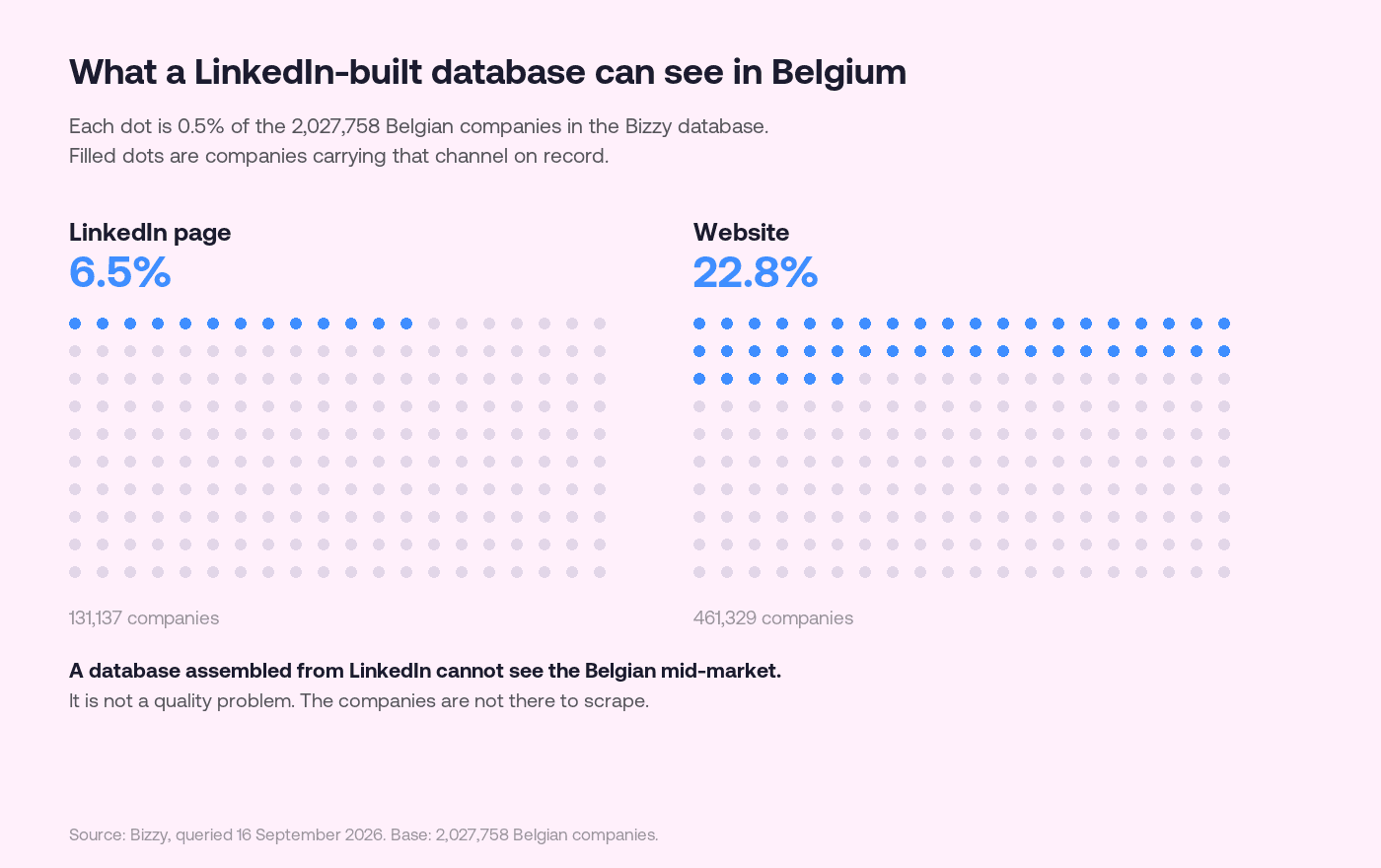
Of the 2,027,758 Belgian companies in our database, 6.5% have a LinkedIn company page and 22.8% have a website. A database assembled from professional profiles and web crawling can therefore see a minority of the market, and a selective minority at that: larger, more digitally active businesses.
That is not a criticism of either product. It is a description of what their sources contain. Belgian company data lives in the Crossroads Bank for Enterprises, a register every business is legally required to join and which neither platform is built on. The same pattern holds across European markets where registration, not self-publication, is the complete record.
So if your ICP is US mid-market, this section does not apply to you and either tool will serve. If your ICP includes European SMEs, it is the deciding factor, and we have set the mechanism out in full in why international prospecting tools miss Belgian SMEs.
Which should you choose?
Choose Apollo if you are a small or mid-sized team, you want data and sequencing in one place, and you would rather start today than run a procurement process. The free tier is a real evaluation, not a demo.
Choose ZoomInfo if you sell to large US enterprises, you need depth on big accounts and intent signals, and you have the budget and the buying process to match.
Add a registry-based source if a meaningful share of your market is European SMEs, because that is the gap neither one closes. That is the problem we built Bizzy for, and you can see how we compare across the Belgian market in our comparison of Belgian prospecting tools.
If you are evaluating properly, the honest test takes half an hour: pull twenty existing customers who match your ideal profile, look each one up in the tool, and count how many come back with usable data. That number tells you more than any comparison table, this one included.
Frequently asked questions
Is Apollo cheaper than ZoomInfo?
Substantially, and the gap is structural rather than promotional. Apollo publishes tiers from $0 to $119 per user per month. ZoomInfo quotes per contract, with third-party trackers reporting a median around $31,875 a year. They are priced for different buyers.
Does Apollo or ZoomInfo have better data?
It depends on the segment. Reviewers who used both generally find ZoomInfo richer on large enterprises and Apollo more consistent internationally and on mid-market accounts. Neither is better across the board.
Do Apollo credits roll over?
No. Apollo credits expire at the end of each billing cycle and do not carry into the next one or survive renewal. An email costs one credit and a phone number costs eight, so plan the allowance against how much phone data you actually need.
Why is ZoomInfo's pricing so hard to find?
Because they do not publish it. Every contract is quoted on team size, credits and modules. Any specific figure online is a third-party estimate rather than an official price.
Are Apollo and ZoomInfo good for European companies?
For large European enterprises, reasonably. For European SMEs, both thin out, because their sources are professional profiles and web data rather than company registers. In Belgium only 6.5% of companies have a LinkedIn page and 22.8% have a website, which caps what any such database can see.