Every sales team has too many leads and too little time. Lead qualification is the work that decides which of those leads deserve your time, and which you set aside today.
Short answer: a lead is qualified when you have an honest answer to four questions. Does the company fit, are you talking to the right person, is there a trigger, and can they pay. Everything outside that is a feeling.
This article covers those four questions, what a qualified lead means in practice, two filters you can apply in Belgium before you call anyone, and the agreement between marketing and sales that turns "the leads are bad" into a number you can measure.
What is lead qualification?
Lead qualification is checking whether a lead is a real sales opportunity. You start with someone who showed interest and whose contact details you hold, and you end with a yes or a no.
The distinction that comes before it matters more than most teams think. A company that fits your target market but has done nothing yet is not a lead, it is a suspect. Confuse the two and you are not qualifying, you are cold-calling. That difference is set out in full in what a lead actually is.
Qualifying is therefore not the same as filtering on firmographics. You filter a list; you qualify a conversation.
What makes a lead qualified?
Quality is not a property of the lead. It is how well that lead matches your criteria. The same company can be an excellent opportunity for one team and noise for another. There is no general definition of a qualified lead, only yours, and it has to be written down.
Which is why "we want better leads" produces nothing as an instruction. What works: four questions everyone on the team answers the same way.
The four questions, briefly
The criteria themselves are not complicated and we have set them out in full elsewhere: does the company fit, are you talking to the right person, is there a trigger, and can they pay. What each of those means in practice is in what a lead actually is.
What is not there, and what this article is about, is the practical half: which answers you already hold before you call, how to run it weekly, and what to record so your criteria improve.
Two filters you can apply before the first conversation
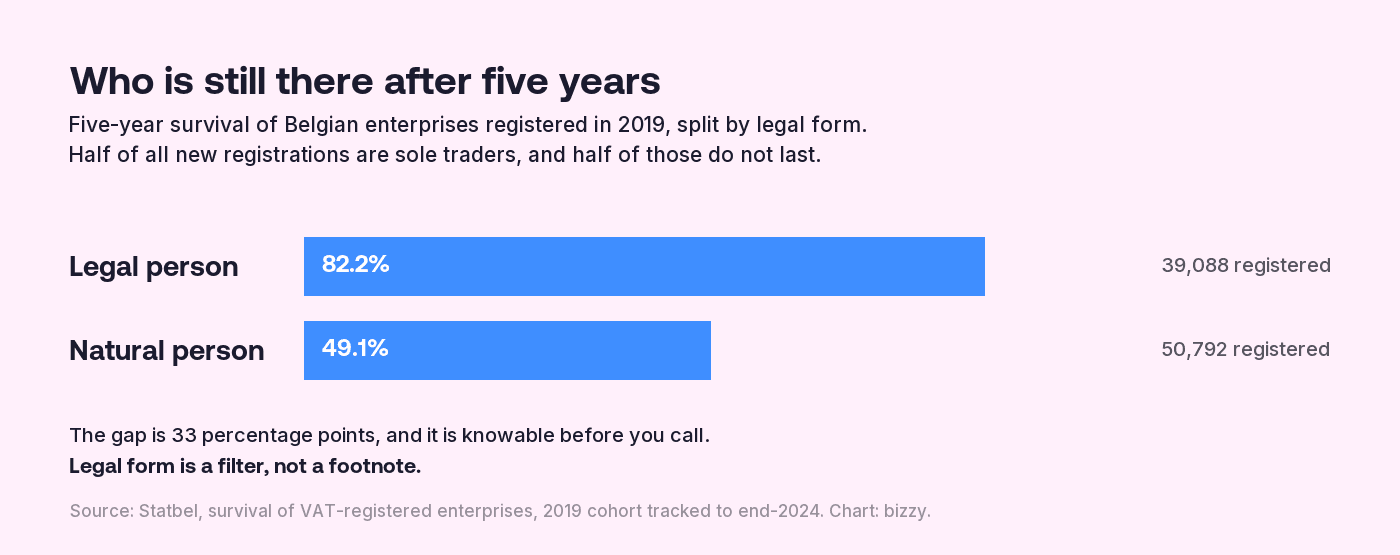
This is where Belgium differs from most of the advice you will find online. Two characteristics that correlate strongly with whether a company still exists in five years are sitting in the public register, free, before you call anyone.
Legal form. Of the companies that first registered for VAT in Belgium in 2019, 82.2% of legal persons were still active five years later, against 49.1% of natural persons (Statbel). A 33-point gap, and it is in the register.
Headcount. In the same cohort, four years on, 68.1% of enterprises with no employees were still active, against 85.5% with one to nine staff and 91.5% with ten to forty-nine. That matters because 93% of all new registrations have no employees at all: an unfiltered Belgian list is mostly made of the least durable segment.
Two caveats, because these are survival rates and not buying signals. They say nothing about whether a company wants your product, and a sole trader can be an excellent customer. Use them to order your list, not to delete companies from it.
Which sources these are and how to read them is in our guide to the Belgian company register.
What qualifying looks like across a week
Criteria on paper change nothing if nobody runs them. What works in practice is a fixed moment and a short agreement about who does what.
Once a week, not once per lead. Run the new list through the filters above in one sitting, then distribute. Deciding lead by lead costs more time and produces inconsistent calls.
One owner per lead, from the start. A lead with no name against it is a lead nobody follows up.
Record three fields, not ten. The trigger, the answer to "can they pay", and on a no, the reason. More fields than that do not get filled in.
Put the marketing-to-sales line on paper. Which companies, which job titles, which action, and how fast follow-up happens. That is the entire point of MQL and SQL: it turns "the leads are bad" into a number you can measure. What those terms mean is in what a lead actually is.
When lead scoring does make sense
Scoring is useful at volume and misleading without it. At a few dozen leads a month you are mostly measuring noise: one incidental download moves the average. So start with the four questions and add a score once you have enough leads to see patterns.
If you do have that volume, it is a different story. How automated scoring works and where it goes wrong is in lead scoring explained.
Follow-up: speed, and recording why you said no
Qualification does not end at a yes. Two things make the most difference in practice, and neither is about criteria.
Speed. A three-hour-old demo request is a different conversation from a three-day-old one. The qualification you did perfectly yesterday is cold today.
Recording why you rejected a lead. This is the part almost everyone skips. If you do not note why a lead did not become a prospect, your criteria never improve: you repeat the same rejections without learning which of them were wrong. One field with a reason is enough.
Qualifying gives time back
Lead qualification sounds like extra work and in practice is the opposite: it is the decision to treat fifty companies well instead of a thousand badly. That is what a qualified pipeline buys you: not more names, but fewer wasted conversations.
One more thing belongs with it: what you may do with a qualified lead is settled law in Belgium. Advertising email is opt-in and the do-not-call list covers company numbers too, with sources in the prospecting guide. Where qualifying breaks down at scale is the manual part. Our lead generation agent runs your qualification criteria across your whole list and passes only the matches to your CRM. How it fits the bigger picture is in what lead generation is and how to build a system around it.
Read next: the best B2B prospecting tools for European sales teams and how to generate B2B leads in Europe.
Read next: is B2B cold outreach legal in Europe? The rules for Belgium, the Netherlands and Germany, channel by channel.
Read next: Generating leads: from a company list to a conversation.