
Tired of spreadsheets and manual CRM updates? Here’s how to automate your outbound and build a system that actually scales.
Most sales teams don’t need another tool.
They need a better system.
We see it all the time. Some teams are still working out of Excel, sharing prospect lists on Slack, trying to remember who followed up with who, or they have a CRM but no one trusts what’s in it because nothing’s ever fully up to date.
Maybe you’ve said something like:
“I built a great list last week but I can't remember where I saved it.”
“Wait, didn’t we already talk to this company?”
“I think I know that contact... let me check.”
“Why does it take so much time to know if a company is worth my time?”
The truth is, no one enjoys prospecting when the system is messy.
But when it works? You find better companies, have better conversations, and spend more time doing what actually moves the needle.
Here’s how to build a lead generation system that works behind the scenes, from spotting the right signals to booking your next meeting.
Step 1: Know who you want to target
Before you do anything else, you need clarity on who you're trying to reach.
This isn’t about having a massive target list or a perfectly polished slide deck. It’s about being able to say, right now: “This week, we’re focusing on these kinds of companies, for this reason.”
If your criteria are vague or inconsistent, your lists will be too. And so will your outreach. After all, you can't find a message that speaks to everyone all at once. It’s easy to waste hours searching for prospects if you don't know what “good” even looks like for you.
That’s why your ICP (Ideal Customer Profile) is so important. And we're not talking about the one someone created last year in a workshop - or even the one you may have targeted last week. We want you to define an ICP that your team can use in their day-to-day right now. And if anything has changed since you last did this exercise, so should your ICP.
Step 2: Use buying signals to reach out at the right time
Once you know who you’re looking for, the next challenge is knowing when to reach out.
Timing is everything in outbound.
The best moments to connect are usually when something has changed like a funding round, new hires, market expansion, a public launch. These are the signals that say: “Something’s shifting here. There might be an opportunity.”
When we talk about this to our own prospects, we see that they get it but struggle to apply it to their own context. So let's walk through some examples:
You offer candidates for construction work: when a company matching your ICP announces that they have just landed a big prestigious project, they will probably need personnel to make that happen. A perfect time to reach out.
You sell desks and office chairs, or even computer services: a company matching your ICP just announced they're moving into a new office - or you see them hiring 10 new people and think they might burst out of their current one. They will need new furniture and equipment for their office.
You offer consulting services: a company matching your ICP just completed a funding round, taking their company to a whole new level. They don't have the experience yet to operate at that level. You do. This is an incredibly interesting time to reach out.
Ask yourself what that trigger is for someone to consider your solution. And if you need help, this is also something we cover in the ICP guide.
Step 3: Make sure your prospect info is always up-to-date
This is where most outbound processes fall apart.
You build a good list. But then what?
Some reps save it to a sheet. Others copy-paste into their CRM. A few add contacts manually to their sequencing tool. And suddenly, your “process” depends on how much energy someone has left at 4 p.m.
Especially when you have a larger sales team, you need to make sure you centralise all of this information and you keep it up-to-date.
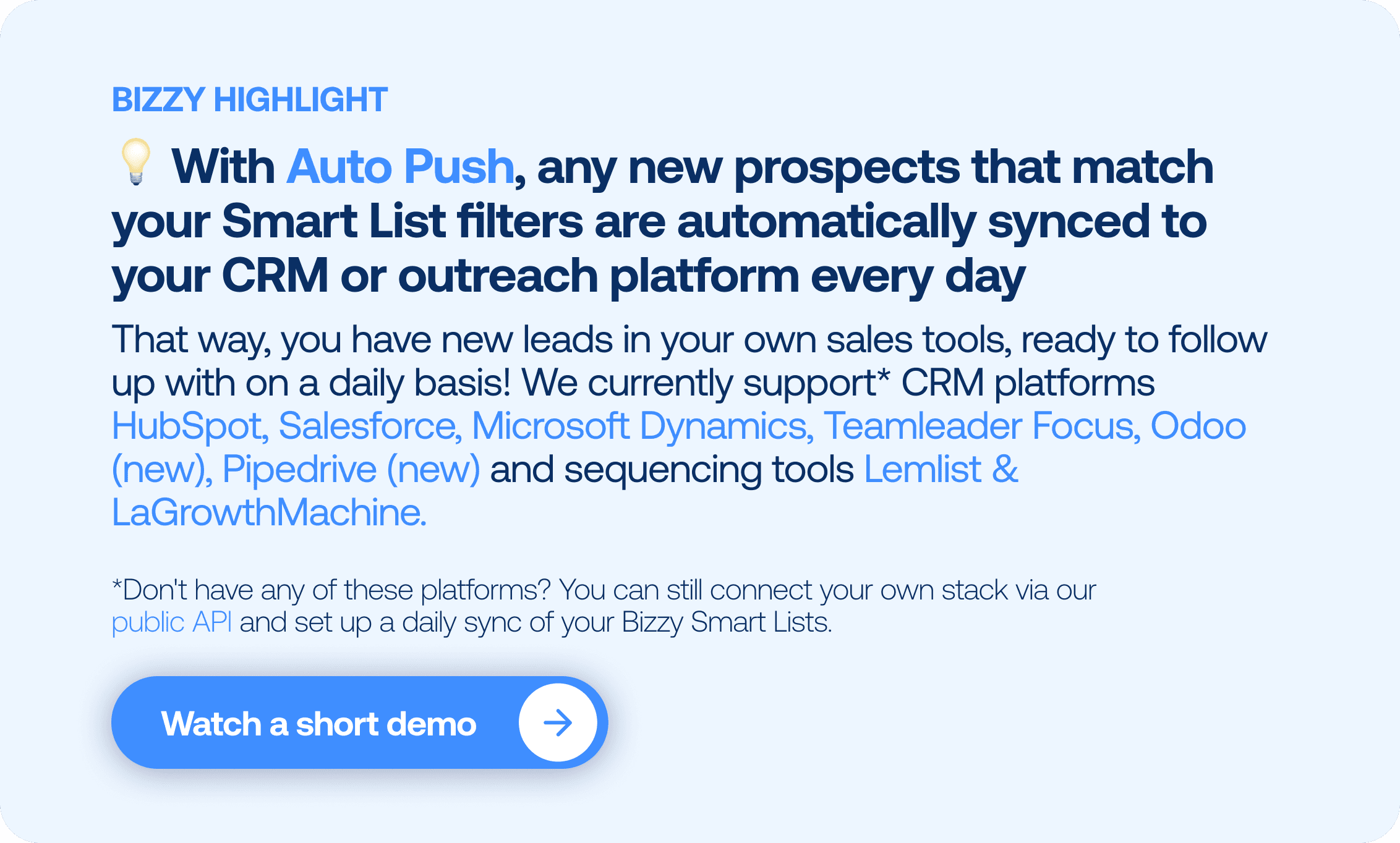
This is where automation truly make a difference. By linking prospecting or lead generation tools to your CRM or sequencing platform, you can rest assured that all info is synced automatically between the different platforms. Everyone in your sales team knows the latest status, the context, and they have all the info in one place to start their outreach.
Step 4: Let your team focus on conversations, not admin
Most reps didn’t get into sales to manage tools and update sheets.
The less they can spend time on this, the happier your team will be. And your team can focus on what they’re actually great at:
Starting conversations.
Personalising messages.
Booking meetings.
Building pipeline.
And if you’re trying to scale that across a team of BDRs or AEs? Managing your entire sales cycle in platforms doesn't just keep your team from working on the same accounts, or the wrong ones. It also gives you the chance to collect data so you can spot bottlenecks, opportunities, improvements and challenges. That's where automation really starts to shine!
More leads is one thing, removing the manual work is even better
The best outbound teams don’t just send more messages.
They build a process that runs. Even when people are busy. Even when someone’s out. Even when no one remembers what was in that spreadsheet from last month.
You don't need to automate your whole system all at once. Look at the pieces that take you the most time today, and start there.