On 1 January 2025 the activity code of every company in the Belgian register was rewritten automatically. Nobody had to ask for it and nobody had to approve it.
For roughly three quarters of codes the swap was clean. For the rest it was a guess, and the government says so in writing: after the conversion, it warns, the activities of your entity "may be incorrect and/or incomplete".
Then in January 2026 it happened again, and the code that used to mean "this company sells online" was removed altogether.
If you build target lists on activity codes, both of those matter. Here is what a NACEBEL code actually is, how to look one up, and what to distrust.
NACE, NACEBEL, and which is which
NACE is the European list. Statbel describes it as an official European list of activity descriptions, mandatory for all EU countries, used as a tool for compiling economic statistics.
Each country may deepen that list with extra codes, as long as the European base stays untouched. Belgium's deepened version is called NACE-BEL. Statbel notes that the social security office, the VAT administration and the business counters all use these codes to classify companies by economic activity.
So the first four levels of a Belgian code are European and comparable with Germany or France. The fifth is Belgian and is not.
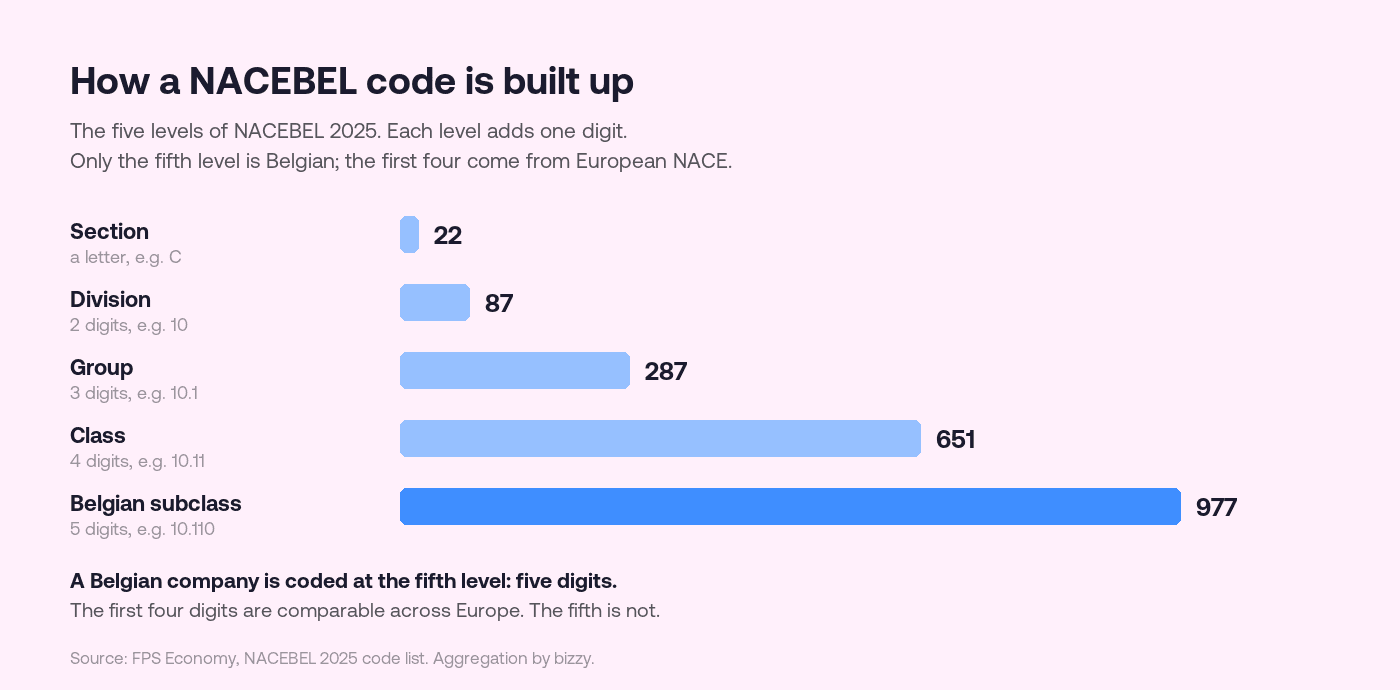
Counted from Statbel's published 2025 file, the classification holds 22 sections, 87 divisions, 287 groups, 651 classes and 977 Belgian subclasses. Underneath all of that, the Crossroads Bank keeps its own seven-digit administrative level, with 1,235 codes. Only 508 of the 977 subclasses have any seven-digit detail beneath them.
Worth knowing: you cannot read the section off the division number. Computer programming sits in division 62, which in the 2025 structure belongs to section K, not J.
How to look a code up
For another company, use KBO Public Search. It is free and needs no login. You can search by number, by name, by activity, by address or by permission. The activity search is labelled "Activiteitcode(s) 2025".
Two limits are official. You get at most 200 results per search, and the data is a day behind: changes made in the register appear in Public Search the following day.
For your own company, use My Enterprise, which is where the FPS Economy tells businesses to check and correct their codes.
To find the right code rather than a company, use the NACE-BEL search module, which is the tool the federal business portal points to.
One warning that matters if you are tempted to automate any of this. Reusing Public Search data is explicitly forbidden, and systematic downloading is not allowed. The penalty named in the Code of Economic Law is a fine of 26 to 50,000 euro, or up to 6% of annual turnover. The legal route to the data in bulk is the Crossroads Bank open-data file, which is free but requires registration and a licence, and which forbids using personal data for direct marketing.
A company does not have one code
This is the part that trips up most list building. A Belgian company does not carry a NACE code. It carries several, registered by different bodies, and they do not have to agree.
The official code table lists five activity groups currently in use:
Group | Registered by |
VAT activities | the VAT administration |
Activities | the business counter or My Enterprise |
NSSO activities | the social security office |
Federal public service activities | FPS Policy and Support |
Subsidised education activities | the register |
On top of that, codes exist at company level and at establishment-unit level, and within each group a code is flagged as main, secondary or auxiliary. An establishment unit must have at least one main activity and may have at most five.
So "what is this company's NACE code" is not a question with one answer. When a data provider gives you one, ask which group it came from.
What the main activity actually means
The rule is looser than it looks. The FPS Economy says the main activity is determined by the highest estimated annual turnover, or the largest estimated number of full-time equivalents, or another criterion determined by the entrepreneur, with the burden of proof resting on whoever chooses that third option.
The register is also explicit that only activities actually carried out belong in it, and that activities a company merely intends to carry out do not. It instructs businesses to close any registered activity that is not being carried out or never was. Companies have one month to register a new activity after starting it.
Since 28 March 2025 auxiliary activities are no longer treated as economic activities and no longer need to be recorded at all.
What changed on 1 January 2025
NACE-BEL 2025 replaced the version that had been in use since 2008, following the European NACE Rev. 2.1 regulation.
The conversion was automatic. Every active activity registered under a 2008 code was converted per activity group, and new entities are entered directly under 2025 codes.
This left a date artefact you should know about. Converted 2008 activities were closed with an end date of 31 December 2024, and the replacement 2025 activities were opened with a start date of 1 January 2025. So an activity start date of 1 January 2025 in the register usually means the code was converted, not that the company started doing something new that day. If you filter for "companies that added an activity in 2025", you will catch most of the country.
And the conversion was not always one to one. The FPS Economy puts it plainly: some 2008 codes have several 2025 counterparts, in which case only one was entered, and as a result the activities of an entity may be incorrect or incomplete.
We counted how often that applies, from Statbel's own conversion table. Of 943 Belgian subclasses in the 2008 list, 720 convert cleanly. 223, just under a quarter, map to more than one 2025 code, and for those the automatic conversion picked a single preferred target.
The spread is not even. The 2008 code for retail via mail order or internet has 67 possible 2025 successors. The code for other non-store retail has 65. General business services has 24. If a company was an e-commerce or general-services business under the old system, its current code is a coin toss among dozens.
Then January 2026 removed "sells online" entirely
This is the part almost nobody has noticed.
The 2025 nomenclature stopped classifying retail by sales channel. The FPS Economy explains that the codes no longer take account of points of sale and selling methods, in shops, by telephone, online, at markets, and are now based purely on the products sold.
So in January 2026 a set of seven-digit codes was automatically replaced, including market and street trading, fairground activities, limited-service food outlets, and e-commerce. Among the replacements:
Removed code | Replaced by |
Retail of all kinds of products via the internet (e-commerce) | Other non-specialised retail |
Mail-order retail | Other non-specialised retail |
Online auction sales | Intermediary activities for specialised retail |
Door-to-door sales, vending machines, demonstration selling, itinerant trade | Retail of solid, liquid and gaseous fuels, excluding motor fuels |
Read that last row again. A company selling door to door or through vending machines now sits, by default, in a fuels retail code.
The practical consequence is blunt: there is no longer a Belgian activity code that tells you a company sells online. If your segmentation relied on the e-commerce code, it stopped working. The FPS Economy again asks businesses to check their codes and request corrections where needed, and the same warning appears as a standing banner on Public Search.
Fixing a wrong code
Correcting a bad conversion is free, but the route depends on which group holds the code. Activities registered through a business counter or My Enterprise are corrected free through My Enterprise. VAT activities go through a 604B form in the e604 application. Social security activities go to the NSSO statistics directorate by email, and that one is a request rather than an edit: you receive a reasoned answer stating whether the change will be applied.
Changing your codes because your business genuinely changed is a different matter. The federal business portal notes that going through a recognised business counter for that is a paid service, unless you are a non-profit, which can make the change free through My Enterprise.
If you build lists on activity codes
Four things follow from all of this.
Treat 2025 codes on old companies as unconfirmed. Roughly a quarter were assigned by an algorithm choosing among several options, and the government has asked businesses to check them.
Do not read a January 2025 start date as a new activity. It is almost always the conversion.
Stop using channel as a filter. Online, market and door-to-door selling are no longer distinguishable by code.
Ask providers which activity group they are showing you. VAT, social security and business-counter codes can differ for the same company, and a single "sector" field hides that choice.
None of this makes activity codes useless. It makes them a starting filter rather than a fact, which is how we treat them too.
Method and sources
Structure counts come from Statbel's published NACE-BEL 2025 file and are our own count of that file, not a published figure. Conversion figures come from Statbel's official 2008 to 2025 conversion table, using its own FULL and PREF correspondence flags, where every 2008 code has exactly one conversion outcome. Both files were downloaded on 16 September 2026.
Statements about the conversion, the January 2026 replacements and the correction routes are quoted from the FPS Economy.
There is no official figure for how many Belgian companies carry a wrong code, and we have not estimated one.
One last trap if you compare official statistics. Statbel is rolling NACE 2025 out per statistical domain on a European timetable, so for the same 2026 months its bankruptcy figures still use NACE 2008 while its VAT-registered enterprise figures use NACE 2025. Check which classification a dataset uses before comparing two of them by sector.
Related reading
For the register itself, see the Belgian company register. For what sits beneath a company, see establishment units. For building a target list on filters that hold up, see building a B2B ICP on real filters.
Frequently asked questions
What is a NACEBEL code?
It is the Belgian version of the European NACE activity classification. The first four levels are European and comparable across the EU. The fifth, a five-digit subclass, is a Belgian extension. Belgian companies are coded at that fifth level, and the Crossroads Bank adds a seven-digit administrative level on top.
How do I find a company's NACEBEL code?
Search it in KBO Public Search by enterprise number, name, activity or address. It is free and needs no login, though you are limited to 200 results per search and the data is one day old.
How many NACEBEL codes are there?
Counting Statbel's published 2025 file: 22 sections, 87 divisions, 287 groups, 651 classes and 977 Belgian subclasses, plus 1,235 seven-digit codes in the Crossroads Bank code table.
Did my NACE code change in 2025?
Almost certainly. NACE-BEL 2025 came into force on 1 January 2025 and every active 2008 code was converted automatically. Your old activity was closed with an end date of 31 December 2024 and the new one opened on 1 January 2025.
Why might my new code be wrong?
Because 223 of the 943 old subclasses have more than one possible successor, and the automatic conversion could only pick one. The FPS Economy states that activities may as a result be incorrect or incomplete, and asks businesses to check.
Is there still a NACE code for e-commerce?
No. Since January 2026 the 2025 nomenclature classifies retail by what is sold rather than how it is sold, and the seven-digit e-commerce code was replaced by a general non-specialised retail code.
Does it cost anything to correct my code?
Correcting a bad automatic conversion is free, through My Enterprise, a 604B form or the social security statistics directorate depending on which body registered the code. Changing your codes because your activities genuinely changed is a paid business-counter service for commercial companies, and free through My Enterprise for non-profits.