Spickzettel für Verkaufsgespräche: 10 wirkungsvolle Fragen für erfolgreiche Kaltakquise
Tipps
A cold call is hard, but with the right structure and the right questions you improve your odds considerably. I am Tijs, Senior Account Executive at Bizzy, and this is the cheat sheet I use myself: ten questions that turn a sales conversation from a pitch into an actual conversation.
What a cold call has to achieve
A cold call is first contact with someone who has never dealt with your company. It succeeds when you achieve four things.
Understand the situation. Find out how things run today, where it hurts, and who decides.
Create interest. Give the other person a reason to be curious rather than a reason to politely end the call.
Qualify or disqualify. A fast no is worth more than a slow maybe. Your time is the scarce resource.
Set a concrete next step. When there is a fit, book something specific there and then, for example a discovery call to explore the use case.
Note the order. Most calls fail because the seller starts at step two and skips step one.
The ten questions
Four blocks. You never use all of them in one call.
Opening
1. "This is a cold call. Can I have thirty seconds to tell you why?"
You ask for permission instead of taking it. Almost everyone says yes, and from that moment the other person is listening voluntarily.
2. "Before I called I saw [specific signal]. Is that right?"
This is the most important of the ten. A cold call with a real reason is a different conversation from one without. A vacancy, a move, a new location: something that shows you looked.
Understanding the situation
3. "How do you find new customers today?"
Open, not leading. You let the other person describe their own process in their own words, and you use those words for the rest of the call.
4. "Who does that, and how much time does it take per week?"
This is where the pain surfaces. Time is more concrete than satisfaction, and people answer it more honestly.
5. "And what happens if that falls short for a quarter?"
This makes the stakes visible. Without a consequence there is no urgency, and without urgency there is no second conversation.
Qualifying
6. "Is this on the agenda this quarter, or more likely later?"
A friendly way to test timing. "Later" is a perfectly good answer, because then you know when to call back instead of pushing.
7. "Who else would be involved if you took this further?"
Not "are you the decision maker", which sounds like a test. This asks the same thing without diminishing anyone.
8. "Have you already tried something for this?"
You immediately learn whether a competitor is in play, whether there is an internal project, and which solution was rejected before. That last one is gold.
Closing
9. "What would you need to see to say this was worth it?"
The other person defines their own success criterion. After that you only have to meet it.
10. "Shall we put half an hour in the diary on Thursday to look at it?"
Specific, with a day and a duration. "I will send some information" is not a next step.
How to use them
This is not a script. A script is audible on the other end of the line, and once it is, the call is over.
Use it as a map. You always open with questions 1 and 2, you pick two or three from the middle based on what you hear, and you always close with question 10. Six questions in a five-minute call is a lot. Ten is an interrogation.
The ratio that matters: if you are speaking for more than a third of the time, you are pitching rather than qualifying.
And write down verbatim what they say to questions 3 and 9. Those two answers are the opening of your next conversation.
What I see go wrong most often
Calling with no reason. Without an answer to "why are you calling me, today", question 2 becomes empty and the call collapses back into a pitch.
Pushing past a clear no. Fast disqualification is a win. It saves you three follow-up emails that go nowhere.
Leaving the next step vague. "I will send something over" is the end of the process, not the beginning of it.
Not preparing the list. If a quarter of your list is unreachable or irrelevant, the problem is not your call.
Preparation makes the call shorter
The best cold call starts before you dial. Two things decide almost everything: are you calling the right companies, and do you have a real reason.
For the first, it helps to build your profile on attributes that actually exist in the data rather than attributes you wish existed. We worked that through in building an ICP on filters that actually exist.
For the second, hiring signals are the most usable: a company that is recruiting is changing something. See how to find Belgian companies that are hiring.
For the telephone side more broadly, see B2B cold calling in Europe. And for what is legally allowed in cold outreach in Belgium, the Netherlands and Germany, see the rules for cold outreach.
Frequently asked questions
How long should a good cold call be?
Four to six minutes is normal for a first call. Shorter usually means you jumped to the meeting too quickly, longer means you started pitching. The goal is not the call itself but the next step.
Do I have to ask all ten questions?
No. Use questions 1 and 2 to open, pick two or three from the middle based on what you hear, and close with question 10. Ten questions in a row feels like an interrogation.
What do I do when someone says they are not interested straight away?
Probe once with question 3, how they solve it today. If nothing comes back, disqualify and move on. A fast no is more valuable than a polite maybe.
What is the difference between a cold call and a discovery call?
The cold call is first contact and exists to qualify and book a meeting. The discovery call is that meeting, where you genuinely explore the situation. The ten questions above belong to the first.
Is cold calling allowed in Belgium and the Netherlands?
Business-to-business calling is permitted, but rules apply around registers where numbers are shielded and around what you do with the data afterwards. The detail per country is in the rules for cold outreach.
Warum es einen Unterschied macht, die richtigen Fragen zu stellen
Die richtigen Fragen zu stellen ist entscheidend dafür, die Aufmerksamkeit Ihres Interessenten zu gewinnen, Vertrauen aufzubauen und Mehrwert zu bieten. Effektive Fragen:
Eröffnen das Gespräch auf natürliche Weise. Zum Beispiel bietet die Bizzy-Plattform Einblicke in die neuesten Updates über das Unternehmen, das Sie kontaktieren. Wenn sie kürzlich ein neues Büro eröffnet, eine Finanzierung erhalten oder ihr Team erweitert haben, ist das Erwähnen dieser Meilensteine eine hervorragende Möglichkeit, ein bedeutungsvolles Gespräch zu beginnen.
Helfen, die Bedürfnisse und Schmerzpunkte des Interessenten zu identifizieren.
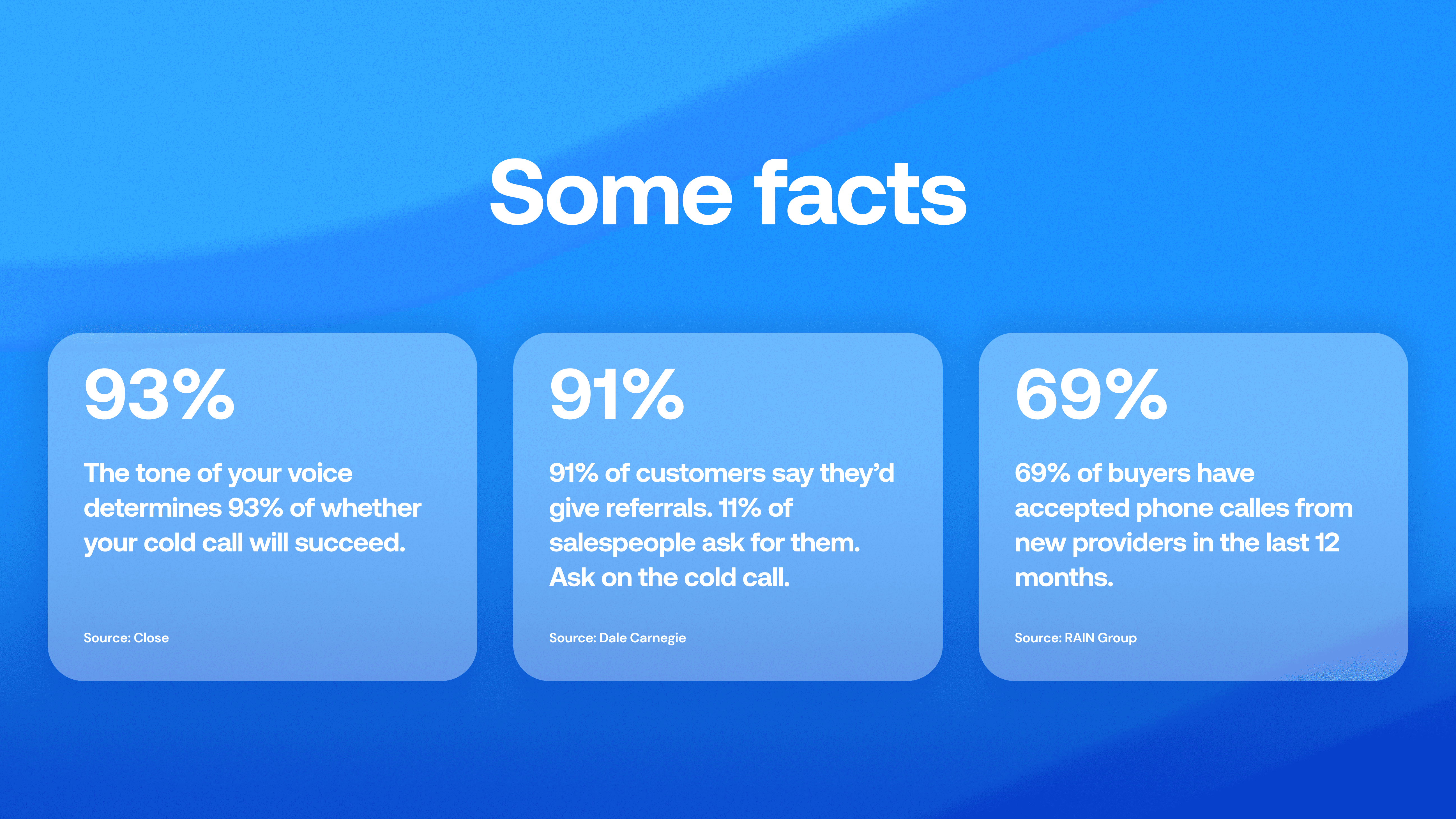
Was ist ein großartiger Kaltanruf?
Respektiert das Bedürfnis des Interessenten nach Autonomie und lässt ihn oder sie sich wohl fühlen, mit Ihnen sprechen zu wollen.
Es ist ein Gespräch (zweiseitig). Tricks oder Manipulationen sollten vermieden werden, stattdessen sollte versucht werden, das Gespräch zu führen und die Kontrolle darüber zu behalten.
Bringt Ihren Interessenten dazu, anders über die Lösung nachzudenken, die sie haben, und darüber, was möglich ist (neue Chancen über das hinaus, was sie derzeit haben).
„Handhabt Einwände“ nicht, da sie selbst verschuldet sind, wenn der Verkäufer seine oder ihre Agenda durchsetzt.
Das Ziel ist es nicht, ein Meeting zu erzwingen, sondern ein qualifiziertes Meeting zu vereinbaren, wenn es für beide Seiten passt.
Die 10 kraftvollen Fragen für erfolgreiche Kaltanrufe
Hier sind zehn Fragen, die Sie verwenden können, um Ihre Kaltanrufe effektiver zu gestalten:
„Was verwenden Sie derzeit zur Lösung von [spezifisches Problem]?“
„Wie zufrieden sind Sie mit Ihrer aktuellen Lösung?“
„Was ist Ihre größte Herausforderung in diesem Bereich?“
„Welche Prioritäten haben Sie für dieses Quartal/Jahr gesetzt?“
„Haben Sie jemals in Betracht gezogen, [Lösung] zu verwenden?“
„Wie sieht für Sie eine ideale Situation aus?“
„Wer ist in den Entscheidungsprozess für [spezifische Lösung] involviert?“
„Was ist Ihnen am wichtigsten, wenn Sie einen Lieferanten/Partner wählen?“
„Wie viel Zeit oder Ressourcen kostet Sie [aktueller Prozess] derzeit?“
„Wie offen sind Sie für eine kurze Einführung, um mehr über eine Lösung zu erfahren, die [Wert bietet]?“
Voicemail ❓
Eine Voicemail hinterlassen oder nicht... Wenn Sie Kaltanrufe tätigen, sollten Sie sich die Frage stellen: „Was ist der zusätzliche Wert meiner Voicemail?“ Außerdem, von 100 Voicemails, wie viele würden zurückrufen?
Persönlich hinterlassen wir (fast) nie eine Voicemail. Jedes Mal verlieren Sie mindestens 30 Sekunden, wenn Sie eine Nachricht hinterlassen.
Ein praktisches Beispiel von Bizzy
Bei Bizzy haben wir diesen Ansatz mithilfe datenbasierter Erkenntnisse verfeinert und optimiert. Hier ist ein Beispiel, wie das aussieht:
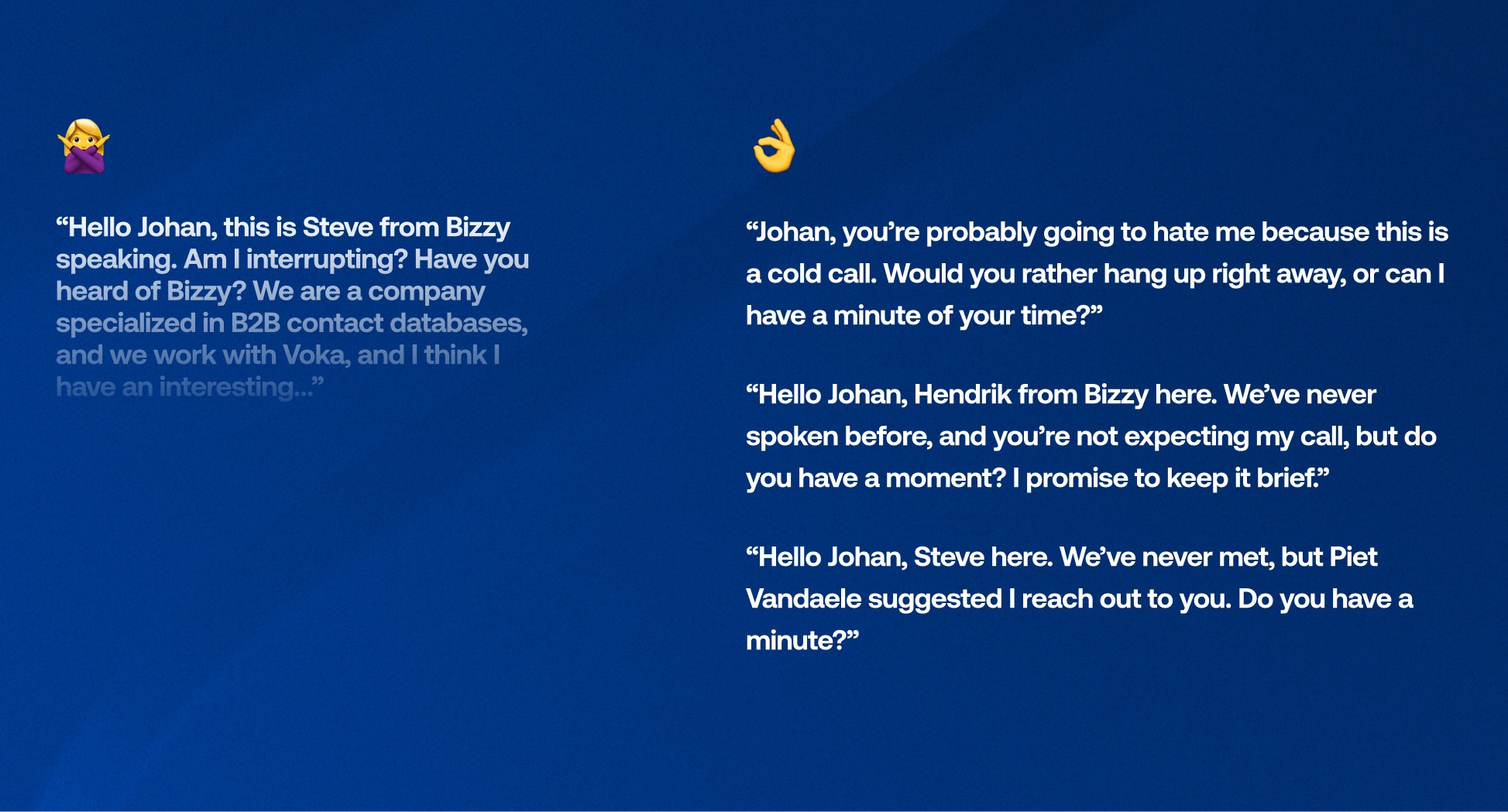
Sehen Sie sich ein Beispiel für einen Kaltanruf von Bizzy an (auf Niederländisch)
Ergebnisse: Dank unseres Ansatzes und unserer Daten haben wir beeindruckende Ergebnisse erzielt:
Verbindungsrate: 33%
Meeting-Rate: 38%
Unsere Datenanalyse hat uns geholfen, Gespräche zu personalisieren und wirklich mit Interessenten in Kontakt zu treten. Indem wir uns von Anfang an auf die richtigen Interessenten konzentrieren, gewährleisten wir, dass jeder Anruf bedeutungsvoll und wirkungsvoll ist. Diese Zahlen zeigen, dass ein strategischer Ansatz für Kaltanrufe, gepaart mit ordnungsgemäßem Prospecting mit Bizzy im Vorfeld, sich auszahlt.
Noch schnellere Verbindungen mit direkten Telefonnummern
Bei Bizzy setzen wir uns dafür ein, das Prospecting schneller, intelligenter und effektiver zu gestalten, weshalb wir stolz unsere neueste Integration ankündigen: direkte Durchwahlen unterstützt von Prospeo! Diese neue Funktion bietet verifizierte Telefonnummern für Schlüsselentscheidungsträger direkt innerhalb von Bizzy, damit Ihr Team Barrieren durchbrechen und effektiver Kontakte knüpfen kann.
Zeit ist Geld, und die richtige Kontaktinformation zu ermitteln kostet wertvolle Verkaufszeit. Mit den direkten Durchwahlen von Prospeo, die in Bizzy integriert sind, kann Ihr Team Entscheidungsträger schnell erreichen, ohne allgemeine Nummern anzurufen oder unbeantwortete E-Mails zu senden, wodurch die Verbindungsraten steigen und Verkaufschancen erhöht werden. Außerdem müssen Sie nicht zwischen Tools oder externen Datenbanken wechseln – die Nummern sind bequem dort verfügbar, wo Sie bereits Ihre Leads verwalten.